Beautiful boules with a banneton (brotform)
Keep that scorchy flour off your lens!
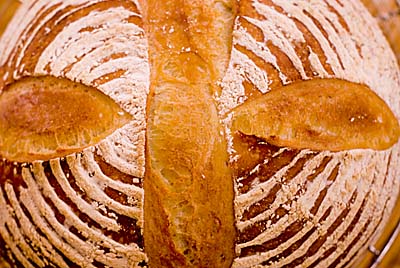
People have asked how to prevent free-form loaves from spreading sideways, especially if the dough is a little too wet or it’s near the end of its batch-life (two weeks). Using a banneton (or in German, brotform), is one gorgeous solution to the problem, and they work well with our method. But, you’ll have to make a few adjustments. Interested? Bannetons (brotforms) are wicker rising baskets available from baking supply places or on Amazon. By containing the rising/resting dough, the basket prevents sideways spread with wet dough, and creates a beautiful pattern of flour that contrasts nicely with slash-marks. Since very small bannetons (5 or 6 inches would be ideal) are hard to find, you’re stuck making large loaves, like the one in the picture, with my 8 to 9-inch banneton. That’s OK, but keep in mind that rising/resting times, and most importantly, baking time, will have to increase dramatically. To make the loaf in the pictures took nearly 3 pounds of Italian Peasant dough (page 46 in the book). So, here’s how to use the banneton:

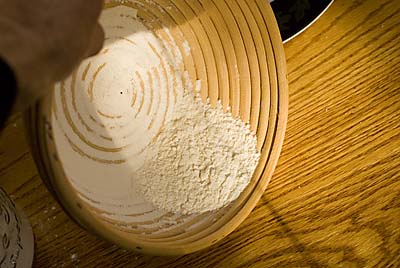
Put some white flour into the bottom of the banneton and then shake it all around so it coats the sides. Be generous with the flour!
Shape and “cloak” a round freeform loaf as usual, pinching together the loose ends underneath. Choose a loaf-size so the dough comes about 2/3’s of the way up the sides of the banneton. Place the loaf into the banneton with the irregular side up. The smooth cloaked side should be in contact with the wicker basket. For the 8 to 9-inch banneton, this took about 3 pounds of dough, so the loaf needed along rest to come close to the top of the basket, about 2 hours. Twenty to forty minutes before baking, preheat your oven to 450 degrees F, with a baking stone near the center of the oven and a broiler tray on any other shelf that won’t interfere with rising bread:
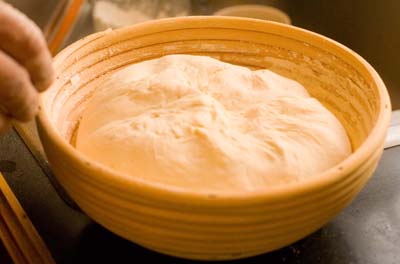
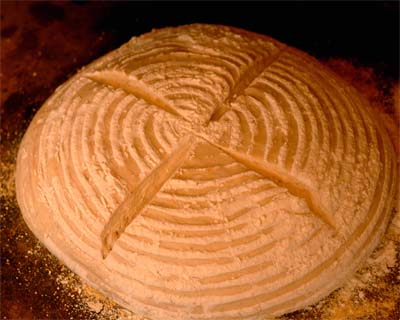
After the dough is rested, use your fingers to be sure that it isn’t sticking to the wicker (it wasn’t). Don’t dig way down or you’ll start deflating everything. Gently turn the basket over onto your preheated stone; it should gently drop onto the stone. If it doesn’t, help it out with your fingers and make the best of it. It should be salvageable even if it deflates a bit, because of oven spring. Slash the loaf in a cross, which will be beautiful with the concentric circles of flour:
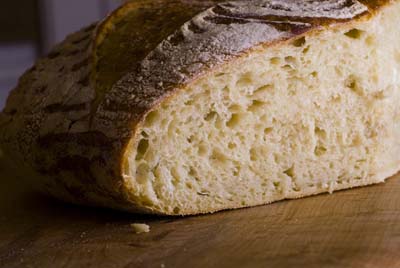
Now comes the tricky part; this is a beastly huge bread. It took about an hour in my oven at 450 and I was happy with the result (crumb pictured below, crust above). When you make a large loaf you risk doughiness in the center; let the crust get deep, deep brown. Frankly, mine could have gone even longer. It’s tough to overbake large loaves made from high-moisture dough. But the result was worth the effort. If I can find a small banneton, I’ll post again.
Note: BreadIn5.com is reader supported–when you buy through links on the site, BreadIn5 LLC earns commissions.
Has anyone tried to bake (or just proof) in a stoneware form to maintain the integrity of the design? I work with clay and it would allow my creativity including the coil effect.
Hi Chris,
As long as you flour the inside so the dough doesn’t stick to the form I bet it would work. If you do make one please report back so we know how it turned out!
Thanks, Zoë
I have a terracotta brotform, I dont see why ceramic would not work just as well.
Hi Andriana,
Yes, I think it should work in the same way, just make sure to flour it well, because of our sticky dough.
Thanks, Zoë
Hi there I don’t know if already posted, but another cheap brotform alternative is a waffle weave tea towel in a appropriately sized bowl. Generously flour the tea towel and give a spritz with a bit of cooking spray. Don’t have to worry about longevity of a traditional brotform staples if you want to do overnight rises in the fridge with very wet dough etc… The larger the waffle on your towel the more dramatic the look. I even managed a slight flower decoration on one loaf using an embroidered cloth napkin, before I found the waffle tea towel. That was pretty cool!
Kelly: Thanks for the great tip!
I should add I use this technique so I can make a grapefruit sized boule – instead of an enormous loaf which you get with a brotform – I use my smallest glass mixing bowl. The bigger the loaf the more side folds the teatowel needs, and it is just not as pretty. I also cover with parchment. Just before baking I flip the whole thing onto the peel, remove the towel, slash and into the oven pronto.
Just got your “Healthy Bread” book and can’t wait to give it a try. I found the smaller brotforms you mentioned (5.5 inches round) online for $12.99 (each) here:
https://brotform.com/zencart/index.php?main_page=index&cPath=1
They say they’re for a half-pound loaf, but that doesn’t make sense given that you needed 3-4 lbs of dough for the 8 inch size. I’ve ordered a couple of these smaller ones and am going to give them a try.
Judith: Yes, sometimes the marked size/weights don’t make sense to me either.
I have a question. Why are people asking about how long the dough can be stored? I never seem to keep my stored more than a couple of days because we eat it too fast. Thanks for the book and its secrets!
Real question: How do you keep baked breads fresh longer? I never seem to get more than 2 days out of a cut loaf.
Hi Jeffrey,
That really is a problem with breads without preservatives, they don’t last all that long once they are cut. We leave them standing cut side down on a cutting board. Here is more info: https://artisanbreadinfive.com/?p=1569
Thanks, Zoë
I wonder if the Japanese Tangzhong method would work with your doughs. (For those unfamiliar, it’s kind of a roux of heated flour and water you add to your dough that with traditional bread dough makes a very soft white bread that lasts a long time. I’ll bet it would work with most any dough.) See Tangzhong, Hokkaido, Asian milk bread for more info.
I bake a lot of sour dough breads. First, making the started I have to remove a cup a day. Instead of throwing away I freeze or use that every day for dough. The other remark, regarding freshness. Sourdough bread lasts longer. I don’t remember the scientific reason why; but it stays fresh longer. I have frozen loaves and I have liked the results when thawed, and refrigerated. I usually leave a loaf out and it can last 5 days with no issues.
If you refrigerate the dough, instead of baking, it has a stronger sour dough flavor
Fresh longer because of acids in the bread that derive from sourdough.
The real scary question: How many calories are in a loaf?
Jeffrey: Can calculate this for any loaf/any ingredients by using USDA’s calculator— check it out at https://artisanbreadinfive.com/?p=1319
Totally off topic, but I was intrigued by mention of Bubbles’ boozy peach jam and have spent the last hour scouring the internet for a recipe. You would think it would be easier to find one here in virtual land. I’m going to try this one:
https://bookcook.blogspot.com/2009/11/vanilla-bourbon-peach-jam.html
On a more on-topic note, I’ll be trying my first loaf of bread from the article on the Mother Earth magazine website tomorrow. I have the book on hold at the local library, but I’m 7th in line before I get it. I should probably just buy it now, since I’m sure I’ll end up with it anyway!!
I used to bake bread using a poolish and it involved doing the final rise in a basket. However, any bowl-shaped object will do (have used baskets, bowls, colanders). The trick is to line the container first with a well floured piece of cotton (something with a fine weave). The floured cloth keeps the bread from sticking to the basket, but allows the dough to form and take on any bumps or ridges as it rises. The result is beautiful, and a more rounded shape. I’m hoping to try this with my next batch of dough.
Hi Elaine,
When you are working with our dough you will want to use a considerable amount of flour on the cloth, since our method requires a wet dough.
Let us know how it goes! Zoë
Here are instrux make your own banneton.
https://www.instructables.com/id/2-Banneton-for-Better-Bread-Loaves/
CAN I use a Bakers couche to proof baguette shape loaves.?
Also can I use a couche lined basket? This would save me a lot of money
There is an art store where I live which sells raw flax linen at a reasonable price
Our stuff might stick to it, but probably OK if you flour it very well.
thanks Also, your pizza dough is so good. If you ever get to St. Louis be certain to go to the Hill. It’s the Italian section of St. Louis. Great restaurants and, of course pizza. Volpi sausage store is there
Hi,
in Germany these forms are actually known as “Gärkörbchen”.
Those are available cheaply in any size you wish.
You can get them via amazon Germany for example here: https://www.amazon.de/Birkmann-208964-Gärkörbchen-rund-Höhe/dp/B003CRM272/ref=sr_1_15?ie=UTF8&qid=1387223399&sr=8-15&keywords=brotform
I’ve been proofing the Master Boule Dough (New Bread in 5) in a 13″ long coiled wicker brotform, about 2 to 2 1/2 pounds of dough, with good results. I’ve been forming the ball and then stretching it into a log, but it takes quite a bit of handling to get it that long. Even so, the bread has a lovely, holey crumb although one end of the loaf is often a little thicker than the other because the dough is so nicely springy.
In order to get a more uniformly-shaped loaf, however, I wondered if I would be better off rolling out the dough into an 11- or 12-inch wide oval and then using the letter-fold to shape it before transferring it to the brotform. I know it will stretch a bit as I am moving it to the brotform. I don’t really want to roll out the bubbles but hope that they might re-form during the steamy oven spring. What are your thoughts?
Hi Rita,
Yes, I’d recommend that you use the letter-fold technique to get it to the shape and length you desire. It will rise and bake beautifully!
Cheers, Zoë
Thanks, Zoë! I’ll do that ASAP. For some odd reason I am out of dough….again.
I didn’t want to get any oil on my brotforms when covering my dough with oiled plastic wrap during the 90-minute or longer proof (final rise); it is unwieldy and sometimes it stuck anyway. I found several sizes of plastic shoe or boot boxes at The Container Store that would accommodate my 13 1/2″ brotforms/bannetons. (Best ones for me are the men’s shoeboxes.)
https://www.containerstore.com/shop/dorm/storage/storageBoxes?productId=10000166
They also have some square accessory boxes that might work for small boules. If proofing multiple loaves under one roof, they also carry larger under-bed boxes, although I find the single-loaf boxes more convenient.
I just turn them upside-down over the rising dough on the counter, whether it was in brotforms or shaped as free-formed boules on parchment. This keeps them in a moist environment during the proof and keeps them from forming a skin. Since they are clear, it is easy to check on the dough’s progress. And if placing the brotforms in a right-side up box, they can be moved or stacked to save space.
And lastly, the boxes are great for storing the brotforms and my bread-making equipment!
In the unlikely event that you should have a spare empty dough bucket, you could use that as a proofing box for boules as well.
Hi Rita,
These are great tips, thank you!
Cheers, Zoë
I am fairly new to the world of sourdough breads 8 months now, but I am in love.
I had recently purchased two brotforms but was not 100% sure how to use them. Your article was all I needed to give it a try. https://levitz.smugmug.com/Food/Artisan-Sourdough-Breads/i-qLR2pK4/0/X2/WP_20140314_14_31_26_Pro-X2.jpg.
Thanks for the post.
Fantastic!
Can you turn it on to parchment paper first so you can score it before it goes in the oven?
I actually score it right after I turn it over onto the baking stone (be careful). Or you’re way’s great too.
Thank you SO much for the quick reply. I did it your way- first one not too bad and I let it go longer so it got nice and dark! I just love baking bread thanks to you and Zoe and I LOVE the new book!
Great!
Hi Jeff,
First off, I’m amazed that you are so great at responding to people here, and your first book changed my life 🙂 Now to my questions, is there a reason that the dough has to totally fill the banneton? Is it so that there’s less of a chance of it deflating when you tip it out, or just for the design aspect? And second, even with lots of flour my dough stuck to the wicker. I see that some people use a bit of oil before the flour. Are you opposed to that? TIA.
Hi Kate,
The design made by the flour is more noticable if the dough fits in the basket. If it is just a small ball at the bottom you will only have the rings on the top of the loaf.
I make sure the dough has a good covering of flour, so it isn’t as sticky when it goes into the banneton. I’ve never had a need for using oil, but it may work. I’d use it very sparingly.
Thanks, Zoë
Thanks Zoe! Trying again tomorrow
I have had great success following exactly what Zoe and Jeff suggest. I have an 8″ basket I found on Amazon and using 3 lbs of master dough and letting it rest two hours was just the right time for it to rise. I only use rice flour in the basket (no oil, no water etc). I baked it for an hour and it got really dark but was very moist inside. The challenge I have now and keep working on is the scoring- a good serrated bread knife seems to work best for me- The more loaves I do the more the rice flour builds up in the banneton and the better the circles. My question now is what changes, if any, do I need to make with this and other breads in a gas oven. Never made bread in one before and I’m heading to vacation home that has one. Do I put the water pan on lower rack (thought I read one place it just sits on bottom of oven w/out a rack) and pizza stone above just like w/ electric oven? Can’t wait to take the “new” book and try lots of new things- just a bit nervous using a gas oven. Thank YOU!
Hope you can see the picture. This is 1.5 lbs in an 8″ brotform baked for 40 minutes. Next time I would do another 5 minutes for a crisper crust.
https://www.facebook.com/photo.php?fbid=10204049288453253&set=pcb.10153055044103009&type=1&theater
Hi Kate,
It is beautiful! Thanks for the photo.
Cheers, Zoë
So, I made the master recipe and I want to use my new brotform (lucked out and found one at an estate sale for $3),but I don’t know how many pounds of dough are in the master recipe. It seems like 3 pounds in my little brotform would be too much (it’s 8″ side to side but only 7-1/4″ inside). Plus, if I put the whole 3 lbs in there, it will be all gone. 🙁
Hi Ellen,
The Master recipe makes about 4 pounds of dough, and you couldn’t use it all at one time in a form that small. You’ll want to use about 1 1/2 pounds, just a touch more than a 1/3 of the batch. Be sure to flour the form generously.
Thanks, Zoë
I have tried this twice and both times had lots of trouble getting the loaf to release from the brat form, so it deflates and loses the beautiful ring decorations. I’m using King Arthur whole wheat flour with their bread flour as the white flour., as well as vital wheat gluten. I use the extra water (41/4 C) recommended in the book. The first time I used about 1.5 pounds (what was left after two other free form loaves)- and turned it directly on to stone in hot oven- very difficult since it didn’t release well. The bread was delicious, with holes that had shiny edges as book says- it just wasn’t that pretty (or tall).
The second time I used more of the dough (about how half the full bucket) and lots of flour, both on the brat form and the loaf, Let it rest until it was close to the top of the form, nearly two hours. Then turned it on parchment paper and peel first, so I could ‘mess’ with it in a safe place, then slid into oven. It is still in the oven so I can’t describe final results, but am hoping for tips on a more complete release! I love the new book!
My guess–your measuring technique is leaving you with a too-wet dough. Maybe decrease the water by 1/8 cup? OR weigh the flours. If using measuring cups, are you using the scoop-and-sweep method?
Thanks for your suggestions- I have thought the dough may be a bit too wet but don’t have a perfect way to know for sure (beyond trial and error). Could a too wet dough also be what makes an unconfined loaf spread out too much? (That happened with all batches I baked without the bratfrom).
I used the sweep and scrape measuring technique first, then next batch tried weighing- but my kitchen scale is not digital, and is only marked in ounces so the 10.5 oz is just an estimate. I will definitely try the decrease in water with the next batch. The last batch of bread looks pretty good (my husband said “looks great”) but is much flatter and wider than the bratform so I’d like to get better at this. But it tastes fabulous! Thanks again
I am thinking it’s maybe too wet. A bit.
I am a novice sourdough maker and have just bought a Benetton with liner and used for the first time I coated the liner liberally with flour but the bread stuck to the liner. I read somewhere there is a way to clean it and protect it in future but cannot find the article can you help please?
Don’t think we have a post specifically on that–which of our dough recipes are you using (which book and page number?)?
I use a regular size boule for smaller loaves, just gently tip basket onto a peel, score the loaf and then slide it into the oven.
Can also do that directly onto the stone…
Amazon.com sells bannetons ranging in size from 5.5″ to 11.5″.
https://www.amazon.com/dp/B01FXA5KH4/_encoding=UTF8?coliid=IOAW8ERMSXEFB&colid=26VQ8V3G8NKYP
How much dough can I expect to use for a banneton that’s more than 9 inches? What are the rising/resting times? Amazon delivered my 9.5-inch Chefast banneton yesterday. The quality and size look great, but it’s my first time to use one…that’s why I was doing a little research on how to use it… by the way, my banneton is made of rattan… Is the one in your pictures made from the same material? Thanks for your help!
Not certain they’re rattan, but it is some natural material like that. Which of our books are you using, what recipe and page number, because that effects my recommendation.
For now, I have a problem making the slash properly. i do have the tool needed but how and when? Just putting the bread in the oven to bake it?
Hi Mary,
Here is a video that may help: https://artisanbreadinfive.com/2015/08/31/how-to-slash-dough-video/
Thanks, Zoë
Great tip, i have a round banneton and your artisan and healthy break, i Will this
Hi!
I’m just starting out with my new banneton and cloth. What is the best way to clean/maintain the cloth,
if I use oil in my dough?
Thanks!
Tony: for your dough, which of our recipes are you using (which of our books and page number)?
You may know this by now, but a search for mini banneton will net you a few sites with 5” baskets. I have a set of two on its way – can’t remember if I ordered on amazon or eBay.
How do you use the Canvas? As a cover I assume?
Michael, what I’ve seen canvas used for is to bunch up between French baguettes as they rise. But it goes underneath them with a kind of a fold in between each baguette. We actually haven’t experimented with them.
Amazon sells 5 1/2” bannetons. Work great.
I found a set of two 5-inch bread proofing bowls on Amazon. Here is the link.
https://www.amazon.com/Brotform-Banneton-Proofing-Basket-Baking/dp/B078W4V7KD/ref=sr_1_16?crid=J6A8ZP0B6N4N&dchild=1&keywords=brotform+bread+rising+baskets&qid=1624977909&sprefix=brotf%2Caps%2C175&sr=8-16
I’m hoping these are right size for your recipes.
Those will work– just be sure to flour them well when using our wet dough.
I have been using small bannetons with the master recipe. I found that using rice flour to coat the banneton before putting the dough in works so much better than flour. I read that this is because there is no gluten in rice flour. I found the small bannetons on Amazon.
Nice, thanks for the tip!