English Granary-Style Bread
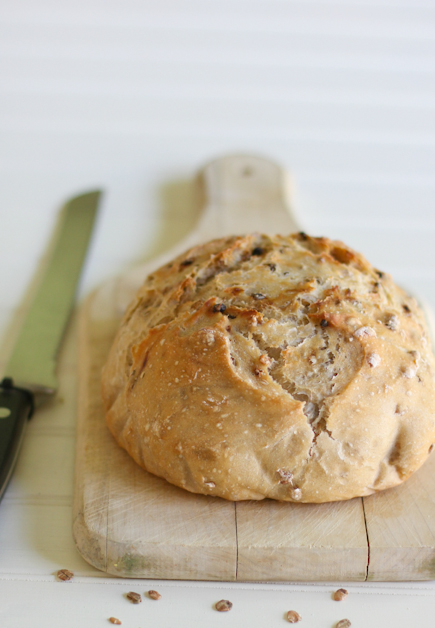
Following a 1983 (!!) bicycle trip through southern England, I had to re-create this loaf, which is a standard in country bakeries there. This recipe’s in The New Artisan Bread in Five Minutes a Day. Two kinds of malted grain provide a slightly sweet flavor, even beery flavor …
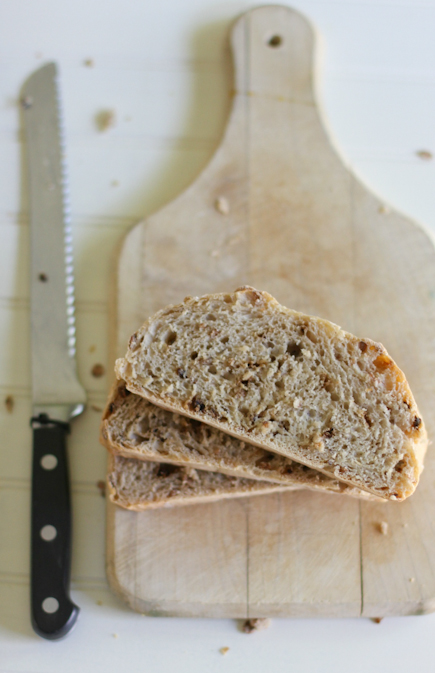
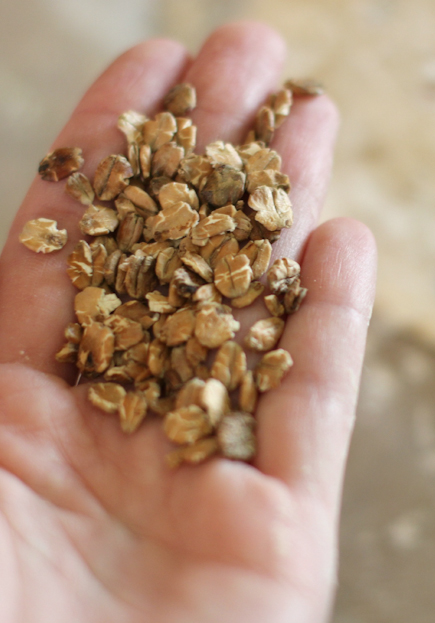
Granary-Style Bread is a classic English brown bread made with a mixture of whole wheat and white flours, with cracked grains of malted barley and wheat. Since malted barley grains are nearly impossible to find in the US, I use barley malt powder and malted wheat flakes.
This bread was once considered to be a very rustic English specialty– little did elite society know that country folk were eating the most flavorful bread. It is hearty and delicious, full of flavor and with a slight crunch.
It’s a perfect dinner bread, but I also enjoy a slice in the afternoon, dunked in some olive oil or eaten with a nice, sharp cheddar. Or maybe toasted with some marmalade (see Laura’s Three-Citrus Marmalade on page 165 of ABin5 for an easy recipe). It also goes perfectly well with a little Jane Austen, and whether you are a fan of her books or the movie adaptations, I can imagine Elizabeth Bennett insisting that Mr. Darcy serve this at his table, despite his wealth.
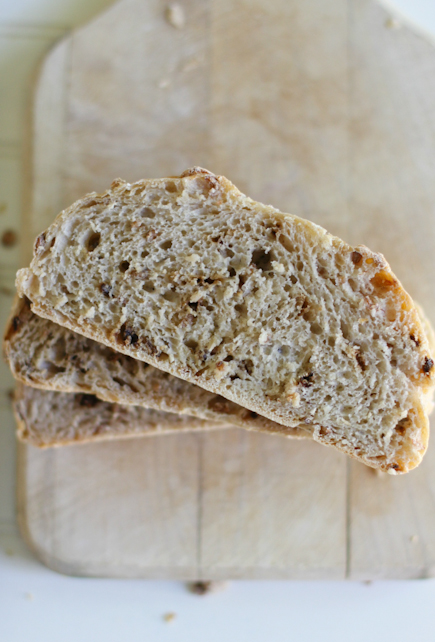
English Granary Bread
Makes 4 loaves, slightly less than one pound pound each. Can easily be doubled or halved (store and use extra dough in the fridge for up to 10 days)
3 1/4 cups lukewarm water
1 tablespoon granulated yeast (or one packet)
1 tablespoon coarse salt (recipes tested with Morton’s Kosher)
1/4 cup malt powder
1 cup malted wheat flakes
1 cup whole wheat flour
5 cups unbleached all-purpose flour
cornmeal or parchment for the pizza peel
Cornstarch wash (blend 1/2 teaspoon cornstarch with a small amount of water using a fork; add 1/2 cup water and microwave or simmer till mixture appears glassy)
1 tablespoon cracked wheat, for sprinkling [optional]
Mix, store, and shape the dough according to the Master Recipe Instructions, but include the malt powder with the water, yeast and salt, then add all the flours and malted wheat flakes. If you want a more open hole structure, consider the longer rest after shaping.
Place a metal broiler tray (no glass) near the bottom of the oven, and a baking stone near the center– and preheat to 400 degrees (about 20 to 30 minutes). Just before the loaf goes into the oven, brush with cornstarch wash and sprinkle with the cracked wheat if you’re using it. Slash a cross or tic-tac-toe pattern into the top. Slide the dough onto the pizza stone, pour 1 cup hot tap water into the broiler tray, and bake for about 35 minutes. Smaller or larger loaves will require adjustments in baking times (see this post on making a 2 pound loaf here).
Note: BreadIn5.com is reader supported–when you buy through links on the site, BreadIn5 LLC earns commissions.
Malted barley grains are available at any homebrew store. You can choose from several ‘roasts,” from ‘black’ to ‘crystal.’
We make beer and I use some of the spent barley in a whole grain bread. Most stores will crack/crush the grains for you for a small fee (or free). I put them in a heavy plastic bag and crack with with a rolling pin.
We homebrew as well. I’d love to see some recipes for bread using spent grain. I tried it once, and it was okay ,but would love some expert advice on a good spent grain beer. Thanks.
Yes yes yes yes yes!!! You have just made my day!! I ordered some malted wheat flakes from KAF specifically for making a Granary-style loaf. I have been busy moving into my new home so making bread has taken a backseat for now but this has just revived my desire for this loaf! I must find time to make this this weekend! Thank you so much Jeff!!
I love making these breads. I have a question. I just saw on Pinterest the idea of making bread in the crockpot to cut down on heating the oven in the summer. Any thoughts on this, do you think it would work with your recipes?
Hi Vicki,
We’ve never tried it, but know some of our readers are doing it with great results. One of these days I will give it a try and post about it.
Thanks, Zoë
I’d managed to find dark malted barley powder but no luck finding any malted wheat. Will still try this recipe, perhaps with coarse whole meal, rolled oats or oat bran in place of the cracked malted wheat flakes. 🙂
Cheers!
Aldrin
Aldrin– guessing that will work. Probably won’t be able to fine malted wheat flakes outside of KAF.
So, I tried making something like English Granary-Style Bread with bread flour, dark malted barley powder, Quaker oatmeal (instead of malted wheat flakes), whole meal (instead of whole wheat flour) and a bit of added VWG to improve the internal hole structure … the results looked way different from the lovely picture you have at the top of this post (the linked page has photos of the dough & bread I’d made).
I was really eager to try making the bread, so I did not chill the dough first after the initial rise. Thus, it was not easy to handle and it had spread out a lot while resting … ended up looking like a giant chocolate cookie! 🙂
But surprisingly, it still tasted great, nonetheless.
Cheers!
Aldrin
Hi Aldrin,
The dough may handle and bake up differently now that it is chilled. Try baking another one and let us know. If it comes out cookie shaped again, I would slice it in half along the length and make a giant sandwich.
Enjoy, Zoë
Hi, Zoë, so, I made a second loaf from the chilled dough I’d made based your English Granary-Style Bread, this time using a silicone loaf pan to limit its spread while resting … I’m calling it my Dark Malt Oat Meal Granary-Style Bread. 🙂
You can see a photo of the resulting loaf in the web page linked above.
Cheers!
Aldrin
Sounds great, Aldrin!
I was clicking on your site tonight to see if I could find out whether to use diastatic or non-diastatic malt powder for this very recipe – thanks for posting about this and including the link to non-diastatic!
The instructions for the wash call for 1/2 cornstarch – is that 1/2 cup cornstarch to 1/2 cup water?
So sorry Michelle, should have said 1/2 teaspoon! I will fix.
Hi Jeff and Zoe,
Northern Brewer (https://www.northernbrewer.com/shop/brewing/brewing-ingredients/grain-malts) has malted barley and wheat and you can order it cracked. They were very helpful and sent me this:
“For baking purposes you’d be best advised to stick with base, toasted & light crystal malts. The flavor descriptors we list for brewing will translate somewhat evenly into the realm of bread making. Base malts such as Vienna, Munich & Rye malts make for great light-flavored breads with subtle complexity. The addition of crystal malts will add caramel-like sweetness to the bread’s flavor & toasted malts will add robust flavor accents. I’d advise against the roasted grain because the heavy kilning of these malts will lend an acrid flavor to your flour. We also have flaked barley, oats & rye available to use in conjunction with the crushed malts for extra texture in your bread.
My recommendation for matching our offerings to your recipes would be to go by the intended flavor of each recipe. Some experimentation is likely necessary, but most possible combinations of the aforementioned grains are unlikely to produce an inedible bread – just perhaps a bit different than what the recipe had intended. You should also see if your brother might be able to provide you with some of his ‘spent’ grain – that is, the grain he uses in his brewing. This article on the topic is worth a read.” the article webpage is
https://byo.com/stories/article/indices/32-food-recipes/500-cooking-with-spent-grain
Hi Mary Ann,
Thank you for sharing this information!
Enjoy the bread, Zoë
Great. I am ordering them from KAF. I have a devil of a time with wheat berries and these sound delicious. I will invent my own English rolled wheat bread instead of cracked wheat!
NC: Probably could use rolled oats too, would be different but also nice.
I kinda can’t follow a receipe..have to mess with it! I used 4 cups whole wheat, 3 cups white (all KA), 1/2 cup ground flax seed, 2/3 cup of wheat flakes, 1/4 cup VWG, 1/2 cup of really good local honey, 2 packets of yeast and 4 cups of water. I figured the moisture in the honey would counter the flax seed,wheat flakes,VWG. turned out GREAT! if I do say so myself!!!!
Hi NC Baker,
Your bread sounds just great! Glad it all worked out for you!!!
Thanks, Zoë
in the days b4 I found abin5 I used to use beer (1 can) and reduce the water by the amt of beer. I thought maybe the english granary would be good with beer also. (I only use what I drink and I’m a dark amber hoppy beer lover. )Thoughts?
Hi NC Baker,
Sounds like a great combination. Maybe start with a 1/2 batch and let us know what you think when you try it.
Thanks, Zoë
Are there any recipes for Squaw Bread in the books? I have the Artisan Bread in Five Minutes a Day and have not come across Squaw.
Haven’t done one…
I was linked to this recipe when I did a search on your site for White Whole Wheat Flour…I am wondering if I can substitute equally for either white all purpose flour or for regular whole wheat flour. How does one use this product?
Hi Dianne,
You can use it instead of regular whole wheat flour in our recipes.
Thanks, Zoë
Thanks – can’t wait to use it!
I’m a little confused about the malt powder in the recipe list. The link sends me to KAF “Non-Diastatic Malt Powder” which indicates it’s used in bagels where as their diastatic malt powder also lists uses for bread baking. Help?
Thomas: In our recipes, not crucial which. Diastatic can cause shaping problems (can make the dough loose) so not a great choice in bagels, but I’m not sure I can tell the difference.
I’m just getting into baking bread, for better health, and have just learned that einkorn, spelt, and kamut are better on the digestive system. Have you ever baked with a combination of spelt and kamut flours?
Have used spelt yes, but not kamut. My guess is that either can be used in place of whole wheat in our recipes where there’s also a lot of white flour. Both are low in gluten, so you’ll probably need vital wheat gluten for good results (especially if you plan to store the dough as we do). Do you have our second book, Healthy Bread in Five Minutes a Day (on amazon at https://bit.ly/3wYSSN)?
I am intrigued by this recipe. We have a fantastic home brew supply shop near our house, and I imagine I could get the malted barley from them. If so, how would that change the recipe?
Another question: Bob’s Red Mill sells Malted Barley Flour. Could I simply replace the malt powder and whole wheat flour with this? I get so scared about changing recipes!
Thanks!
Water requirement will probably change, the malt powder is mostly malt sugar while the malt powder (I’m guessing) is mostly grain (starch and protein). Bet you need to increase water, but not certain and if so, by how much. Experiment!
Thanks! I am definitely feeling brave enough to experiment here, which is a first for me because I’ve only been baking bread since January and the science behind it is a little intimidating!
In researching, it looks like barley flour has higher gluten than wheat, but lower than all purpose white. To start, I am thinking of replacing 1 C of the white flour with the barley flour. In looking closer at the malted barley flour, it’s just diastatic malt powder which is not what we need for this recipe. So regular barley flour it is. I may add some vital wheat gluten as well to help give it a little extra oomf (and follow the water addition recommendations for that also). I’m just trying to see what I can do to get a higher ratio of whole grains into our bread.
The original recipe is fantastic. Really fantastic. Warm with a little butter and homemade marmelade, it’s just… words fail me!
I adore your books. I have the original one, the Pizza and Flatbread one (the naan with yogurt recipe is like heaven!), and I am saving up for Healthy Bread in 5.
Is there a granary loaf recipe in Healthy Bread in 5 Minutes a Day’?
What’s the best substitute for Malted Wheat Flakes?
Thanks!
No, this bread is in Artisan Bread in Five: on Amazon at https://amzn.to/17Rw23Y (page 156). Rolled oats may substitute the texture, but not the flavor. If you did this, try increasing the barley malt a bit to increase that flavor. You can use an HBin5 recipe, maybe the basic recipe, then swap out some flour for the malted ingredients. Will take some experimentation.
Thanks for the quick response. I’m looking forward to trying it!
I’m in England and I’m struggling to find barley malt powder (not even on amazon!). Would malt extract work instead, do you think?
BTW I received The New Artisan Bread in5 and Healthy Bread in 5 for Christmas and my family are loving the bread.
Yes, it should, though you may (and I mean may) have to adjust for the little bit of extra water. Unfortunately I can’t guess at how much. So glad to hear…
I’ll experiment and report back in due course!
A resounding success! I substituted 1/4 cup malt extract for the powder and kept everything else the same. Then I used a 1 lb loaf tin, let rise for about two hours ( a mistake, but turned out ok), baked at 350 for 45 minutes and then put the loaf back in ( out of tin) for a further four minutes to crisp the sides. Delicious, this is our new favourite bread.
Fantastic, this is great! One of my favorite loaves. I often let it go longer than 90 min w/o a problem, so 2 hours is fine unless the room is very warm. You inspired me to go back and update that post, some mistakes in it, and missing links.
More about questions. Today i tried the recipe for english Granary bread. i just want to know if this is normal: the dough was much drier than the basic recipe. It was much easier to make the cuts with the bread knife. Cooking time was 15 minutes longer than suggested (my oven has been calibrated and works well with the basic recipe). The crumb structure was quite closed even after a 55 minute rise. The taste and appearance was very good, but I would have liked a more open crumb.Could not understand why bake time was so long. Your suggestions?
Jim
Hi Jim,
This recipe varies a bit depending on the wheat flakes. We tested with King Arthur Flour flakes, but they had stopped selling them for a while and other brands were behaving differently. Were you able to find them at KAF?
Are you weighing flour?
That said, this is less hydrated than most of our WG stuff. So, if the holes are small, and especially if the result is dry, try increasing the water by 1/4 cup.
Thanks, Zoë
Zoe, thanks for your response. Yes I got the malted wheat flakes from KAF. Cracked wheat berries from Nuts.com. All KAF Flours and weighed within 1 gram. Holes are a ittle smaller than your pictures show. But the crumb is not dry. Baking time was a lot longer than your book indicates but we went until internal temperature was 205F. Perhaps next time I will add alittle more water and a gram or 2 extra of yeast. Do you thnk extra yeast might help?
Hi Jim,
A little more yeast won’t hurt, but you can achieve the same thing by allowing the loaf rest a bit longer before baking. Your dough may be cooler or you may be working the dough slightly more, both require a longer rest to get a nice internal crumb.
I’m happy to know that KAF is carrying the flakes again.
Thanks, Zoë
So, I made the granary bread from the 1st book. Problems-even at 40 minutes, it was still “doughy” or barely cooked in the center. The crust was awesome, but bitter from being over done. I baked it according to directions, but on parchment instead of right on the stone. I baked 3 instead of 4 loafs from the batch too. So, could it be a) the parchment paper instead of baking directly on the stone, or b) the loaves were too big (3 instead of 4) or c) something else?
Hi Douglas,
The larger loaf will need to rest longer (20 to 30 minutes) before baking and bake about 10+ minutes longer. Be sure the oven is true to temperature with an oven thermometer. Be sure the baking stone is fully preheated, which can take 30 to 60 minutes, depending on the thickness of the stone. Lastly, don’t cut into the loaf until it is fully cooled or it will seem gummy.
Thanks! Zoë
So, I’ve made this twice. Both times the crust was an awesome dark crunchy thing, but the interior was not fully baked, even when I let another loaf go longer, same problem. I used the KAF Diastatic Malt Powder. What could be wrong? The bread is delicious, but the unfinished crumb wrecks it. HELP!
Disregard my 27 Feb comment! I didn’t read your response to the comment I posted on 12 Dec-and I didn’t remember posting it either!!
How did you know I am impatient and always cut into the bread 30 seconds out of the oven! The 2nd loaf I baked today I have NOT TOUCHED! I will see how it turns out and post. Thx Zoe!!
Fantastic!
OK, I did let it sit until cooled. It was better, but still, gummy. I saw in a post somewheres something about using vital wheat gluten? If so, that ingredient is not in the recipe…..sooooo……am I supposed to be using vital wheat gluten in the English Granary bread? If so, how much??? Thanks!!
Well, you can try that (see the FAQs post about how to use it), but I’d check your oven temp first–I bet it’s off.
Or you just need to adjust the water (downward).
Thank you, Jeff. I did check my oven’s temp-was 25F degrees off. Re-calibrated, and mixed up another batch. Again, bread delicious, awesome crusty exterior, but the crumb was wet. Damp. I even let it cool +40 mins. I will try less water the next time around.
yep, that’s the plan, let us know if that’s not it.
If anyone is looking for malted barley grain…
Sorry Rachael, we can’t post product referrals and websites for products that we haven’t tried…
I’ve tried this recipe a few times and have found the dough is a lot wetter than I suspect it really should be. But as I’m troubleshooting my latest loaf and rereading this recipe today, I notice that if you calculate the weights, you do end up with an extremely wet dough:
* 1 cup whole wheat = 113 grams
* 5 cups all purpose = 600 grams
* 1/4 cup malt powder = 36 grams (though not really sure this should count toward the flours)
which is at most 749 grams. otoh:
* 3 1/4 cups water = 769 grams
That’s more water than flour! Which seems a bit crazy for this kind of bread — am I missing something here?
Yes, you’re missing the whole cup of malted wheat flakes!
I didn’t actually forget the malted wheat flakes when I made it! But I see from your other post (https://artisanbreadinfive.com/2007/11/26/question-about-weighing-the-flour/) that you’re counting a cup of flour as 140 grams rather than the 120 I was using, which I think will make a difference. Will try again!
Excellent, that may have been the problem.
I made this dough last week and refrigerated it after mistakenly forgetting about it in the kitchen. Baked a loaf that doesn’t look at all like the photo – was quite flat, crisp on the outside, and gummy on the inside. (Oven thermometer says 400 degrees, so the oven isn’t the problem.) Threw out the rest of the dough. I made another batch two days ago and am baking the first loaf now. Let it rest a bit longer before putting it in the oven and still it looks the same as last time – it didn’t so much rise as spread out. What went wrong?
Followed the recipe in the book, which says 1 and a half tablespoons of yeast (I’m using SAF) and 1 and a half tablespoons of salt. But I see that the online recipe here says 1 tablespoon of yeast and 1 tablespoon of coarse salt. Not sure why the print and online versions differ.
Hi Susan,
Over the years we reduced the amounts of salt and yeast in all of the recipes, realizing that they worked just as well with less of each. They still work both ways and you can use the larger amount if you prefer, as many of our followers do.
I provided you the ingredients in weights, so hopefully that will fix the issues you had with the dough spreading.
Thanks, Zoë
The link regarding flour weight (earlier post in this thread) is for all-purpose flour. Would you mind listing the weights for wheat flour and the malted wheat flakes?
Hi Susan,
You need 130g whole wheat and 120g wheat flakes.
Hope that helps! Zoë
Thank you for your reply to both posts!
Please post weight measurements for the flour. Thanks
All of our books, with one exception, have weight equivalencies–which of our books do you have?
On a fall “family roots” trip to Scotland and England I fell in love with this unusual bread. It was called simply “brown bread” when it was routinely offered as the white toast alternative at breakfast. I had a vague recollection of a recipe for a British bread that sounded similar but couldn’t recall the name or where to look in my large cookbook collection. I thought the source was my vintage James Beard bread cookbook–but was thrilled to find it was in one of your cookbooks, since the Artisan Bread in 5 approach is the only one I use now!
I have been experimenting ever since. I keep looking for alternatives to KAF malted wheat flakes. I have tried a three-grain natural flaked cereal (so-so); a popular brand name nugget-type cereal that is a little more processed but contains nothing but wheat flour and malt (good); and khorosan wheat flakes that I toasted first (also good.) I found a good malted bread flour. I sometimes use barley malt syrup instead of malted milk powder. And most recently I added 2 T. oil. It is always good! Thanks so much for helping me hold on to memories of a special trip.
Blair: I had the same experience following a (1983!!) bicycle trip through Southern England, which is why this recipe went into the book. Thanks so much for writing, and the tips on swaps for the malted flour! Jeff