Using Fresh-Ground Whole Wheat Flour (and some highlights from book tour)
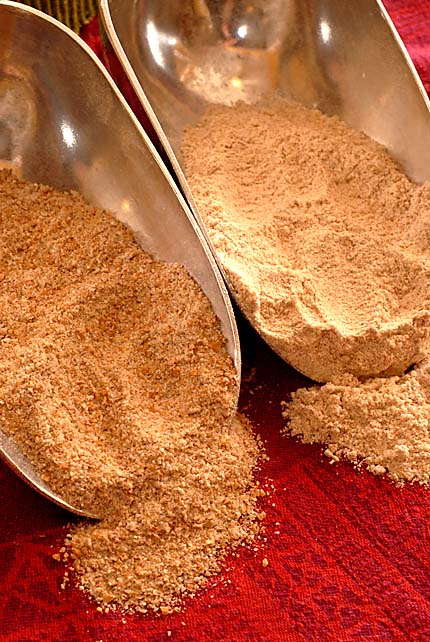
The flour on the left (the browner, coarser one) is an organic fresh-ground (aka fresh milled) whole wheat. On the right, the commercial whole wheat flour is obviously finer-ground and lighter in color (it’s the Dakota Maid brand, a very consistent and tasty product). So many of you have asked about grinding your own wheat to make whole grain breads, that I decided to try it myself.
OK, I didn’t really grind it myself, I sourced fresh-ground wheat from a local miller. The flavor’s terrific.
It’s not an absolute requirement for whole wheat bread, but here’s a little on my first experiments with this great flour. Considering how different the fresh-ground product looked compared with commercial whole wheat, I was surprised at how easily this stuff was able to be used in one of my whole-grain Master Recipes— with no changes. After some whole wheat talk, a little about the West Coast leg of book tour (Seattle, Portland, and San Francisco).
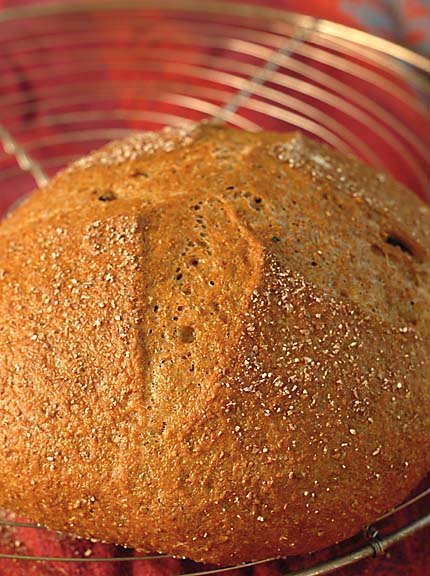
I loved the gorgeous whole wheat loaf that the fresh-ground flour made. It developed a very firm and crisp crust (oftentimes, oils in the wheat germ make it difficult to get a crisp result on a whole wheat loaf). The flavor was terrific– the difference from commercial flour was subtle, but very nice. It had a certain brightness and sweetness, which was a neat trick since there were no added sweeteners. I used our plain Whole Grain Master Recipe from Healthy Bread in Five Minutes a Day.
The big surprise was that this coarse, fresh-ground flour had almost exactly the same density (ounces per cup) as the commercial whole wheat in the top picture– it weighed in at 4 3/4 ounces per cup, while the Dakota Maid weighed 4 1/2 ounces per cup. So I was comfortable just swapping it in exactly for commercial whole wheat flour. The resulting dough was a touch wetter than my usual, but I just ignored it (in the first book we said “… if you worry about the bread, it won’t taste good”).
But be careful: Your own fresh-ground may be of a different density, moisture content, or bran content, and you may need to adjust the liquid up or down, to achieve a result like you see in our videos for the whole grain breads. If you want to use these great flours, be prepared to experiment.
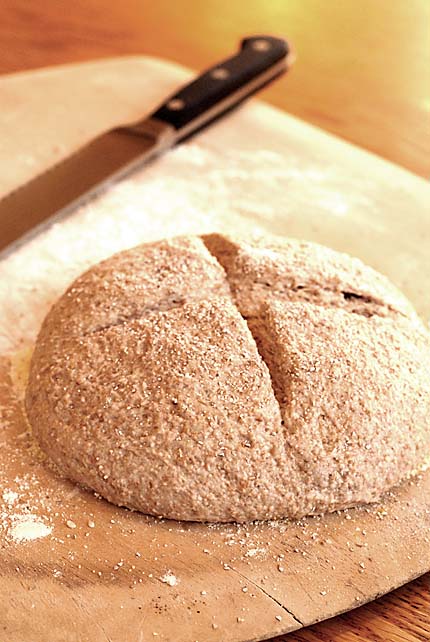
Why the wetter result, even though this flour’s a little denser? Makes sense to me–it’s more coarsely ground despite being denser, and those larger particles present less surface area for water to bind onto and absorb. Or something like that. Next book we should write “… if you turn this into chemistry, you may not have any fun.” And even though this dough was a little wetter, it held its shape nicely through a 90-minute counter-rest under plastic wrap, and slashed well with a bread knife (see videos for more details on forming and slashing):
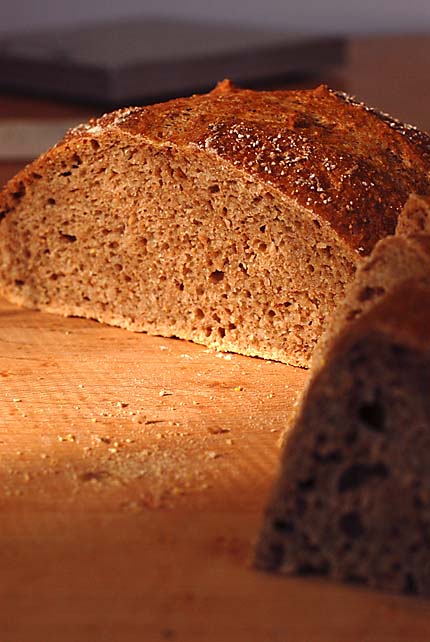
The result was great: a superior whole grain crust and a terrific flavor:
I’m going to post more about the dough that this flour made in the next 10 days, to see how well it stores compared to commercial whole wheat flour (click here to view).
OK, on to the book tour. After Chicago and Milwaukee (WGN-TV, a podcast with ABC-TV’s Steve Dolinsky, and two TV segments in Milwaukee–WITI-TV Fox and TMJ-TV NBC), there were a couple of days home before heading off to Seattle, Portland, and San Francisco–with book signings along the way.
In Seattle, an appearance on Channel 13’s morning show, in a great segment with budding home baker and news anchor Mark Wright (on left) and co-anchor Lily Jang (right):

In San Francisco, there was a live studio-audience broadcast of KGO-TV (ABC-7)’s “The View From the Bay,” with hosts Spencer Christian and Janelle Wang, who helped us mix the Whole Grain Master Recipe.
When not working (which was almost never), there was eating. A sample platter:
At Tom Douglas’s Serious Pie in Seattle, there was fantastic beet salad with anchovy, pistachios, and fresh mint:

… and then the guanciale and arugula pizza. Though you can’t see it, there’s an egg cracked onto the top of the pie before baking, and it was sublime. This may look like salad sitting on top of a pizza crust, but it was perfect:

I met Tom at an event in Seattle and asked him about recreating this topping for my next book (on pizza and flatbread, in 2011). Answer was something along the lines of yes, but he wasn’t open to supplying his crust recipe! Fair enough. Now where do I find that guanciale (a very fatty and crazily delicious pork product)?
Onward to Boston and Orlando…
Note: BreadIn5.com is reader supported. When you buy through links on the site, BreadIn5 LLC earns commissions.
Ok, I can try baking longer too. But what would happen if, in addition to putting in more VWG, I kneaded it at the beginning, before the 2-hr. rise at room temp. that precedes putting the bowl in the fridge for the first time. Would it do any harm? Might it help? I certainly don’t mind kneading.
Thanks again for all your help and responsiveness — it’s amazing to have this kind of contact and help from an author.
–Matt
Hi Matt,
Kneading at the beginning won’t harm anything, just extra work!
Thanks! Zoë
Glad I found your FAQ concerning using home-ground grains. I have been grinding my own hard red winter and hard white winter wheat and using your master recipe for making whole wheat bread.
It’s pretty good as far as flavor goes, but it is about the size, shape, density, and weight of a standard brick (more like a 4 lb. loaf than a 1 lb. loaf). The crumb is very packy.
What am I doing wrong? Or, better yet, what do I need to do to get the airey, holey interior of bread I purchase commercially?
Thanks for your help.
Jim
Hi Jim,
You should read through the comments here, if you haven’t already, there are some great ideas from others using this type of flour. I suggest that you up the amount of Vital Wheat Gluten, which may also mean increasing the amount of water slightly. The home ground flour tends to be coarser and doesn’t have the gluten structure of commercially ground flour. Adding more VWG will help create the strength it needs to rise better, especially after being stored for several days.
Thanks, Zoë
Hope this helps! Zoë
This does not seem to be mentioned in the comments (except an old one by me that is buried) but you may try cutting your rise time in half with homeground wheat, and not refrigerating (just making it right away). This works for me. I make a modified 5MAD whole wheat sandwich bread recipe and have excellent results every time. This is how I show people to make it:
5 cups home ground whole wheat flour (I use hard red wheat berries from an organic farm)
2 1/2 cups all purpose flour
1/4 cup vital wheat gluten
1/2 cup rapadura (whole unrefined cane sugar)
1 1/2 Tbsp yeast
1 Tbsp regular sea salt
3 1/2 cups warm water
1/2 cup olive oil
Mix dry ingredients together — thoroughly.
Mix wet ingredients together.
Mix wet and dry ingredients together, stirring as you pour, mixing briskly and quickly until all is incorporated (I use my hands).
Cover and let rise 1 hour at room temperature.
Dump dough onto a heavily floured surface and dust all over with more flour (either whole wheat or all purpose, both work fine).
Divide dough into half, and half again. Dust more flour if necessary but do not knead, you just want to be able to pick it up and transfer it without it coming apart. It will be sticky.
Quickly and roughly shape a loaf at a time, with a few quick under-turns (cloaking), and place the loaf into a 2 pound stainless steel loaf pan that has been sprayed with cooking oil. (I have four, I make all four at once.) Repeat.
Cover loosely with plastic wrap, preheat oven to 350F, and let dough rise at room temperature for about 20-25 minutes.
Remove plastic wrap, place all four loaves in the oven, and bake for 45-55 minutes until done.
Cool a minute or two in the pan, remove loaves from pans and place on cooling rack, covered with a clean lint-free dishcloth.
When completely cool, you may store in a plastic bag.
I also make rolls from this recipe (weighing and shaping 3 oz balls of dough, baking for about 20-25 minutes). It is so amazing, people tend to freak out…
But… for most of our readers, the fact that it isn’t stored is going to be a non-starter. You have to make this from scratch every time you want it. Also, is rapadura available in the U.S.?
Five-Minutes-A-Day readership is broad and not limited to folks who want to bake new loaves every day. Case in point: Your method got me into making bread in the first place, since the traditional kneading-waiting-texture-game was not working well for me. I have all your books. ALL of them. And I use them! And lend them… and praise them.
This is just my “daily driver” recipe, modified from your recipe and method, which came about through trial and error, using home ground wheat.
Rapunzel (and one other brand I can’t think of right now) imports rapadura, now called “whole unrefined cane sugar”, and you can get it online (from places like Amazon, or local bulk suppliers like Azure Standard, etc.) or in most natural foods stores. You can use whatever sweetener you want. Honey, sugar, whatever. I have not really cared about small moisture differences in the dough based on sweetener choice.
I mentioned not storing the dough because I do not use that method under normal circumstances. I have a family of eight and we blow through the sandwich bread too fast for it to make any sense for me to store dough. It also does not make sense on an energy-usage level, when I can make all four loaves in the same hot oven.
I figured posting this might help someone else who grinds their own wheat berries and is having trouble. I, too, had trouble with the density, texture, moisture, rise, smell, and flavor (using home ground wheat) — in fact, I almost gave up — but found if I cut both rises in HALF I could succeed with home ground wheat. Who knows, I could be the only one in the universe who gets to bake four 2-pound loaves that get rave reviews in just over two hours with minimal effort! (ha.) =D
Em, can you tell me what kind of yeast, quick-rise or just active dry yeast in your recipe? Going to try this one for sure. Winnie
Hi Winnie,
You can use any kind of yeast in our recipe. We’ve tested with instant, active dry, quick rising, bread machine, fresh cake and it all seems to behave the same with our stored dough method.
Thanks, Zoë
Regular active dry yeast from costco. I figured my organically grown local wheat berries must have more naturally occurring yeast on them already or something, and instead of experimenting with the yeast amounts, I tried rise times and it worked for me. If you’re already having trouble, it can’t hurt to experiment.
Hi Em,
Interesting post! I am curious to know, have you tried soaking your freshly ground wheat before adding additional ingredients?
Freshly ground wheat (FGW) contains all of the germ, endosperm and bran that store bought WWF does not. Therefore the particles are denser and do require additional time and water to fully hydrate. A 12 hr soak of the FGW with all of the water before adding additional ingredients will ensure a lofty loaf and softer crumb with a sweeter taste!
Hope that helps for anyone who uses FGW in their breads!
But– wouldn’t our dough storage accomplish the same thing? It’s meant to be stored, you could just delay first use.
Can you use regular oil and omit olive oil? and also can it be made omitting all purpose flour and adding more home ground red hard wheat?
Regular versus olive oil are interchangeable in all our recipes (taste will change, of course). But you can’t just swap whole grain for white flour the way you suggest, the whole grains absorb more water, which you’ll probably have to increase by a quarter cup or so. You’ll have to experiment given that this is home ground and we have no idea what its water-absorptive capacity will be.
We’ve recently heard about your bread, and are eager to give it a try. We are one of the families who grind our own flour, so read, with interest, those specific comments and questions. Just wondering if anyone has tried mixing some soft white wheat in with a hard red or hard white to get a lighter bread? Curious to hear from those of you who have experimented with your own flour… We’re REALLY looking forward to the flatbreads, and would also be interested in a corn flatbread receipe, as one of my daughters has difficulty processing gluten…. Love the research you’ve done! Thanks for sharing it!
Mary: We’ll include a Mexican-inspired corn flatbread (but not 100% corn). Corn makes greawt tortillas, but it’s tough to make a risen bread from pure corn. If you’re interested in gluten free recipes with a mixture of gluten-free flours, check out our second book– Healthy Bread in Five Min/Day, which has a whole chapter of them: https://bit.ly/3wYSSN
Our usual recipes are made with a softer wheat– unbleached all-purpose (compared with bread flour, aka “high-protein” flour, which are made with hard wheat). So I’m sure you’re idea would work well. As I mention in this post, the trick with fresh-ground flour is the unpredictability of how it absorbs water– so you’ll have to experiment.
Jeff
Hello
My first try using 100% whole wheat flour didn’t turn out well. I stired and stired however this morning when I took out my dough I felt many hard spots in the dough . . Help Help
Hi Pat,
Do you think those lumps you described could be the vital wheat gluten? Are you using the recipe from ABin5 or Hbin5? If you don’t stir the flour together with the vital wheat gluten it can form lumps.
Let us know if that sounds like it could be the culprit? Zoë
Can any of the recipes in Artisan Bread in Five Minutes a Day be altered to incorporate sprouted wheat berries?
Judy: It’s going to make things denser, so go easy. Maybe no more than a cup or so of sprouted wheat berries, decrease the flour, not sure about how to adjust the water but see our videos (tab above) to keep moisture level in the finished dough constant. Obviously we haven’t tried this ourselves! Jeff
Hi, I have looked around your website and haven’t found anything yet about adding extra protein components
I am working from the HB5, and usually make the 100% wwbread or the sandwich bread, since it has eggs. Have you ever added other flours with more protein, or actual protein powder? I want to find an alternation where I can boost the protein to at least half the amount of carbohydrates. I don’t grind my own flour.
I LOVE this method as I live in Northern Thailand where there is little bread to be found!
Thank you!
Rebecca
Hi Rebecca,
You can try adding bean flours to the bread (soy, garbanzo and others) to boost the protein content. You will have to do a bit of experimenting to find the right combination without the breads getting too dense. The bean flours also have an assertive flavor, so start with a little and see if you still like the flavor!
You may also want to try the more enriched doughs that have eggs in them.
Thanks, Zoë
Just wanted to thank you both for your amazing book (Healthy Breads)! For years I have made whole wheat bread for our 4 boys grinding our own wheat flour. It has always been a very laborous task though, with all the kneading and rising.
I used my favorite – prarie gold – wheat with your recipe and it turns out wonderfully. I have not perfected a great rise yet, but I know I will get there. I have only made the artisan loaves so far and want to try the sandwhich bread next. Our boys really love it. We made a loaf with vegetable soup last night and of course it was GONE. Thank you so much! I can’t wait for the pizza book!
Blessings to you both ~ Dee
Thank you Dee,
Enjoy all the bread! Zoë
Can I use my soneware bread pans if I line them with some parchment paper. I think I would grease the paper also. I do not have or use non-stick pans. Thanks
Hi Suzy,
You may want to line the bottom of the pan for the first loaf and see how it goes. Some pans are fine with just a thick coating of butter, but others stick like mad.
Thanks, Zoë
Hi,
In your Hbi5, for the recipe on making bread loafs, the instructions say to put a stone in the oven during the preheat, but then you later say that the stone is not necessary if making the bread in a bread pan, and if you do leave it out, the preheat need only be 5 minutes. You don’t say how to bake the bread if you do put a stone in the oven? Would you put your bread pan on top of a piece of stone? I am very confused about how you would use both.
I do have a stone bread pan. Would I heat that up first and then put my dough in it? Or do I shape the dough in the pan and let it rise for the extra time and then put it in the oven?
And last, I notice that the 1 cup of water evaporates very, very quickly. Do I need to add any more or is the 5 or so minutes that there is steam in the oven before it has all evaporated enough time to make a nice crust?
Renee: Same baking instructions with the stone in oven, but you’d need the longer preheat. We’ve found that once it’s in a pan, it’s not very important whether it’s right on the stone or not. Do it however’s convenient.
I’ve used stonewear bread pans by putting the dough into them cold, allowing the rest/rise, and then the filled pan goes into the preheated oven. In this case (another) stone in the oven is completely optional but doesn’t harm anything (except forcing the longer preheat).
The water is intended to do it’s thing in the first ten min of baking– you really don’t want it after that to allow for crisping. So this is fine. Jeff
Thanks for the quick reply! Another question. I am using freshly ground wheat and find that it is really hard to mix up given the amount of water required. And my dough dries out on the top when it is in the fridge, even though it is loosely covered. Do I just not have a wet enough dough? Do you need more water when it is freshly ground?
Renee: Check out the FAQ on this, click above (“Fresh Ground Grains…”). Sounds like you need more water; this stuff is very unpredictable depending on the grinder and the age of the wheat and its moisture content when ground.
I’ve never preheated anything I put on a stone, but see our post on stones, also at the FAQ (“Stone broke…”). Jeff
Oh, and one more question- so placing a room temp bread pan onto a hot stone in the oven won’t wreck my stone? I ask because I recently broke one of my stones in the oven so I want to be extra careful.
We grind our own wheat flour with our vitamix and we can get it fairly fine. We also add the gluten (the first batch we didn’t and the only difference was that it was a lot wetter than the batch where we added the gluten).
My issue is that even though we pull a pound of dough (I weigh it to be sure) it never seems to make the same sized loaf or boule I see in the videos or in the book? It’s got a dense pudding-like texture with a crispy chewy crust (so yummy), but I don’t see the “oven-rise” It also tends to flatten out rather than hold it’s shape during the time to bring it to room temp. We’ve done the whole wheat and the whole wheat/rye dill and they’ve both been fabulous.
Pam: Confused, so which ones haven’t been fabulous?
Try the recipes once with commercial flours and that way you can get a sense for how you need to adjust the water so that the consistency is the same as what we achieved with commercial, otherwise will be very difficult to advise you on how to adjust for your fresh-ground flour. Jeff
Great idea – I’ll get some commercial wheat flour and try again to compare. Thank you for the speedy response!
I redid the master recipe with commercial wheat and white flour and it definitely got the “oven rise” and looks a lot more like the pictures. The flavor is wonderul and the crust chewy and verging on sourdoughey.
When I’m through the commercial flour we’ll go back to the home-ground and see if we can grind it fine enough to get the fluffier texture.
Both types are fabulous, but it’s easier making sandwiches with the larger loaf (-:
Hi Pam,
Adding a bit of vital wheat gluten to the mix will help also. If you are using the recipes from HBin5, just add 2 to 3 more tablespoons.
Thanks, Zoë
Pam, I used to grind my flour in a vitamix too, but only got good results grinding 9oz (2 cups) of wheat berries at a time, and even then it was an inconsistent grind. Also, the heat generated in a blade grinder can destroy some of the nutrients in the wheat. I switched to a burr style grinder where it drops the ground flour into a bin below the unit when it’s ground to the coarseness setting of the burrs. Since then I’ve gotten much better results with traditional baking methods with whole wheat flour, but haven’t tried it with the HBin5 method yet, but am looking forward to it. Burr grinders will give you a more consistent grind, help preserve the nutrients by not heating the grain/flour, and give you the flexibility to grind a half cup at a time, or 12 cups at a time.
I’ve been baking like crazy with the olive oil whole wheat dough, making cinnamon rolls, stromboli, chicken braids, cinnamon bread, sandwich thins, sandwich bread and more. I use canola in place of olive oil too. I’ve been very pleased with the results. I found out i don’t have to let it rise ninety minutes when I roll out out and top it. 15 minutes and I’m ready to roll up in a braid or loaf and the chill is gone and it rises great. Lovin it! I’m making nearly all of our breads for our family of six.
Hi Jackie,
How great, thanks for sharing your discovery!
Enjoy, Zoë
Hey Jeff!
I realize your original post on the topic of using freshly milled WW flour was in November of 2009, however, I am a newbie to the HBi5 method and just found this string of posts. At the end of your post, you state:
“I’m going to post more about the dough that this flour made in the next 10 days, to see how well it stores compared to commercial whole wheat flour.”
I’ve read through this whole string of posts and didn’t seem to notice any specifics about the storage of the breads and doughs made with the freshly milled WW flour. Sorry if I’ve missed the comments, but I’m wondering if you have any thoughts?
Thanks in advance,
Cindy
Hi Cindy,
From what we have found the dough stores better when an extra 2-4 tablespoons of vital wheat gluten is added, otherwise it tends not to have very good rise after a few days.
Thanks, Zoë
Thanks, Zoe, for your quick reply! Kudos to you and Jeff for not only creating and sharing this amazing technique for making bread through your great books, but also for fostering such a warm, curious and above all, enthusiastic community. This website and all the questions and possible answers have been inspiring to read and I hope one day to be able to contribute back as well (I’m new to this method of bread baking).
Great Cindy, come back anytime. About the dough in this post…
In this particular case, this flour, which was very fine-milled, didn’t need any extra VWG and stored beautifully. The problem with fresh-ground is that most people using it are doing it at home, with highly variable results (often more coarsely ground).
Those flours absorb water unpredictably (sometimes you need more, sometimes less), and that’s the difficult part. And sometimes they need a little more VWG.
If you’re grinding your own, the bottom line is that it will take experimentation with water volume and with the level of VWG needed.
Keep us posted. Jeff
I am excited to start experimenting with the HB5 book I just got today! I wanted to say that my mom made your GF bread using fresh ground sweet rice flour and it turned out wonderfully.
I also wanted to say that I have been using commercially ground organic sprouted wheat flour and will be experimenting with it in your recipes. I’ll do my best to keep you updated on my results. Thanks again for all of your experimenting!
Hi Kcaarin,
That is fantastic, thanks for letting us know about the fresh ground rice flour. I am glad your mom is enjoying the gf breads!
Pleased do keep us posted! Thanks, Zoë
I have been using sprouted wheat flour and while I haven’t gotten the combination of things to get the oven spring (seems like something always goes wrong LOL) The taste is wonderful!
Oh, and I don’t know if you know this but there is a difference in the way the flour works if you are using fresh ground that is right out of the grinder and if you are using ‘fresh ground’ that has been in your freezer.
If you are using it right out of the grinder you might have to use a bit more because the flour is fluffy, almost as if you had sifted it.
In “laurels kitchen bread book’ she recommends letting the flour sit for awhile because it’s as if the flour has just run a marathon after being ground and needs to get rested before being at peak performance for baking. (terribly paraphrased but you get the idea)
Hi Kccarin,
Thank you for the information, it is going to be helpful for those using freshly ground flour.
Zoë
Will sprouted grain flours work with the recipes in the Healthy Bread in Five Minutes a Day cookbook?
Ann: No reason to think they wouldn’t work, so long as you use them in moderation (no more than 15 or 20% of the flour). We haven’t tested this, so please let us know how it works. Jeff
Thanks Jeff, I’ll give it a try!
i was diagnosed with high sugar & have been using your book “Artisan Bread in five minutes a day” & could not find any 100% whole wheat recipe. I’d like to bake a whole wheat or Rye blend (without bread flour) bread- please help.
note: i am a seasoned bread baker & difficulty is not a problem. Thanks in advance for any help
Mike
Michael, ABin5 has a 100% WW recipe on page 76. There are many more 100% whole grain recipes in our second book, Healthy Bread in Five Minutes a Day, on Amazon at https://bit.ly/3wYSSN
THANKS – i found it , but can i omit the 1/2 cup honey ?
Hi Michael,
You can omit the honey, but it will obviously effect the flavor and hydration. You will want to replace it with about 1/4 cup of water or other liquid.
Thanks, Zoë
Michael, you might try replacing the honey with an equal or slightly lower amount of agave syrup (it’s a bit sweeter than honey and sugar.) It has a low glycemic index and is recommended for diabetics. I don’t have blood sugar problems, but I use agave almost exclusively now for baking, cooking, canning and in my coffee and tea just because it tastes great and doesn’t leave an aftertaste.
Can I subsitute Whole wheat flour (store bought) for white flour in a recipie? I work from your “Healthy Bread” book. I’ve been using 100% WW bread, Plain and Simple on p. 79, but use the American-Style Honey WW variation at the end of the recipie. I also add ground flax seed and bake in cast iron loaf pans. Do to family hints that it is somewhat bitter. I tried the Soft WW Sandwich bread on page 92. It got good family reviews, but I still would like to use all WW Flour. How do I measure differently if I use all WW? I weigh the flour instead using of measuring cups. Thank you.
Lea: It’s really going to change the character of that loaf; will be denser, less soft. Basically, when you use WW, you need more water– it absorbs more. You’ll need to experiment, but I’m guessing that it will take about 1/4 cup extra water to keep the consistency as you’re used to.
But WW is the bitter ingredient– this recipe may soften 100% WW’s bitterness because of the eggs and honey, so it might be a winner with your family. Jeff
Thanks for the imput Jeff. I tried the “Soft WW Sandwich bread on page 92” again this weekend. I didn’t mention to you that at my first attempt, the dough came out VERY wet, but I managed to get it baked. I was actually wandering if I should use more WW flour than White since white weighs more per cup (and I weigh flour instead of scooping). Since it came out so wet the first time, I thought I may not have calulated the weights correctly, so I carefully re-calculated the measurements into grams and tried again using all WW and no extra water. Again, the dough came out very wet. I did put a little extra vital wheat gluten in (45 g instead of 35g) in hopes to add extra lift to the extra WW, and I reduce the yeast a little due to our high altitude (12 g instead of 15) as I always due. I managed to get the very wet dough into the pans, but let it over rise in the pans too long. It started coming down the sides, so I had to reshape the loaves and let them rise a second time in the pans. I almost let them raise too far again, but they baked up with a pretty loose crumb. Have had no complaints of being bitter (but they didn’t c/o of this with the other recipie untill I brought home a fresh loaf from a new local bakery in town). So why is coming out so wet? Was it ok to put extra vital wheat gluten in, and should I subsitute WW straight across for White, or should I use more due to the weight difference? Thanks.
Lea: The recipe is pretty forgiving. If you’re finding the recipe is too wet as written, just decrease the water by 1/8 or 1/4 cup (or work in more flour if you start the mix and aren’t happy with the moisture level). You can also increase vital wheat gluten by 50% and that absorbs extra water too.
Why’s this happening? Don’t know! Our stuff is meant to be wet (that’s why it’s storable). If you’re not storing, you don’t need to make it so wet. Jeff
I usually use the Master Recipe from your “Healthy Bread in 5” book. It’s wonderful and works great for pizza dough and focaccia as well as the loaves. We love it! Now, I am wanting to include sprouted grains in our healthy diet. Do you have suggestions or a recipe for sprouted grain bread using your method? Thanks!
Hi Jennifer,
Neither of us has tried adapting the recipes for sprouted grains. Several people have mentioned wanting to, but I have not heard back on their progress. Please, let us know if you try it!
Thanks, Zoë
Can whole wheat or whole wheat white flour be substituted for the white all-purpose flour in your recipes. Great book -I have the “Healthy Bread in Five Minutes a Day”
Thank you for the help
Hi Shelly,
White AP flour absorbs water differently, so you can’t use whole wheat in its place, or your dough will be too dry. You can try adding a bit more liquid to the dough to get the right consistency, but this will take some trial and error. You may just want to try baking one of the several 100% whole grain loaves.
Thanks, Zoë
Hi all,
I am trying to make Betsy’s seeded oat bread on page 147. I was thinking about omitting the seeds since I do not have them but I still want to make an oatmeal bread. Do I have to adjust the recipe in any way if I omit the seeds? Also, can I use butter instead of the oil because that is what I have in the house right now.
Thanks!
Lindsay
Hi Lindsay,
Mostly it will be the flavor that is much different if you eliminate the seeds, but the recipe should still work. It will result in less dough. You could also use chopped nuts in the place of seeds.
You can use butter, but the dough will feel tighter when you first take it out of the refrigerator, because the butter will have turned to a solid.
Thanks, Zoë
I grind hard red wheat into a fine flour and freeze it to retain the nutrients. I’ve learned that using flour straight from the grinder produces worthless bricks every time. The advice to let the flour rest is GOOD counsel.
Marsha: Very interesting. Any idea why that’s so? Jeff
Many years ago, my Mom, and our ranch cook always ground their wheat, then used it immediately, and we never had ‘bricks’ just good breads. They always said ‘the fresher the better’ and the longest I’ve ever let fresh ground grain sit before using is about 10 min. I use a Family Grain Mill, it makes a pretty fine flour. I add around a tsp to Tbsp per loaf of vital wheat gluten, depending on what I want, flatbreads or a lighter loaf. I also let it rise for less time, than usually suggested for white store bought flour. We prefer the hard white wheat, much nicer taste. Our local Wal-Marts carry Montana white wheat berries in 25# bags, nice.
Hi Dusty,
This sounds just perfect and what a wonderful tradition of bread baking you’ve had!
Cheers, Zoë
Hi Zoë and Jeff!
I got your first two books for christmas last year and have been baking a lot of bread with great success. The breads are just fantastic, I especially love the Quinoa and the Flaxseed Bread.
Can you please help me out with the Buckwheat Bread on p. 127 in HBI5? It says to use 1 cup of buckwheat flour, but how much does that weigh? I couldn’t find anything in the tables at the beginning of the book…
I would like to grind the buckwheat myself, so I don’t have to buy any extra flour, but my measuring cups are not very precise (with those I never get the same weight as stated in the tables).
Greetings from Germany!
Anne-Lisa
Anne-Lisa: we’ve never weighed that product, so I don’t know. But you’re using home-ground, so it would be meaningless anyway. What I’d suggest is grinding down enough buckwheat to make a cup, then just weigh that and use it as a starting point– you’ll have to experiment; as I say, home-ground bears little relation to the measuring characteristics of commercial products.
First I must thank you for your wonderful books, they have revolutionized bread making!!! I share your method with everyone who asks about my bread and insist they buy a book and promise their life will change 🙂 I have had the basic boule dough in my fridge constantly for about 3 years as well as other dough’s…there is always dough…..but I was using other methods for my fresh ground wheat, and it was labor intensive and we didn’t really like the taste or texture so we gave up the health benefits of fresh ground for your lovely boule until now! I cant believe it worked, i made pizza and even pitas…they are wonderful. Thanks you for all your great recipes.
Wonderful, thank you Michelle!
We are so glad you are enjoying all the bread!
Cheers, Zoë
Thanks for the wonderful books…just got mine yesterday…prior to that I was using/loving/recommending to friends the recipes on your site. Two quick questions about the whole grains specified in the Vollkornbrot recipe on page 83 of HBiF. First, can I substitute rye berries for rye flakes, and if so, would I still use one cup; and, second, there’s no mention of cooking them first, but I wanted to confirm that they go in straight from the package. Thanks again for all you guys have done to make enjoying wonderful breads so easy!
BeeJer: Rye berries will prob work, but may throw off resting time, baking time etc. So experiment. Probably need less. 3/4 as much? 1/2 as much? Since I’ve never used them, not sure if they need to be cooked first. If they’re hard rocks, probably do.
Thanks so much for your quick response…I need an adventure, so I’ll likely divide the recipe in half, pick a measure, put cooked in one batch, raw in the other, and see what I get…could get two winners! Appreciate you help!
First, thanks for these awesome books!
I learned how to make bread from HBin5, and since I was baking every day, we invested in a wheat grinder. I thought what I’ve learned might be of help to others working with fresh flour — at least it would give some ideas for experimenting.
*I keep a container in the freezer for wheat berries and refill as needed. Room-temperature wheat comes out hot after it’s ground. Hot flour absorbs water oddly, and results in really dense dough than never rises. Frozen berries come out cool and, apparently, retain more nutrients (make sure to store in something air-tight though, so moisture doesn’t get in).
*I don’t add gluten anymore. I don’t know why, but this made the dough tighter and it wouldn’t rise. The fresh flour gets a nice, soft crumb without it, so…one less thing to measure/store.
*I don’t use old wheat. Someone gave us some old #10 cans of wheat that I don’t think were stored properly. The wheat tastes fine and works great in muffins, but it just won’t turn into bread. I used the new (whole white wheat) berries we’d just bought, and voila! Bread.
After watching the cast-iron naan video on this site, we make that all the time from this fresh-flour dough, then brush it with a little honey and cinnamon. Tastes like sopadillas, but so, so much easier (and healthier).
Anyway, I hope that’s helpful to someone!
Thanks MK!
Thank you for your comments. I always used the hot flour after grinding and the bread was dense. I will refrigerate for now on.
Blessings
Sharon
Great sharon!
I use a local organic hard red wheat and grind my own flour. It is coarser than commercial whole wheat and I found that because it is from a small organic farm there is more natural yeast on the wheat berries — meaning if the initial rise on the dough is 2 hours, I end up with bread that smells and tastes like whiskey. Even after it bakes. The fermentation goes fast, especially because I am adding sweetener to make a sandwich bread for the kids. So to remedy this I found that if I simply cut the initial rise to 1 hour and the second rise to 30 or 35 minutes, I get bread in 3 hours, start to finish, and it’s just as awesome as it always is. I especially like the rolls I can make with this recipe, since they bake in 25 minutes. Hooray for the 5 minutes a day method! I will never go back.
thanks emily!
You are so right! Ours does the same. Thanks for the tips.
Just bought and am reading Healthy Bread In 5 Minutes and really excited about baking. I have diabetes and have been using almond flour in quick bread baking to lower carb content. Would it be feasible to use a percentage of almond or coconut flour using your 5 minute method ? How would I adjust? My dietician suggested using sphlet and teff flours – would these work with almond or coconut as a blend? I’m new with mixing flours and the chemistry of yeast breads. Thanks for this kind of feedback. Love your website, too. Need to get your pizza book.
Hi Christi,
All of the flours you have suggested are gluten-free, so they would be best used in our gluten-free recipes in that book. The almond flour is much heavier and less absorbant than anything else we are using, so it will take some experimenting. I would start with a small amount of the flour in place of another, and make only a small batch until you find the combination that works best for you. We do use spelt flour and teff in some of our recipes already.
Thanks and let us know how it goes.
Zoë
OK, I went through many of the frustrations you have, I have been grinding my own hard white and hard red wheat for years. 2 things I have found that have really made a difference in the bread 1. it takes time mixing to develop the gluten in the flour, I will mix in about 2/3 of the flour with all of the ingredients except the yeast (dissolved in water) and will mix for 10 – 15 min this develops the gluten in the wheat with or without VWG and make the bread softer. after initial mixing add yeast mix, and remainder of flour, mix just until you have the texture to mold into pans, don’t handle too much. 2. Raise and bake I no longer “punch down” and raise a 2nd time. Experiment took me 1 yr baking weekly, and will vary based upon climate and seasons. Good luck
I’m loving your recipes, but so far haven’t really experimented with changing flours or anything. A friend recently bought some multigrain flour at a local mill, and wants me to make bread with it. Do you have recipes with multigrain flour, or can I just substitute for WW flour in the master recipe in HBiF?
Thanks!
Hi Elena,
I think you can probably just use it in place of the whole wheat. The only thing to consider is that many freshly ground flours tend to be coarser than commercially ground brands, so they don’t absorb as much water and they don’t produce as much gluten. You may want to start with a half batch and see what you think. If the dough seems too wet, just add a bit more flour. If the dough doesn’t have as much structure as you are used to, add a bit more VWG in the next batch.
Thanks, Zoë
In reply to Elena above, Zoe said:
“You may want to start with a half batch and see what you think.”
My question is, when you divide a WW recipe, do you also halve the yeast amount?
I have seen some say to leave it in the original amount but someone else said to reduce it but not by half. ???
Thanks.
You should reduce the yeast proportionally.
Hi there, am in the process of trying your bread for the first time. Just a couple of questions regarding flour. Can I use Spelt flour and if so would I use the same quantity as white flour. Also can I use fresh yeast instead of dried year and what is the quantity (in ounces if possible). Many thanks for your help
Hi Andrea,
You probably want to check out our book Healthy Bread in Five Minutes a Day, where we write about spelt flour. You can’t replace it for all-purpose flour since it has a very different protein content, which means it absorbs water differently. Since it is lower in gluten, you will need to use more spelt in recipes than you would if you were using regular whole wheat. Adding vital wheat gluten is a good way to add that strength back into the dough, if you aren’t using spelt for its low gluten properties.
Here is a post about fresh yeast: https://artisanbreadinfive.com/2010/02/09/back-to-basics-tips-and-techniques-to-create-a-great-loaf-in-5-minutes-a-day
Thanks, Zoë
I also have a question about flour. On doctors orders I have been taken off regular white and WW flours. But I can still have ancient forms of wheat. My DH found a loaf of Kamut bread at a Bakery about 25 miles from us. I only had a small taste because it did not meet all the requirements of my cleansing diet. It was like a taste of heaven! I am so tired of tasteless GF bread! Yes, I have your GF book but I am having a hard time getting excited about it. I also have your HBi5 and want to know if I could sub Kamut for APF and WW in the master recipe? It’s whole grain ground Kamut, the grind is very fine,almost finer than white flour.
Also can I bake these as loaves in 3 1/2″ x 12″ loaf pans? I want to use them for sandwiches. What weight of dough should fit in each pan? I’d rather not over fill the pans as I like rather small sandwiches.
Do I need to add eggs/egg replacement, milk substitute, or other enhancers? I’m fine with a soft crust for sandwich bread.
I can’t add VWG. Also no GMO’s, only Organic ingredients, everything GF (the gluten in ancient wheat is different from modern wheat and I’m not allergic, I’m cleansing from a 16+ year illness) no Dairy, no vinegar, very limited sugar (only enough to activate the yeast and as natural as possible), many other restrictions but I don’t think they apply here. As you can see I’m quite restricted and am looking for a few easy options. I have everything I need to get started except information. Any help you could give me would be greatly appreciated.
Hi Stacy,
If you use Kamut without the VWG for the recipes in HBin5, you’ll need to use much less water and the dough will not store for more than a few days. It can be done, but you’ll need to experiment with how much water to add. I would start with a half batch and just add the water slowly until it resembles the dough that you’ve made in the past. The bread will come out denser, since you won’t have the structure of the gluten to help the rise.
Thanks, Zoë
This is the recipe I use…
2 Loaves Whole Wheat Bread
Mix together
2 ½ cups warm water
¼ cup oil
¼ cup honey
2 tablespoons lecithin granules ( optional )
4 teaspoons yeast
1 ½ tablespoons gluten (optional)
2 teaspoons salt
½ teaspoon vitamin C powder (optional)
whole wheat flour
Stir in enough flour so dough is like pancake batter. Cover and allow to rise about 15 minutes. Beat down and add enough of the flour to make dough that can be kneaded. If using machine to knead make dough softer as this produces a softer loaf of bread. Knead about 20 minutes by hand or 10 minutes by machine. Allow dough to sit 5 minutes then turn out onto surface, which has been oiled. Do NOT use flour at this stage as it causes bread to be hard. Divide dough in half and form into loaves and place in pans to rise. When bread is double bake at 325 – 350 degrees (not all ovens are at the same temperature they are supposed to be) until done about 35 to 45 minutes or until 200 degrees when instant thermometer is placed in center of loaf.
I take a razor blade and cut along the length of the loaf after placing in pans about ¼” deep. This helps it to bake better.
If you have a Kitchen Aid mixer you should be able to make 2 loaves of bread in that very well. I have a Bosch mixer, which is made for bread baking, and you can easily bake 6 loaves at one time. I store it in the freezer and it keeps quite well. .
I normally use half Bronze Chief and half Prarie Gold hard wheat, I buy it in 50# bags and store it in clean buckets. Sometimes you can purchase the clean buckets from them. .
Just started baking with the ABi5. Great results! Would rather used fresh ground flour. Wondering if anyone has tried using fresh ground hard white wheat berries in the recipes out of this one?
Hi Stacey,
I only use hard white wheat in my mill. It depends upon how fine you are milling. I have a Country Living Grain Mill with motor and mill it fairly fine – but this takes longer to mill. I just made my first loaf of bread from the Hbi5 master recipe. It was a little short, but looked and tasted beautiful and the interior was soft and had lots of little holes. This master recipe was milled, mixed, raised, refrigerated 3 hours and then baked with following instructions all in the same day. I am wondering if waiting a day would have made it a difference. My dough was also fairly wet still after getting cold. Wetter than the master dough from Abi5. Hope this helps!
Using sprouted flour: what adjustments, if any, should be made to recipes if I use sprouted whole wheat flour, or any sprouted flour for that matter? Thanks!
Haven’t tested with sprouted flours as of yet. My guess is that they’ll behave like whole wheat, but you’re going to have to experiment.
Do you think that kneading will help to develop the gluten needed to keep the bread from being dense? I have a heavy duty bread mixer, made for mixing and kneading bread, so it’s no problem. Would adding ENER-G egg replacer help to keep the bread lighter? In the past I always used VWG and eggs to keep bread lighter/from being dense (I’ve been baking our family bread for about 25 years, until now). I am also dealing with high altitude, 7000′. Any other suggestions would be appreciated. Thank you!
Hi Stacy,
I just baked in Denver, which isn’t nearly as high, but the results were amazing. Here are some tips for baking at high altitude: https://artisanbreadinfive.com/2008/02/10/qa-high-altitude-baking Adding VWG will add the strength you may need, but it will require adding more water to the dough. I’ve never tried the Ener-G egg replacer in a case like this, but it is worth trying.
Kneading will develop more gluten, but with our wet dough it really isn’t necessary, but won’t hurt the dough.
Thanks, Zoë
Hello Zoe and Jeff
I tried your Badley Benn’s Beer Bread from HBi5.
For some reason my dough doesn’t seen to rise like i would expect it to, and after watching your video on how to shape the dough, i am certain it does not get to that volume or elasticity.
The master recipe took me a couple of times to get it right, but this beer bread dough seems way off.
I followed all the instructions, the dough was refrigerated, and when i grabbed it to cut off the 1 pound piece, it had no elasticity at all and it tore from the rest just by pulling it.
So, i am wondering what could be wrong.
Could you help me?
Thank you so much!
Hi Anna,
Here is a post I did about that dough, let me know if yours looks different: https://artisanbreadinfive.com/2010/10/12/bradley-benns-beer-bread-video-and-the-winners-of-the-red-star-yeast-giveaway
Thanks, Zoë
The secret to using fresh ground whole wheat flour in a no-knead bread????????? Whey, diastatic malt powder and an overnight room temp “soak”. Wow! What a HUGE difference. I had given up on making no knead bread with my home ground flour which tastes sooooooo much better. Then, I started making my own yogurt at home and had tons of whey to figure out what to do with it all. Enter – bread! So, I first tried it in Master Bread in ABin5. Talk about rise in the bucket!!! So, I moved on to the Peasant Bread. Still beautiful. Enter, HBin5 with fresh ground flour. I ground my flour last night, about 4:30. Made the dough directly after milling, using NO vital wheat gluten added, instead, I used the diastatic malt powder – 2 tsp total. I also weigh all my ingredients and use a fairly fine grind from my Country Living Grain Mill, and room temp whey (from making yogurt, so it is an acid whey). I did use just slightly less (about 20 grams) of liquid, but otherwise, it stayed the same. The rise???? It was as tall in my bucket as the white flour gets!!!!!! Now, I know that the average person doesn’t have diastatic malt powder on hand, but if you grind flour at home, I highly recommend it. Much better than VWG. If you have any other questions – I’d be happy to provide as much detail as I can!!
Hi Becca,
Thanks for letting us know, this is so interesting. I am sure other readers will be happy to try what you’ve done here.
Cheers, Zoë
Hi Becca, I have being grinding my wheat for years and making bread, but I want to be able to make a nice artisan bread, but do not have much luck with it rising high enough. Do you think adding kefir instead of water might do the trick?
Hi Janet,
I am thinking that would work. It definitely won’t be any worse than normal! 🙂 I have found that using the whey, my dough definitely gets the “sourdough” taste after more than a week sitting in fridge, which we love!
Becca,
Where can I by this whey?
Janet
I get mine by straining regular yogurt–to make Greek yogurt, I have this yogurt-strainer thing. Can’t remember where I bought it. That said, I don’t think whey will improve the rise–the problem is that home-ground wheat is coarser than commercial– that means denser bread, though it’ll be delicious.
The whey can’t hurt though.
Hi Janet,
Contrary to what Jeff said, the whey gives my bread a much better rise. I do mill my flour fairly fine.I don’t know why, I just know that it worked for my regular sandwich bread, and so I figured I’d give it a try with this method as well. Still not as much as it would with white flour, but definitely more!! I’m not sure if you can purchase whey anywhere or not, but I get my whey the same way that Jeff does, by straining my homemade yogurt. The strainer I use is this one: https://www.amazon.com/Euro-Cuisine-GY50-Greek-Yogurt/dp/B0091XNL0I/ref=sr_1_1?ie=UTF8&qid=1464666948&sr=8-1&keywords=yogurt+strainer