intro copy

The homemade bread revolution continues, with healthy new recipes…


… ARTISAN BREAD IN FIVE MINUTES A DAY taught busy people how to make great bread at home, with only five minutes of active preparation time. Now, HEALTHY BREAD IN FIVE MINUTES A DAY whips up fabulous breads made with more whole grains, fruits and vegetables. The secret? Mix up a lightning-fast batch of moist no-knead dough, save it in your refrigerator, tear off portions over the next week or more, shape, and bake.

click to purchase

Click to purchase

store logos

amazon

Follow us on Twitter


Red Star Yeast

Recent Posts

Categories

Links:

Beautiful boules with a banneton (brotform)

Print | Email | by Jeff, January 28, 2008
Filed Under Special techniques | 106 Comments

jeff bread

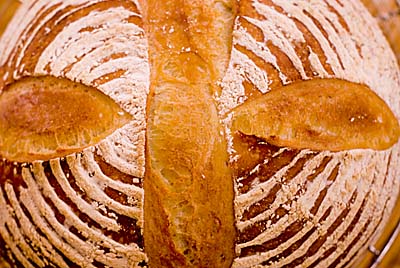
Keep that scorchy flour off your lens! Here’s how it looks a little closer in:
jeff bread

People have asked how to prevent free-form loaves from spreading sideways, especially if the dough is a little too wet or it’s near the end of its batch-life (two weeks). Using a banneton (or in German, brotform), is one gorgeous solution to the problem, and they work well with our method. But, you’ll have to make a few adjustments. Interested? Bannetons (brotforms) are wicker rising baskets available from baking supply places like King Arthur Flour. By containing the rising/resting dough, the basket prevents sideways spread with wet dough, and creates a beautiful pattern of flour that contrasts nicely with slash-marks. Since very small bannetons (5 or 6 inches would be ideal) are hard to find, you’re stuck making large loaves, like the one in the picture, with my 8 to 9-inch banneton. That’s OK, but keep in mind that rising/resting times, and most importantly, baking time, will have to increase dramatically. To make the loaf in the pictures took nearly 3 pounds of Italian Peasant dough (page 46 in the book). So, here’s how to use the banneton:

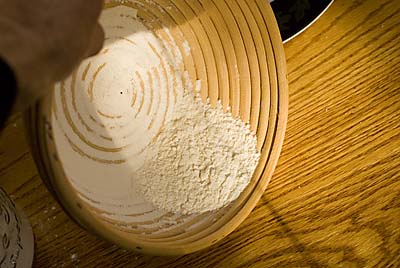
                              Put some white flour into the bottom of the banneton and then shake it all around so it coats the sides. Be generous with the flour! And of course, luxuriate in the slanting Northern winter sun as it sets your heart afire. Then get a plane ticket somewhere south, to the lands of the umbrella drink.
Shape and “cloak” a round freeform loaf as usual, pinching together the loose ends underneath. Choose a loaf-size so the dough comes about 2/3’s of the way up the sides of the banneton. Place the loaf into the banneton with the irregular side up. The smooth cloaked side should be in contact with the wicker basket. For the 8 to 9-inch banneton, this took about 3 pounds of dough, so the loaf needed along rest to come close to the top of the basket, about 2 hours. Twenty to forty minutes before baking, preheat your oven to 450 degrees F, with a baking stone near the center of the oven and a broiler tray on any other shelf that won’t interfere with rising bread:
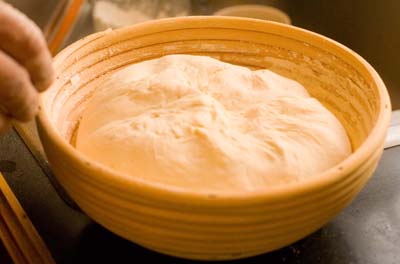
Dough in basket

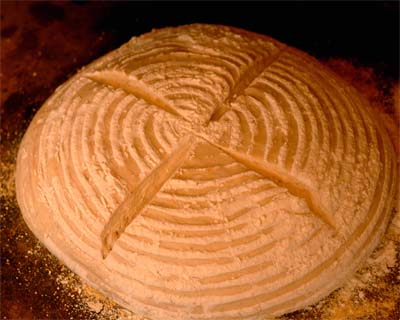
                   After the dough is rested, use your fingers to be sure that it isn’t sticking to the wicker (it wasn’t. Don’t dig way down or you’ll start deflating everything. Gently turn the basket over onto your preheated stone; it should gently drop onto the stone. If it doesn’t, help it out with your fingers and make the best of it. It should be salvageable even if it deflates a bit, because of oven spring. Slash the loaf in a cross, which will be beautiful with the concentric circles of flour:
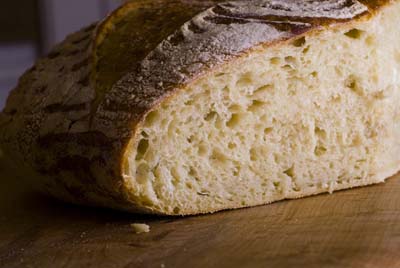
    Now comes the tricky part; this is a beastly huge bread. It took about an hour in my oven at 450 and I was happy with the result (crumb pictured below, crust above). When you make a large loaf you risk doughiness in the center; let the crust get deep, deep brown. Frankly, mine could have gone even longer. It’s tough to overbake large loaves made from high-moisture dough. But the result was worth the effort. If I can find a small banneton, I’ll post again.

Comments

Ulrike aka ostwestwind said...
January 28, 2008 at 11:51 am

In German a banneton is also called G

LJCohen said...
January 28, 2008 at 2:57 pm

Lovely! I’ll have to try this. What I have been doing to keep the dough from spreading out too much is to let it rise on a parchment paper lined cookie sheet with an inverted tupperware bowl over it. Keeps it warm for the rise and keeps the dough from spreading too far sideways.

A question (that has nothing to do with this post, sorry!):

I’ve been playing with keeping back a hunk of the dough and using it in my next batch. That has helped the bread develop a lovely, almost sour dough flavor. So have I recreated a quasi-sourdough starter? And can I just keep using the previous dough as my ’starter’ without adding new yeast?

jeff said...
January 28, 2008 at 5:13 pm

LJ: Everyone’s coming up with strategies and they all work.

Another poster told me that they’re using the leftover dough as the only leavening agent and I told them I’d try it, so ditto! Very interesting. You have indeed created a quasi-sourdough starter based on commercial yeast. Over time, however, it will be replaced by wild yeasts and we’ll see if that’s storable. When I experimented with wild yeasts before the book came out, I found that it was a bit unreliable for storage (or at least too temperamental for beginners). So we left it out of the book. Your idea is different since it starts with commercial, not wild yeast.

Jeff

Dan said...
January 28, 2008 at 7:17 pm

Hello,

I just received the book today and I was skimming through all of the master doughs. I noticed that most of the recipes in the beginning to mid book used 1-1/2 tablespoons kosher salt, whereas several later recipes (especially the enriched doughs) only called for 1-1/2 tablespoon salt (not specifically calling for kosher salt). Because the amount of flour looks to be about the same in these enriched doughs, I am wondering if these enriched dough recipe meant to say “kosher” salt. I checked in your “Errors” section and there wasn’t a mention of this for the enriched dough recipes (although I think it does correct this error for the peasant dough recipe). Anyways, I just wanted to be sure that I have the salt amount clear in my mind.

Thanks,

Dan

jeff said...
January 28, 2008 at 7:55 pm

Dan: Our mistake, it should say “Kosher” salt throughout. We tested with Moreton’s Kosher salt, just as an FYI. You’ll probably end up altering to fit your taste in any case.

Jeff

Biff said...
January 28, 2008 at 9:50 pm

Zoe: You say for a one pound loaf you want a 6″ brotform but I could not find one after much searching.

Freiling info states:

Frieling 300x – Round Brotform Bread Rising Baskets
If you are looking to make homemade bread that has a crunchy crust, ribbed, floury d

Dan said...
January 28, 2008 at 9:56 pm

Jeff,

Thank you for your prompt reply. That was what I thought, I just wanted to be sure. As you know, the level of saltiness can vary considerably if I end up using the wrong type of salt. I’ll just make a note of this in the book.

Dan

jeff said...
January 29, 2008 at 5:39 am

Biff:
Thanks for the info on the smaller bannetons/brotforms, this is the first I’ve seen of a 7-incher. I mentioned 6-inches but you’re confirming that it probably doesn’t exist. Our loaves tend to be easier to deal with in smaller versions, so I was hoping for a 6, but 7 is probably fine (I did the one you see in an 8 to 9-inch one). Price is never great, they’re imports and probably handmade. Do you have a website for these?

Jeff

Barbara said...
January 29, 2008 at 9:35 am

The San Francisco Baking Institute sells bannetons, both round and oval, to accomodate 1 and 1.5 pounds of dough. They are very reasonable, but they also sell some plastic forms that are a even less expensive.

http://www.sfbi.com/baking_supplies.html

jeff said...
January 29, 2008 at 10:08 am

Thanks Barbara, this is a great link. I’m a tiny bit skeptical about one thing though. They’re billing the 8-inch banneton as good for 1 to 1.5 lbs loaves. My 8.5 inch banneton took 3 pounds! Still, it’s a great price because it’s a fundraiser, so check it out. Jeff

Biff said...
January 29, 2008 at 11:46 am

Jeff, I don’t remember which of the many websites I checked out that my banneton post was from but I found this page on Fantes where I have purchased things before. About half way down the page is a 6.5″ brotform for about $15 plus shipping from Philadelphia.

http://www.fantes.com/brotforms.htm

jeff said...
January 29, 2008 at 1:14 pm

Thanks Biff. Bet that 6.5-incher is the way to go. I’ll try it and post again.

Jeff

Lindy said...
January 30, 2008 at 7:06 am

You don’t need to spend a ton of money on a proofing basket. Peter Reinhart’s The Bread Baker’s Apprentice points out that a $1 wicker basket will do the same job as a $30 bentwood banneton. Quoting from page 34: “They both do the job; you do the math.”

laura said...
January 30, 2008 at 4:39 pm

a few months ago I wanted to rise my bread in a basket. not having anything else available i did use an inexpensive basket from the store and used a clean
linen towel for a liner. It did the job I wanted. the top of the
bread still came out with a very nice design. i haven’t tried it with this recipe, but since i have three batches of dough thawing on the counter, i will try it tonight.

larry silva said...
January 31, 2008 at 1:30 pm

Quick question: with this Banneton bread you mention a broiler tray but failed to mention placing 1 cup of hot water in it; i assume this is why it is there but you know what they say abut assuming things…so did you use a cup of hot water and do you ever need to replenish the water on a long baking bread?

jeff said...
January 31, 2008 at 6:59 pm

Larry: Yes, it needs the steam; pour one cup hot water just before you close the oven door. Thanks for catching.

Jeff

Ji An said...
February 3, 2008 at 10:20 am

Zoe, I finally bought your book and tried Boule with a great anticipation. However, it was a disappointment. I mixed the ingridients and let it rise about 1 hour 30 min. and baked it in convection oven. It had a nice crust, but very doughy inside which we didn’t care for. And it tasted very bland. I thought it was going to be a little bit salty. What did I do wrong? Did I need more rising time? Before I send it back to Amazon.com, I would like to give it another try.

Jutta said...
February 3, 2008 at 11:43 am

Hi Jeff,
thank you and Zoe for writing this great book – I received it yesterday and I’m absolutely delighted.

In Germany, several foodblog-users are experimenting with flour, water and yeast to develop a dough, that corresponds to yours.

My first attempt was not bad but the dough was very wet and it was almost impossible to handle it. I must confess I cursed a lot.

So I developed a method to keep my blood-pressure low;-):

http://schnuppschnuess.typepad.com/manzfred/2008/01/muffchen-m—th.html

Today I tried the “Italian Semolina Bread” with Ilkas (http://rksuite.ccwn.org/)advice in mind concerning the amount of flour (1 cup of flour = 166 grams / 1 cup of water = 240 grams)) and it was simply great – I can’t believe that it really works, but it does.
I love it and I’m looking forward to baking all those lovely breads and pastries you recommend in your book!

zoe said...
February 3, 2008 at 3:30 pm

Hi Ji An,

From what you describe, I think that you need to let your dough store for at least 24 hours before you are going to find the flavor and the crumb to your liking.

As the dough ages the flavors become more complex and develop a crumb that has more holes and is far better. So if you can wait a day or two I think you will be happier with the boule.

You may also want to try a couple of the other recipes to see if you find the rye or brioche to your liking.

I really think that the beauty of this method and bread are that it can store for so long and as it does it gets better!

You may also want to give the dough a longer initial rise. The flavor is not going to have developed much in a 1 1/2 hour rise.

Please keep us posted on your bread!

Thank you for trying it and I hope you find the next loaves more to your liking!

Zoë

zoe said...
February 3, 2008 at 3:33 pm

Hi Jutta,

I love your method of baking the dough in muffin tins! That is fantastic. I will give that a try as well.

Your dough did look very wet from those pictures, but the bread was gorgeous!!!

Thanks! Zoë

Tom Gray said...
February 4, 2008 at 12:13 pm

Jeff,
Regarding the comment you left on my blog earlier today about replacing King Arthur all-purpose flour with their bread flour – how will I know if my batch of dough has been stored for too long? Will it start developing mold or smell weird or something?
Thanks-Tom

Teresa said...
February 4, 2008 at 5:37 pm

HI,
sorry if this is a repost but I can’t find my original post anywhere, I’m starting to think I never posted it.
I tried baking some semolina baguettes using the overnight cold rise/bake it cold technique. They were perfect, fully risen, but ready in time for me to make my kids sandwiches on them and leave the house by 9:00. My question is, do you think I could pre-assemble the caramel sticky buns and let them rise overnight and bake them cold? That would just be so great. I’m going to use challah dough to make beignets tomorrow for shrove tuesday.
teresa

jeff said...
February 4, 2008 at 6:31 pm

Teresa: I’m going to let Zoe answer your question about sticky buns. Zoe?

Tom: Your dough is too old when it starts to discolor and doesn’t rise much when you bake it. If you follow the guidelines we set out in the book, you shouldn’t have a problem. As far as smell goes, you do get an intensification of the sourdough aroma that in normal doses, is appealing. If it’s getting too strong, you’re keeping your dough too long. And if there’s mold (black or white patches, sometimes fuzzy), throw it away (I’ve never gotten this but it’s possible).

But the question you’re asking is about a high-protein version, which will be drier. The issue wouldn’t be spoilage, it would be whether the drier dough still rises for the full two weeks. Since we tested our book with AP, I’m not certain how much of a difference this would make (drier doughs offer more resistance to the expanding CO2 bubble). Can you let us know how it rises toward the end of two weeks?

Jeff

zoe said...
February 4, 2008 at 8:33 pm

Hi Teresa,

It is funny you should ask about the overnight sticky buns. Another woman I talked to at the Fine Cooking thread just made her caramel rolls that way this morning. She set them up the night before and baked them this morning. I think it is the way I will do it from now on! I love this approach. It seems to save me even more time!

Let me know how it goes!

Thanks, Zoë

Min said...
February 4, 2008 at 8:39 pm

Hi there, Jeff! Check out Aunt Becky’s beautiful loaf! Top of the page right now.

I can’t wait until my kitchen remodel is finished so I can try out all this breadmaking and join the fun!

jeff said...
February 4, 2008 at 8:52 pm

Aunt Becky rocks! Beautiful result out there. To the point made on your website (http://bad-girls-kitchen.blogspot.com/), appearance does matter for food. Not just appearance and taste, all five senses for bread, yes?

Jeff

zoe said...
February 4, 2008 at 9:02 pm

Hi Min,

Tell aunt Becky that her bread is truly gorgeous!

Thanks, Zoë

Melissa Simpson said...
February 4, 2008 at 9:49 pm

I bought your book a couple of days ago and we’ve made and enjoyed two loaves in the last two days.
Can I use fast/instant yeast?
On the overnight sticky buns, are they left out or refrigerated over night? This is such fun!

zoe said...
February 4, 2008 at 10:36 pm

Hi Melissa,

Great question!!! They are covered loosely with plastic and allowed to rise overnight in the refrigerator. The next morning preheat your oven and bake them straight from the refrigerator, once your oven is hot.

As for the yeast, it doesn’t seem to matter which kind you use. Regular granulated or instant both work.

Have fun with the book! Zoë

Bubbles LaTour said...
February 5, 2008 at 9:29 am

I’m looking forward to meeting you both at tomorrow afternoon’s book signing.
-Bubbles

Sheri said...
February 5, 2008 at 12:43 pm

Timely, since I just posted on Fine Cooking about my dough that spread way out!

I’ve sent the book to one of my friends and have tried to convince everyone else I know that bread baking is something you can do even with time constraints. :)

zoe said...
February 5, 2008 at 12:46 pm

Hi Sheri!

Thanks for your continued support and spreading the word! We too hope everyone starts baking and enjoying the fruits of their wee bit of labor!

Zoë

zoe said...
February 5, 2008 at 12:47 pm

Hi Bubbles,

Please introduce yourself at the book signing, we look forward to it!

Thanks, Zoë

Bubbles LaTour said...
February 5, 2008 at 8:39 pm

I might do that, Zoë. <=8-0). I’ve made two batches of dough since Sunday and have baked four boules. I want to make a baguette!!

zoe said...
February 5, 2008 at 10:14 pm

Hi Bubbles,

We will bring dough to the signing so we can work on a baguette while you’re there!

See you tomorrow! Zoë

Bubbles LaTour said...
February 6, 2008 at 8:09 am

Hey, Zoë!

Outstanding! Just remember that no good deed goes unpunished! :-) I will have something for you, too!

-Bubbles

Rosemary C said...
February 6, 2008 at 10:45 am

I have gone crazy with your bread making ideas. My husband likes “lots of crust”, so yesterday I made rolls. They needed a little help with a spatula to slide off the paddle, but they were crusty and delicious. Lots of people seem to have a problem with spreading dough. My dough does not spread; it just “poofs”, so I have a small high loaf and small high rolls. It doesn’t effect the taste, but should I smoosh down the dough a little more. It’s got to be my shaping method. Thanks

jeff said...
February 6, 2008 at 6:40 pm

Rosemary: Starting with flatter balls should help, but I can’t figure out why this is happening. Are you using high-protein flour like bread flour? Jeff

Rosemary C said...
February 6, 2008 at 7:03 pm

I am using unbleached white flour. I made another loaf this afternoon and it was better. Maybe “shaping” will become an Olympic sport? I think I am getting enough practice. I am making a loaf daily. How do you possibly hit the 14 day mark to see if it will get a more sourdough taste? I am in San Jose, Ca., and grew up in San Francisco just a few blocks away from Boudin bakery. SO….I am in sourdough country. I’m thinking of trying the low yeast method in another bucket. I think I’m going to need a “12 step bread program” soon.

Bubbles LaTour said...
February 6, 2008 at 8:08 pm

Having met Zoë and Jeff this afternoon, I want to encourage all to visit them at any appearance they might make where you are. The bread was awesome and the 113 people who attended the event in the U of M Bookstore were charmed and inspired.

I am eager to present the second copy of your book to a friend who enjoys baking bread. She will be surprised to see it inscribed to her personally. ¡Mil gracias! I’m on the hunt for a bread stone for the oven and will be checking out a local tile store tomorrow.

Chow! Er-r-r, ciao!
-Bubbles

zoe said...
February 6, 2008 at 8:29 pm

Hi Bubbles, the pleasure was all ours! It was wonderful to meet you.

Thank you so much for the amazing gift. I shared your jams with my boys when I got home. We ate them on the bread you had baked for dessert. Ok, so I took one bite of the boozy peach jam and hid it so that I, alone, could eat it. It is truly amazing!!!

Thanks so much! I hope you friend enjoys the book.

Zoë

jeff said...
February 6, 2008 at 9:09 pm

Hey Bubbles:
Great seeing you tonight and thanks for the jams. I had no idea we were in the presence of a Gedney celebrity (apologies to non-Minnesotans, too hard to explain). Hope we see you again around town.
Jeff

jeff said...
February 6, 2008 at 9:32 pm

Rosemary: It’s not that bad an addiction to have. To get to the 14-day mark you really need to have at least two buckets going at once, staggered. If you’re used to San Fran breads from great bakeries, I think you’re going to like the low-yeast version. Jeff

Bubbles LaTour said...
February 7, 2008 at 9:21 am

OK, guys, I have unglazed terracotta tiles on order at my local tile purveyor. Dirt cheap. (Cheaper than some dirt, actually.) What do I do with them when I get them? Wash, I suppose, yeah? Dry them in the oven at a low temp before heating to 450 deg.? I’m eager to try it and I have batch #3 of the basic dough in the fridge now — boule and scallop shape thang are out of the oven ready to be delivered to the Worthy Pure and Holy.
-Bubbles

zoe said...
February 7, 2008 at 11:49 am

Hi Bubbles,

I think you have the right idea. Just dry them nice and slow so they won’t crack!

Let me know how it goes once the tiles arrive.

Zoë

Rosemary C said...
February 7, 2008 at 5:35 pm

FYI: Yesterday on the Today Show they had a recipe (the #1 downloaded from Epicurious) for CREME BRULEE FRENCH TOAST. It uses country style bread. We all have a lot of that around, or the fixins in our fridge. You put it together the night before you bake it. It is awesome!!!

Bubbles LaTour said...
February 8, 2008 at 1:47 pm

Hey, Jeff -
I’ve mixed my third batch of dough since Sunday. Most has been given to friends so I can make more. 8-0)
I messed up the flour measure (too much) in Batch #3 and added water to compensate and loosen the dough. I baked my first loaf from that batch this afternoon and (drum roll) it snapped and crackled when I took it from the oven to the cooling rack. Hoo-yah! “Want some jam, Little Boy?” Three loaves, accompanied by a bread spread, will go to friends’ as hostess and birthday gifts this evening. We’ll have the fourth loaf tomorrow and I get to start a new batch!

jeff said...
February 8, 2008 at 4:18 pm

Excellent, Bubbles! This recipe is very forgiving. I once added in the yeast to mixed dough after forgetting it, and it worked (slowly). I added it as a slurry with water and mixed it in. Jeff

Jean said...
February 8, 2008 at 4:25 pm

Jeff and Zoe,
My 2nd European Peasant loaf resembled a flat pancake after 90″ of sitting at room temp, even under a bowl. I wanted a high, round loaf so baked it in my 5-qt cast iron Dutch oven. Looks great so far (about 5″ high). Next loaf will be with King Arthur AP and KA true medium rye flour for more flavor if I can find it. Does anyone know where to get KA rye in Mpls-St Paul?
Thanks,
Jean

Biff aka Dr. B said...
February 8, 2008 at 7:37 pm

Got my 6.5 inch Brotform via Fantes today and will try to find time to make a loaf this weekend. The instructions that came with the item call for using Baker’s Joy or a similar product to prevent sticking. I assume sprinkling on additional flour is not a problem.

I presume, if I use one pound of dough, that the 30 minute baking time suggested in the Master Recipe is likely to work.

———————-

Why don’t you start a Miscellaneous Blog so things stay specific to the topic for ones such as this Banneton blog? The questions and answers about the Sticky Pecan Caramel Rolls are great but they don’t fit well here. The writers have no other place to ask these questions so they randomly get added to other topics; a Random Question Section would be great, I think. Am I off base?

Jeff/Zoe: Your book rekindled my long lost interest in baking breads, etc. Thanks

jeff said...
February 9, 2008 at 4:56 am

Jean: Sounds like the flour you’re using and the longer rest time aren’t agreeing with each other. I bet KAF AP will solve your problem because its higher protein will absorb more water and result in a drier dough. Alternatively, you could try decreasing the water a bit. To the best of my knowledge, KAF medium rye isn’t available in the Twin Cities so I’ve ordered it from the KAF website. And if you’re loaves are spreading laterally, the Dutch Oven or other pan will solve the problem.

Dr B: My Fantes Brotorm arrived too! I’ll try it as soon as I’m back in town, but it looks perfect for small loaves like one-pounders. The baking time should be the same if the loaf weight is about the same. I was just going to use flour rather than messing with Bakers Joy, we’ll see if that works.

And thanks for your suggestion about a general question area, we know we need it. There are some technical challenges that we are working on; the WordPress software is flexible, but only to a point, and then you need a bunch of custom programming. Jeff

Jonquil said...
February 9, 2008 at 5:23 pm

Those are gorgeous pictures. I mentioned in my LiveJournal that I was having troubles with the basic boule recipe; my most recent batch from the second week wound up *very* wet, so wet that I poured off water when I took it out of the rising bin and had to knead flour into it to give it any body at all. It rose well out of the oven, but fell flat and stayed that way in the oven.

You asked on my LJ if I were using a high-protein flour. My staple flour is King Arthur (the regular, not the bread flour) which is very high-protein and I used American yeast.

Are there weight equivalents anywhere on your site? I might try that next time, rather than the scoop-and-sweep method.

Jonquil said...
February 9, 2008 at 5:24 pm

N.B. I always bake in 450-degree preheated Dutch ovens.

zoe said...
February 9, 2008 at 5:46 pm

Hi Jonquil.

Ok, so it isn’t the flour! I use KA all-purpose all the time with no issue.

Perhaps try weighing the flour and see what you come up with.

2 pounds = 6 1/2 cups all-purpose flour

With the KA flour I usually add another 1/4 cup of water, because the protein content is so high and it absorbs so much extra water.

As you mentioned on your LJ you will want to wait at least 2 days before baking off your first loaf so that it has time to ferment. After that you should be good!?

I really hope you will give it another try and let me know what you find.

Thanks so much! Zoë

Jonquil said...
February 9, 2008 at 5:54 pm

I waited two days before baking my first two loaves. The next loaves came a little over a week later, and had the severe sogginess problem I mentioned.

I may try again with KA’s bread flour instead of the all-purpose.

jeff said...
February 9, 2008 at 8:49 pm

Jonquil: One other thing to consider if you’re finding your result to be too wet is to skip the covered Dutch oven. That method’s worked well for me when I’ve tried it, but its closed environment retains moisture more than baking a free-form loaf on a stone, where all that surface is exposed to hot air (which dissipates the moisture). That might be why you’re getting a result that’s so much wetter than what you’d like. Jeff

Jonquil said...
February 10, 2008 at 12:14 am

Thank you for the thought; the problem has been that the dough has been too wet when I removed it from the dough bucket, long before it ever reached the Dutch oven, and far too wet to hold its shape when baked free-form.

I may retry without adding the extra water for King Arthur flour.

Shari said...
February 10, 2008 at 9:52 am

Hi Jeff and Zoe,
I am enjoying your technique, but I have a website concern: so much good information is coming out in the comments, but then they are not really searchable. For example, I want to read all the ideas about setting up the night before, but there is no good way for me to do so. Can you somehow separate the wheat from the chaff (sorry, couldn’t resist) and let the stuff worth sharing come through? Congrats on one of those ideas that is so obvious afterwards…true proof of a great idea.
–Shari

jeff said...
February 10, 2008 at 6:40 pm

Shari: You are so right. As of this moment, we don’t have the technical capability to do what you suggest, but we are working on it! Jeff

chris said...
February 10, 2008 at 8:08 pm

I got the book for christmas and in the last week have made the basic boule and today the almond cream brioche. I am utterly amazed at the ease and the flavor!! I’m sooo hooked!Am taking one of the brioches to work tomorrow and my husband says I’ll score major points!

I made the boule and then some baquettes and like the internal texture of the baquettes the best.

My one question is how to tell when the interior is done…..the crust looks great but I worry that it might be doughy inside. Any tips?

zoe said...
February 10, 2008 at 9:24 pm

Hi Chris,

We go by the color of the crust to determine if the bread is dough. You can see on the cover of the book that we go for a nice deep brown crust. Once you’ve got that color it should be done.

If you are using a thermometer than it should read 200 degrees. But we never do, we just go by color!

Thanks, enjoy the brioche! Zoë

Biff aka Dr. B said...
February 11, 2008 at 7:57 pm

My first attempt at bread using a banneton/brotform was a mixed result. I floured the brotform liberally so the risen dough easily dropped onto the stone, however the bread was a bit dense with an undercooked center.

Since most of the dough surface is on the brotform it is not exposed to the ambient tempature as is on a pizza peel, thus I should have allowed it to rise for a much longer time.

I did not bake it to a dark crust because I failed to follow the recommendation Zoe made a few messages above this one. I will try again!

The bottom line is the brotform, from Fantes, worked but I will refine my technique over time. Flour, water, yeast and salt are cheap so playing around with dough doesn’t cost much but a little time.

jeff said...
February 12, 2008 at 6:29 am

Dr B: What size brotform did you get from Fantes, and how long did you rest the dough? I have the 6 1/2 diameter basket and I still haven’t baked with it. When I used the 8 1/2 inch basket, I had to let it rest a long time (2 hours). I’m wondering if the rule with these brotforms may be that you need to let it come completely to room temperature but I’ll see.

Jeff

Biff said...
February 12, 2008 at 10:56 am

I used the 6.5″ just like yours that was in the Fantes link I gave you last week. I may try to make another in a couple days when I have more time. Anxious to hear your experience.

gary said...
February 15, 2008 at 10:35 am

OK, I’m cheap! I just improvised by using a plastic serving basket I bought for a buck from my local pub – the type they serve french fries and buffalo wings in – Also used straw basket that came with a fruit assortment at Christmas !

jeff said...
February 15, 2008 at 12:08 pm

Gary: That should work just fine, so long as the plastic doesn’t stick to the dough. We have to work on a Buffalo Wing bread, thanks for the idea.

Jeff

Teresa said...
February 18, 2008 at 7:16 pm

Hi,
well KA doesn’t sell malted wheat flakes anymore. . . For their malt bread (or something like it) it says you can substitute Maltex cereal for the malted wheat flakes, what do you think? I don’t know why I’m fixated on the granary bread but . . . I am.

jeff said...
February 18, 2008 at 8:51 pm

Teresa:
Arghhh!!! Sorry about that, I promise it was available when we wrote that recipe. I’d trust KAF and go with the Maltex; their test kitchens are pretty careful. You could always order the real thing from England (http://www.expats-shoppingarcade.co.uk/supermarket/baking/flour,-yeast-and-bread-mixes/?page=0). Just kidding, unless you actually ordered the Hovis Malted Brown Granary flour. I suppose I’ll be doing it at some point. I promise, I am more obsessed than you are. Jeff

jeff said...
February 24, 2008 at 8:08 pm

All: The 6 1/2-inch Fantes banneton form worked beautifully, much easier to bake through. It only took about a pound and a half of dough. Jeff

Lisa said...
February 25, 2008 at 7:33 am

I use a banneton from KA – works better now that it seems more season after multiple uses. The loafs come out good but my slashes(the ones I cut on loaf tops) often close up. The flour does seem to help with being able to cut better slits – but in general my slits in all of loafs from the book don’t stay open as well. Just wondering if this is a symptom of using the wetter dough – yet the pictures in the book have great slits!

jeff said...
February 25, 2008 at 9:45 am

Lisa: Cut a little deeper (maybe a half-inch rather than the quarter-inch we specify in the book), and keep the blade square with the surface (not at an angle like traditional methods specify). We use a long serrated bread knife rather than a razor or French-style “lame,” those work well for traditional drier dough but not so well for our wet dough.

If nothing else works, mix your dough a little drier, maybe a quarter-cup less liquid per batch. Or even just two tablespoons could be all you need.

Jeff

Lisa said...
February 26, 2008 at 6:37 am

Thanks – I will try that. I was using my lame and slashing at more of an angle. I am a JWU pastry grad and have this slashing technique drilled into me!

Lisa said...
February 27, 2008 at 7:16 am

Baked off a pumpernickel loaf last night and slashed as you described and it came out great – nice deep tic-tac design! Thanks for all of your feedback – never before have I been able to get a book and cook my way thru it while getting such helpful feedback from the authors!

jeff said...
February 27, 2008 at 7:23 am

Lisa: Thank you! Jeff

Jessie said...
February 28, 2008 at 12:08 pm

A friend gave me excellent bread to taste, she made it from a recipe that she got from the N.Y.Times. She used beer and vinegar for some of the liquid
The bread had a real sour dough flavor. If I use beer & vinegar in your Boule, what other subsitutions do I have to make?

jeff said...
March 3, 2008 at 12:17 pm

Add a half-cup beer, 2 tablespoons of white vinegar, and decrease the water by 1/2-cup plus 2 tablespoons and let us know what you think.

Thanks, Jeff

Teresa said...
March 7, 2008 at 4:40 pm

O.k. I found the reference in KA Whole Grain Baking: Maltex, a hot cereal that may be found in your grocery store’s cereal aisle alongside the oatmeal, is a great substitute for hard-to-find (impossible now that KA doesn’t stock them) malted wheat flakes. In Maltex the berries are chopped into fine pieces reather than sliced, but their flavor is the same. Use them 1:1 as you would malted wheat flakes.
So after trying to track Maltex down for a few weeks I found it, finally. I’m going to try the granary bread again!
teresa

Teresa said...
March 11, 2008 at 1:56 pm

I made the granary bread. It was great! Using the Maltex 1:1 is the way to go.

jeff said...
March 12, 2008 at 4:39 pm

Teresa: Where did you find the Maltex? Jeff

Teresa said...
March 14, 2008 at 4:59 pm

Hi Jeff,
I found the Maltex at Hannafords = I found a post on chowhounds for someone looking for Maltex in the Boston area that said that was the only grocery store to carry it. . . you can email the manufacturer and they will tell you if there’s anywhere in your area to carry it I suppose. The bread is really good.

Claudia Lunder said...
March 18, 2008 at 8:19 am

Hey! I made the sun-dried tomato and parmesan and it was great so I am thinking of spreading some of my homemade pesto on and rolling up and baking. I was in a hurry so made just the filling from the sticky bun recipe and spread it on some rolled out master recipe dough and rolled it up and everyone loved it so then I did the same and sprinkled on some chocolate chips as well. Weight Watchers has banned me from future weigh-ins- but I’m happy.

zoe said...
March 18, 2008 at 12:12 pm

Hi Claudia,

That sounds fantastic! I love pesto.

It was great to have you in class a couple of weeks ago!!!

Enjoy! Zoë

Robin said...
April 16, 2008 at 2:18 pm

I’m glad to hear that the 6 1/2-inch Fantes banneton form worked so well. I just ordered one.

I am having so much fun with your book. I identify myself as a cook, not a baker, but I have been thrilled with the results that I’m getting. Weighing the flour rather than using the scope method has worked better for me.

jeff said...
April 16, 2008 at 7:46 pm

It did work nicely, I’m quite happy with it. You don’t need to be a baker to use our book! Jeff

Ethan said...
June 2, 2008 at 4:51 pm

I’ve had good result letting small loaves and sticky buns rise slowly in the fridge overnight and baked in the morning. Given the long rise necessary for an 8/8.5 inch brotform, do you think it is still possible to do a slow rise in the oven. I am looking for a way to get a large loaf fully baked out of the brotform in the morning without getting up at 3 a.m. to shape and rise.
Thanks.

Ethan said...
June 2, 2008 at 5:56 pm

I meant “slow rise in the fridge” not “oven”
sorry

zoe said...
June 2, 2008 at 6:57 pm

Hi Ethan,

What are you considering a large loaf? I do think that this retarded refrigerated rise will work well for a larger loaf of bread. Having said that, there is probably a limit to just how big. You may need to do some experimenting as to just how far you can push the size of the loaf.

Thanks! Zoë

Ethan said...
June 3, 2008 at 10:28 am

I’m using an 8 or 8.5 inch loaf – I believe the same one Jeff used in the pictures above, so I am figuring about 3 lbs of dough. Any thoughts on this size for the overnight fridge rise?
Thanks, appreciate all the help and support you guys have provided.

jeff said...
June 3, 2008 at 11:15 am

Ethan: Well, it’s worth a try, but I think we should view any attempt to bake this right out of the fridge as an experiement— you may waste 3 pounds of dough. If it works, great, but I’m skeptical about this large a piece of dough being baked cold. It’s just going to be hard to get done in the middle.

But as I say, it’s worth a try. I’d put the whole thing in a plastic bag because the fridge can be dehydrating. Jeff

Ethan said...
June 3, 2008 at 1:49 pm

Thanks. I may just get up early to shape go back to sleep while it rises. A small price to pay for fresh baked bread at brunch.

jeff said...
June 3, 2008 at 2:19 pm

Ethan: You are more obsessed with bread than I am, which believe me, is saying quite a lot!

Thanks for your enthusiasm, and let me know how it works out. Jeff

Ethan said...
June 4, 2008 at 2:22 pm

I have you to thank for that Jeff! Here are a few of the breads I have been baking with your book.

Thanks so much!

http://www.brakeforbread.blogspot.com

jeff said...
June 4, 2008 at 5:26 pm

Nice blog Ethan! Thanks for mentioning us (so much). Jeff

Kim said...
October 5, 2008 at 4:03 pm

I was just wondering…. Is it o.k. to use SAF instant yeast with your recipe? Should I use a different amount? Thanks!! Kim

jeff said...
October 5, 2008 at 7:11 pm

Any brand of instant yeast is fine, including SAF. The amounts are the same for all types of granulated yeast. Jeff

Kim said...
October 6, 2008 at 6:48 pm

Thanks Jeff! I can’t wait to get started baking bread!

Abby said...
April 7, 2009 at 3:31 pm

I made a batch of master dough on a Friday night (my first) and didn’t touch it until Tues night and it had the most spectacular sourdough flavour and smell and had that creamy custardy consitency when chewing. While I wait for my baking stone to arrive I’m going to bake the rest in my dutch oven. I’m so glad I found your book and can’t wait for the 2nd.
Abby

Christille said...
June 1, 2009 at 3:00 am

Greetings from sunny South Africa (Johannesburg). I have been downloading recipes from your site for ages but finally received my book! Anybody out there to give me some tips on how to get a better crust? The loaves look and taste great but (I think) the crusts are too thin.

jeff said...
June 1, 2009 at 6:20 am

Thanks Abby!

Christille: Are you using steam as in the book? Have you checked your oven temp? Also consider other steam alternatives if you aren’t happy with the standard method:

Baking in a Dutch Oven: http://www.artisanbreadinfive.com/?p=552

Aluminum Roasting Pan for Crust: http://www.artisanbreadinfive.com/?p=510

Cloche baking: http://www.artisanbreadinfive.com/?p=566

Judith said...
September 22, 2009 at 10:18 pm

When I put the dough into the banneton I cover it with a piece of parchment paper.

To put it into the oven, I just put my peel over the paper, flip the benneton and put the parchment paper and bread onto my preheated stone in the oven.

Works like a charm!

jeff said...
September 23, 2009 at 10:38 am

Yeah, parchment is kind of the wonder paper, isn’t it? Using it quite a lot, though I’ve never had a problem just dropping the loaf right onto the stone. Jeff

Chris said...
October 25, 2009 at 6:41 am

Has anyone tried to bake (or just proof) in a stoneware form to maintain the integrity of the design? I work with clay and it would allow my creativity including the coil effect.

zoe said...
October 25, 2009 at 11:09 am

Hi Chris,

As long as you flour the inside so the dough doesn’t stick to the form I bet it would work. If you do make one please report back so we know how it turned out!

Thanks, Zoë

Kelly Schultz said...
November 24, 2009 at 6:49 am

Hi there I don’t know if already posted, but another cheap brotform alternative is a waffle weave tea towel in a appropriately sized bowl. Generously flour the tea towel and give a spritz with a bit of cooking spray. Don’t have to worry about longevity of a traditional brotform staples if you want to do overnight rises in the fridge with very wet dough etc… The larger the waffle on your towel the more dramatic the look. I even managed a slight flower decoration on one loaf using an embroidered cloth napkin, before I found the waffle tea towel. That was pretty cool!

Kelly Schultz said...
November 24, 2009 at 6:58 am

I should add I use this technique so I can make a grapefruit sized boule – instead of an enormous loaf which you get with a brotform – I use my smallest glass mixing bowl. The bigger the loaf the more side folds the teatowel needs, and it is just not as pretty. I also cover with parchment. Just before baking I flip the whole thing onto the peel, remove the towel, slash and into the oven pronto.

jeff said...
November 24, 2009 at 8:38 am

Kelly: Thanks for the great tip!

Write a comment