intro copy

The homemade bread revolution continues, with healthy new recipes…


… ARTISAN BREAD IN FIVE MINUTES A DAY taught busy people how to make great bread at home, with only five minutes of active preparation time. Now, HEALTHY BREAD IN FIVE MINUTES A DAY whips up fabulous breads made with more whole grains, fruits and vegetables. The secret? Mix up a lightning-fast batch of moist no-knead dough, save it in your refrigerator, tear off portions over the next week or more, shape, and bake.

click to purchase

Click to purchase

store logos

amazon

Follow us on Twitter


Red Star Yeast

Recent Posts

Categories

Links:

Gluten-Free Crusty Boule
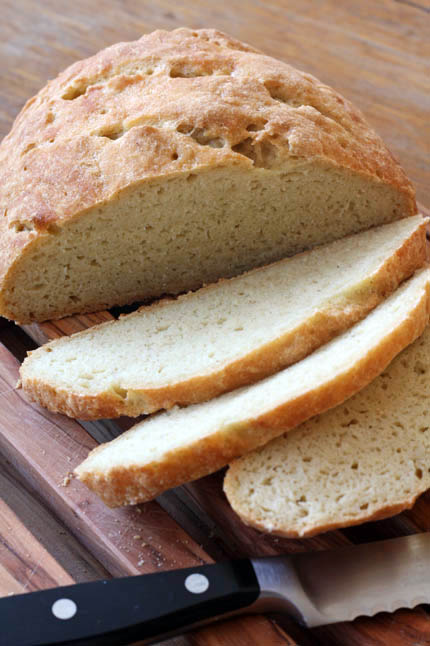
Print | Email | by Zoe, January 5, 2010
Filed Under Gluten-free | 286 Comments

gluten-free-boule-13a

When Jeff and I set off to write HBin5 we knew it would include gluten-free recipes. It was the #2 request from our readers of ABin5, more of a plea than a request. The options for buying gluten-free bread are both unsatisfying and expensive, two qualities we try to avoid. We wanted to create wonderful bread that anyone, celiac or not, would want to eat. Along the way we learned a lot about baking with flours that don’t have gluten, which is what gives wheat breads their desired texture and ability to rise. It took several failed attempts, some sleepless nights and ultimately the advice of experienced gluten-free chef Shauna from Gluten Free Girl before we landed what we think is a dynamite crusty loaf, that just happens to be gluten-free.

Several readers have asked about our olive oil dough on page 238. While the Crusty Boule has a chewy and toothsome texture, the bread made with the olive oil dough has a much lighter, almost fluffy interior. Replace the neutral flavored oil in the Crusty Boule recipe with olive oil if you prefer the texture of that loaf. They are both wonderful and give you fantastic options for free form loaves, sandwich breads, pizzas and even crackers. You will find all of these, plus many other gluten-free breads and awesome sticky buns in Healthy Bread in Five Minutes a Day.

For those of you who are celiac or just baking for someone who is you will find all of the directions and tips for handling gluten-free dough below. It is just as easy as our other recipes, but requires slightly different techniques and a new list of ingredients.

Gluten-Free Crusty Boule

Makes enough dough for at least four 1-pound loaves

2 cups Brown Rice Flour

1 1/2 cups Sorghum Flour

3 cups Tapioca Flour (also called tapioca starch)

2 tablespoons yeast (can be reduced but you will have to increase the rise time)

1 tablespoon kosher salt (increase or decrease to taste)

2 tablespoons Xanthan Gum

2 2/3 cups lukewarm water

4 large eggs, whisked together

1/3 cup neutral-flavored oil or olive oil

2 tablespoons honey or sugar

mixing-gluten-free-dough01

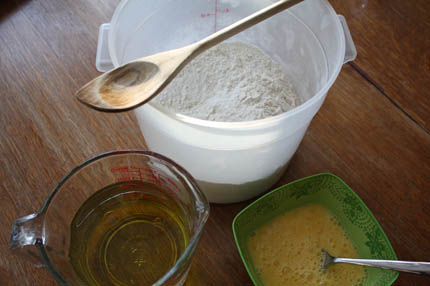
Mixing and storing the dough: Whisk together the flours, yeast, salt and xanthan gum in a 5-quart lidded Round Food Storage Container. Combine the oil, honey and water, set aside.
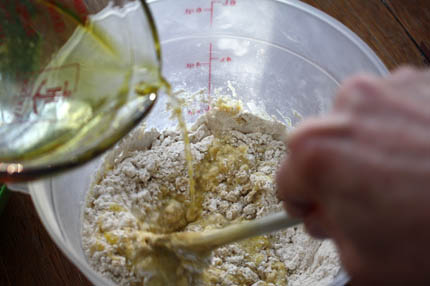
mixing-gluten-free-dough02

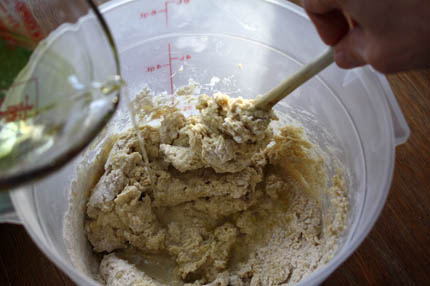
Dump the eggs into the dry ingredients and then stir while you pour in about 1/3 of the oil and water. Unlike our wheat doughs we do not add all of the liquid at once and stir. If you do that it will result in a lumpy dough.

mixing-gluten-free-dough03

continue to stir while you pour in another 1/3 of the liquid.
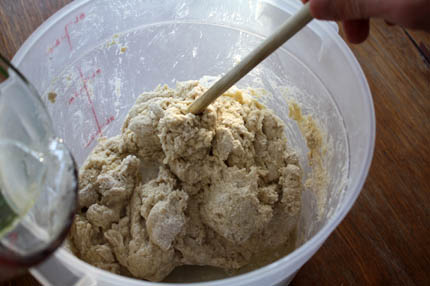
mixing-gluten-free-dough04

The dough will start to come together in a thick dough. Add the final 1/3 of liquid and
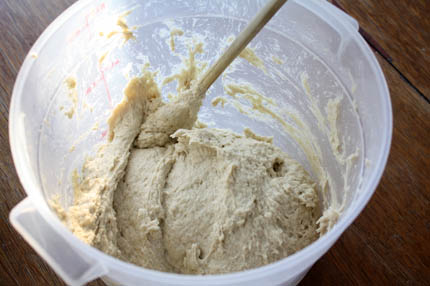
mixing-gluten-free-dough05

stir until the dough is nice and smooth. Cover with the lid, but do not snap it shut. Allow it to rest on the counter for about 2 hours. Place the dough in the refrigerator and store for up to 7 days. (I have a piece in the freezer and I will report back about how that turns out once I defrost it and bake it up. Stay tuned.)
gluten-free-boule-01

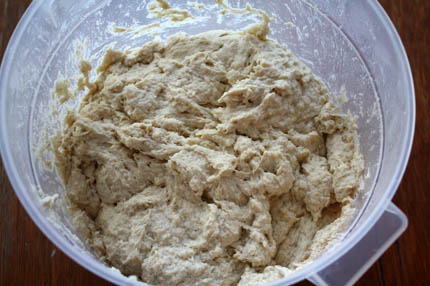
On baking day take the bucket from the refrigerator. The dough will be quite fluffy still and you want to try not to handle the dough too much. Just like our other doughs the trick is to keep as much of the air bubbles in tact as possible.
gluten-free-boule-02

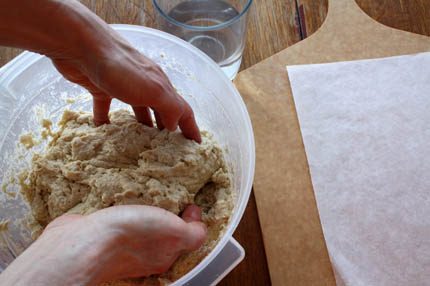
Use wet hands to remove 1-pound (grapefruit-size) piece of dough from the bucket.
gluten-free-boule-03

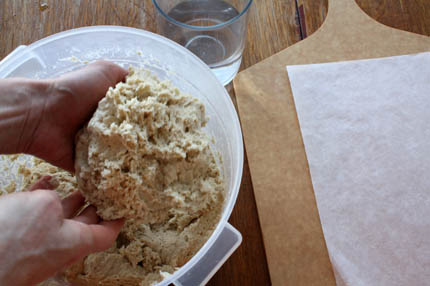
The dough will be quite scraggly when you take it out, just place it on a piece of parchment paper.
gluten-free-boule-04

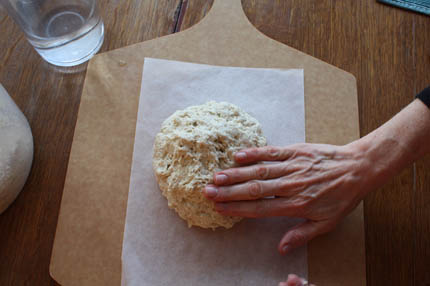
Use wet hands to smooth out the surface of the dough.
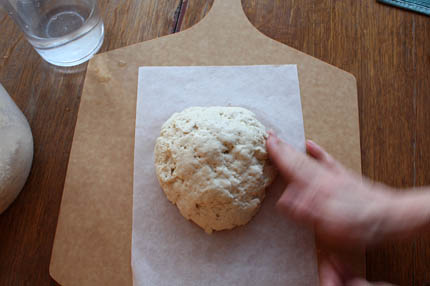
gluten-free-boule-05

This may take dipping your hands in the water a few times…
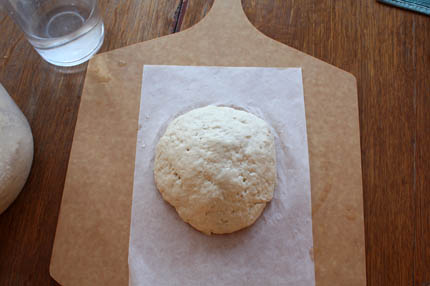
gluten-free-boule-06

to get a nice shape.

gluten-free-boule-07

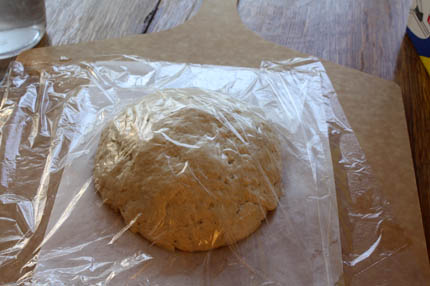
Cover loosely with plastic wrap and allow to rest on the counter for about 90 minutes. If your kitchen is very warm you may only need about 75 minutes.

30 minutes before baking time preheat the oven with a 5 1/2 quart Dutch Oven in it to 500 degrees. Be sure it is fitted with a metal Replacement Knob, the original plastic knobs can only be heated to about 400 degrees. To find directions for baking on a stone see page 237 of HBin5.

gluten-free-boule-08

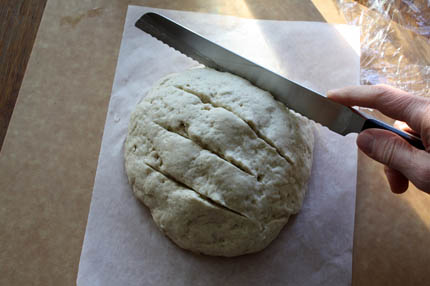
The dough will not have grown much while resting, but it will seem a little bit puffier. Use a serrated knife to cut slashes in the dough.
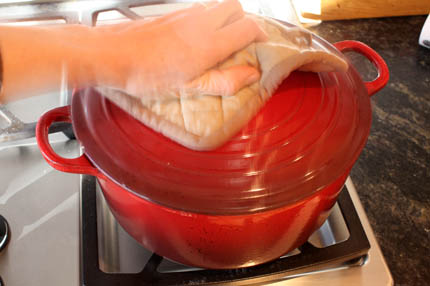
gluten-free-boule-09

Remove the pot from the oven and take off the lid.
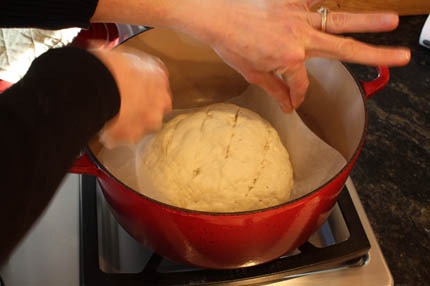
gluten-free-boule-10

Lift the bread on the parchment and VERY CAREFULLY lower the parchment and bread into the pot, replace the lid onto the pot. Return to the oven and bake for 20 minutes. After the 20 minutes remove the lid, turn the heat down to 450 and bake for an additional 15 minutes.

gluten-free-boule-11

Once the bread is done baking remove it from the pot using a spatula.
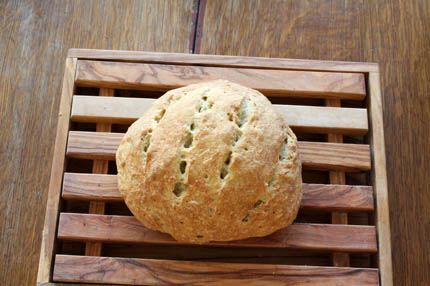
gluten-free-boule-12

Allow the bread to cool completely before eating or the center may seem gummy.
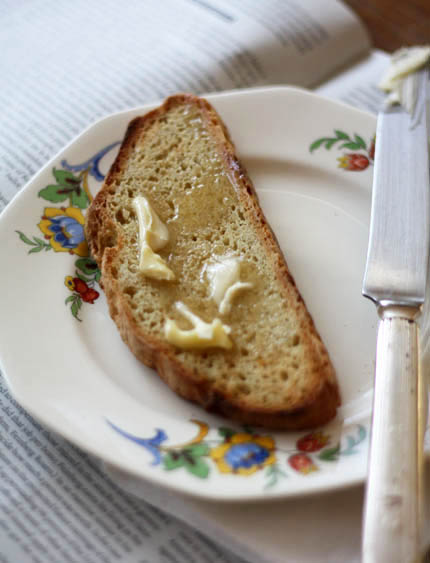
gluten-free-boule-141

The loaf is also wonderful toasted and served with butter and marmalade. Enjoy!

To read an interview Jeff and I did about the gluten-free chapter of HBin5 visit Wasabimon.


Comments

Maria said...
January 5, 2010 at 8:37 am

The loaf looks perfect. I need to try a gluten free loaf!

Suzanne Jager said...
January 5, 2010 at 9:20 am

Have made my first batch of the Master Recipe and am getting a really dense loaf that doesn’t really rise when baking. I’ve followed the directions to a “T” and even left the loaf rise overnight, still after 35 minutes baking, bread was doughy and very dense. What am I doing wrong?

Lynn said...
January 5, 2010 at 9:36 am

I bought your new book and I love the gluten free bread recipes. These recipes have been going gluten free so much easier. I have tried 3 of the gluten free recipes from the book and all were great.

Krista said...
January 5, 2010 at 9:37 am

I’m SO thrilled to find this! I’m not gluten-free myself, but a dear friend is and this will be perfect. :-)

LJCohen said...
January 5, 2010 at 11:51 am

Thank you for posting this! Just sent 3 gluten intolerant friends a link to your blog. they’ve been very jealous of my bread baking. :)

By the way, I’ve been playing with a hybrid of the whole wheat from book 2 and the basic recipe from book one, adding 1 TB vital wheat gluten for each of the 3 cups of WW flour I use. It makes a reasonably healthy bread that my kiddos will also eat.

The art of compromise!

jeff said...
January 5, 2010 at 12:06 pm

Suzanne: You can’t let the loaf rise overnight, that leads to “over-proofing” where it collapses on itself. Stick with the recommended resting times (90 minutes for the whole grain loaves; assuming that’s what you’re baking, from our second book). Other suggestions about dense crumb: http://www.artisanbreadinfive.com/?p=141. And make sure you’re not using bleached flour, which doesn’t work in our recipes.

LJ: Sounds like a great variation! Jeff

jjmcgaffey said...
January 5, 2010 at 12:48 pm

Another printing error – I’m making the Whole-Grain Garlic Knots with Parsley and Olive Oil, and while there’s Parmesan in the ingredient list it never says what to do with it. I’m going to mix it in with the drizzle, so it’s like a lightly cooked pesto – I could also see sprinkling it over the knots after drizzling.

This is my first baking from the Master Recipe in HBin5. When I pulled the dough out of the bucket, there was basically no gluten development – didn’t need to cut the dough at all, it just tore right off. The first couple knots are very sticky and sloppy, too. I used a little more (white) flour in shaping the later ones and they look pretty good. I made the dough with KA Unbleached, KA White WW, and some very old vital gluten – I think I bought it within the last 5 years but I couldn’t swear to it. Does VWG ever go bad? It rose very nicely in the bucket before I refrigerated it, and then I didn’t use it for three days. I don’t know, it may come out fine. When I was rolling the ropes for the knots it was holding together nicely, even the overly sticky ones – never threatened to break up.

Suzanne Jager said...
January 5, 2010 at 3:02 pm

Jeff, thank you for your reply!! I’ve made a second loaf today and let it rise for 90 minutes, baked it, and just now took it out of the oven, after 40 minutes! I can tell it’s still doughy inside. I’m not a beginner to making bread so I know I’m doing everything as your recipe states (except for overnight rising!). My daughter in Iowa, who bakes bread more than I do, is having the same problem. I will try the refrigerator rising tomorrow and pray it works. Any more suggestions?! Thank you.

jjmcgaffey said...
January 5, 2010 at 3:03 pm

And now I’ve baked the rolls – and they’re great! Lovely open crumb, crunchy crust, and no particular difference between the first sticky rolls and the later smoother ones. Gonna make pizza with the dough, now.
Link to a picture of the unstretchy dough, and the baked crumb: http://bluepegasuscc.com/gallery2/v/Baking/

Patti said...
January 5, 2010 at 7:48 pm

I’m one of the folks that requested the gluten-free recipes. :) My son-in-law has celiac disease and I bought your new book for him and my daughter…as well as one for myself. They love the G-F recipes! They are both very busy people and having the bread dough ready in the fridge is a real time-saver. Now my SIL can have his gluten-free bread and my daughter can have her whole wheat. Thank you for listening!!

Patti

zoe said...
January 5, 2010 at 8:05 pm

Hi jjmcgaffey,

Believe it or not it sounds like your dough may have been too dry, which is why you had little gluten development. With the use of KA flours and the vital wheat gluten your flour may have absorbed quite a bit of the water. Having said that the whole wheat doughs don’t have quite the same gluten development as the Master recipe made with all-purpose flour. Did you check our videos for HBin5 to see if your dough looked about the same.

Thank you for bringing the knots to our attention, we will get it added to the error page!

Thanks, Zoë

zoe said...
January 5, 2010 at 8:24 pm

Hi Suzanne,

I’m assuming that you are referring the master recipe in HBin5? If your dough is too dry you will not get a good enough rise on the bread and it will come out dense. On the flip side if it is too wet your loaf will have too much moisture and come out too doughy. When you work with the dough does it keep a good shape to it? Have you had a chance to check out our videos about the bread? They may be helpful to see if your dough resembles what we are working with the in the video.

One issue that experienced bakers sometimes run into with our method is over handling the dough when you are shaping it into the loaf. It is crucial to our method not to over handle the dough or you will knock out all of the bubbles in the dough. These bubbles are what allow the dough to rise nicely.

If everything seems in order and you still are not getting the loaf you like you may consider adding more vital wheat gluten and a touch more water. This will give the dough more structure and allow it to rise better. Not too much or it will start to get tough.

You can also try the overnight refrigerator rise that you mentioned. Lots of things to try. Keep us posted!

Thanks, Zoë

zoe said...
January 5, 2010 at 8:27 pm

Hi jjmcgaffey,

Now that I’ve seen the pictures of your dough I would say that it is a touch too dry, which is why you are not having the gluten development that you expect. Next time use a touch more water. This will require you to use more flour when shaping, but you will get a nicer dough.

Having said that if you are perfectly happy with how they came out you may not want to change a thing! Enjoy! Zoë

zoe said...
January 5, 2010 at 8:49 pm

Hi Patti,

I am so thrilled that your family is using the g-f recipes.

Thank you so much for the suggestion and the lovely note!

Zoë

Jeanie said...
January 5, 2010 at 10:30 pm

Wonderful flavor and texture. My only addition is to cool the loaf in the oven so that it stays as fluffy as possible and does not fall. Just turn off the oven, open the door and let the loaf cool more slowly.

Bill said...
January 6, 2010 at 6:46 am

I love your recipes. My wife and I made the Apples and Honey Grain Challah. Ours spread out quite a bit. It’s delicious, but it really didn’t hold its shape. I noticed that it called for a 1/4 cup oil more than the Braided Challah. Would it be possible to decrease the oil in the Apples and Honey Grain Challah to help it keep its shape?

jeff said...
January 6, 2010 at 6:52 am

Jeanie: That sounds like a great suggestion, must try that. Jeff

jeff said...
January 6, 2010 at 7:05 am

Bill: For any number of reasons, sounds like your dough is too wet. So yes, decreasing hte oil might very well help. Be sure you’re using unbleached, not bleached flour for the all-purpose (bleached doesn’t absorb enough water). Jeff

Flo Makanai said...
January 6, 2010 at 9:18 am

Thanks a lot for posting that recipe! I am not gluten intolerant and my bread baking involves sourdough which reduces the gluten intolerance risks BUT I love to bake differently and I think everyone’s health would benefit from a lower gluten overall diet.
And, as you already know it, I’m a huge fan of your wonderful work around bread baking! THANKS to both of you and, from my snowy countryside in France, all my best wishes for 2010 for your and your families :-)

zoe said...
January 6, 2010 at 2:46 pm

Thank you so much Flo,

Enjoy all the baking and bread! Stay warm.

Zoë

Cynthia T said...
January 6, 2010 at 3:47 pm

G*d BLESS You!!! I LOVED your original recipe, then I had to go GF and I’ve been truly missing good bread.
I can’t wait to try this. Thank you, thank you, thank you.

A thousand times THANK YOU!!!

JT said...
January 6, 2010 at 6:01 pm

Great job guys. I haven’t tried this master recipe but my GF wife is fired up about how good the brioche is.

Cynthia T said...
January 6, 2010 at 7:59 pm

Question: can egg replacement be used in place of egg? We’re allergic to egg as well as gluten…

Stephanie said...
January 7, 2010 at 7:44 am

For those of us in-between (no wheat, but gluten is okay), can you also do some additional playing with replacing wheat flour with spelt, rye, teff, etc? I just got turned on to your system, and make a spelt-based boule and spelt/rye so far. They’re delicious, but don’t rise much, so they come out dense instead of airy.
Even flawed, this is a life-changer! I’m going to make the pizza rolls!

CC said...
January 7, 2010 at 8:07 am

Yeah!! Amazon is now selling a great array of specialty flours in bulk, so get your baking friends together and order! Vital Wheat Gluten, Gluten free and specialty flours by Hodgson Mills, Bob’s Red Mill and others.
http://www.amazon.com/gp/search/ref=sr_nr_n_9?rh=n%3A16310101%2Cn%3A%2116310211%2Cn%3A16310221%2Cp_n_special_merchandising_browse-bin%3A492448011%2Cn%3A16317621&bbn=16310221&ie=UTF8&qid=1262875167&rnid=16310221

jeff said...
January 7, 2010 at 8:17 am

Cynthia: We haven’t tested the various egg replacement products. One that I’ve been meaning to try is on Amazon at http://www.amazon.com/gp/product/B000EDI2C6?ie=UTF8&tag=arbrinfimiada-20&linkCode=as2&camp=1789&creative=9325&creativeASIN=B000EDI2C6“>Bob’s Red Mill Egg Replacer, 16-Ounce Packages (Pack of 4)<img src=”http://www.assoc-amazon.com/e/ir?t=arbrinfimiada-20&l=as2&o=1&a=B000EDI2C6″ width=”1″ height=”1″ border=”0″ alt=”" style=”border:none !important; margin:0px !important;

jeff said...
January 7, 2010 at 8:19 am

Stephanie: In Healthy Bread in Five, we have a variation with spelt in place of the whole wheat, and we’re happy with it. Be sure to use a whole grain spelt, not a “light” variety, or it will be too wet. And you must use Vital Wheat Gluten for it to turn out properly. Spelt itself has some gluten, so this isn’t for celiacs and others who don’t do well with gluten.

Without VWG, they really won’t rise much at all. Jeff

Cynthia T said...
January 7, 2010 at 9:17 am

Thanks Jeff! Unfortunately that Bob’s egg replacer has wheat gluten in it. So it’s not an option for me. :o {

I’ll play around with it and see what happens. I just have to get one of those buckets.

Nance M said...
January 7, 2010 at 11:40 am

Was so excited to find more GF bread recipes…especially since I enjoyed the first book so much before diagnosis. The bread is rising well and has nice crumb and texture but feels ‘wet’ after baking. In fact, lay it on the bread board and it leaves a wet impression of itself. Only deviation from the recipe is I baked it in a bread pan as my DIL had my cast iron pot. Could THAT have been the problem?

jeff said...
January 7, 2010 at 1:47 pm

Nance: Doubt that’s the problem. Try using a little less water next time, or increase the baking time. Ingredients differ and that’s probably the issue. Jeff

Jane L said...
January 7, 2010 at 3:46 pm

No pre-heat oven, I saw posts on the The fresh Loaf about no pre-heating the oven before baking the bread. As we are trying to move to more green environment, I was wondering if I can do the same with the dough I make with ABin5 . Here are some links on the technique http://www.thefreshloaf.com/node/1843/no-knead-preheat [1]

http://www.thefreshloaf.com/node/3047/giving-no-preheat-try [2]

Stephanie said...
January 7, 2010 at 7:36 pm

Thank you for the response, but it sounds like I’m either out of luck or have to work on this on my own! I use spelt because I get ill from regular wheat. As such, VWG is not an option for me. I’ll try xanthan gum (couldn’t find it with the last batch I made, but just came across my bag), and see if it works.

Kurt said...
January 7, 2010 at 7:41 pm

My brother-in-law was in town for the holidays and he is Celiac. Looking through my new gift (HBin5), I spotted the gluten-free breads. Naturally I bought all the fixings and made him the boule (which he at most of before dinner) and then I had put together the gf brioche. With the brioche I rolled it and spread a cinnamon/sugar/butter mixture. Then rolled it back up, shapped it and plopped it in the brioche mold I also got as a gift. I sent that home with him because we made it the last day we were here. My wife says he is savoring 1 piece a day! Also took the brioche dough and made beignets with it. One of the things he missed most was doughnuts… I think he ate 10 :) Lastly we used the other half of the gf boule for a pizza crust. I used a little brown rice flour to help keep the dough from being too sticky for the pizza peel transfer, and it came out great. Had I not known it was gluten free, I never would have guessed. Anyways, it was a HUGE hit. Thanks so much for all the time and effort.

shauna said...
January 7, 2010 at 8:14 pm

I can’t believe I missed this until today! Thank you so much for the nod. We were THRILLED to help. The bread looks gorgeous, and we’ve made it several times on our own, long after the testing for you was done.

For people who are just finding this recipe, enjoy!

Karlynne said...
January 7, 2010 at 8:19 pm

Wow, this looks SO good! Can’t wait to try it!

Bron said...
January 7, 2010 at 8:54 pm

I’m so excited that y’all have written another breadbook that has GF RECIPES!!! WOO HOO!!! Thank you SO, SO much!!! I’m self-d’xed glutenfree, as of about 2 months, & have despaired of finding any good recipes for bread. I miss toast SO. MUCH. Maybe now I won’t have to! :-)
My question is: Can I bake this in either an 8×4 or 9×5 loafpan? My hubby & I don’t have the $$ to buy one of those fancy Dutch oven dealies, but I REALLY want to try the bread!
Thanks so much!!
Bron

zoe said...
January 8, 2010 at 7:09 am

Hi Jane,

This is a very interesting concept and one that appeals to our interest in saving energy. I’m going to try it out and see what I think. I don’t think it will work with a baking stone, because the stone will take too long to heat up and prevent the bread from baking well.

Thanks, Zoë

Pen said...
January 8, 2010 at 7:47 am

My 10 grain dough seems too dry. I’ll bake the first loaf but is there anything I can do to add liquid after 2 days in refrigerator?

jeff said...
January 8, 2010 at 7:59 am

Jane: I’m skeptical about how the crust will turn out, but I haven’t tested no-preheat myself, so I’ll reserve judgement. If you test our method with this approach, please post back to us on what you find. Jeff

jeff said...
January 8, 2010 at 8:03 am

Stephanie: That’s exactly what I was going to suggest, xanthan gum is in place of VWG. Use it the same way we do in our gluten free recipes, though you might be able to decrease it since spelt has some gluten in it. Jeff

jeff said...
January 8, 2010 at 8:05 am

Kurt: So glad to hear stories like this, we were relatively new to gluten-free baking and were on pins and needles as to whether people would have success with them. It’s a great story about your BIL, our best wishes to him… Jeff

jeff said...
January 8, 2010 at 8:06 am

Shauna: Your help meant so much to us, and the response from our readers has been terrific about these new breads (well, new to our world anyway!). Thank you again… Jeff

jeff said...
January 8, 2010 at 8:09 am

Bron: In the book, all our GF breads are done as free-form loaves, the website version uses the closed-pot method but it’s not by any means required, it just creates a really nice crust. I experimented for a while with loaf-pan breads as you suggest, and it works, but the center tends to be a little under-cooked– makes sure you’re done in the center. Given that, we opted for free-forms in the book, which tend to be smaller, for one thing, and all that nice surface area gives the heat a chance to drive off excess moisture. That doesn’t operate quite so well with a big loaf pan. Make small-ish ones, that’s one suggestion. Let us know what you find. Jeff

zoe said...
January 8, 2010 at 8:57 am

Hi Shauna,

Thanks to YOU and Danny for all of the advice and loving support as we figured out the art and science of g-f baking. The response has been so wonderful to this loaf!

xo Zoë

zoe said...
January 8, 2010 at 9:04 am

Hi Pen,

If the bread seems to dry you can add a bit of water to the mix and just let it sit for a while so the flour can absorb it before forming and baking.

Enjoy, Zoë

Mie said...
January 8, 2010 at 10:04 am

I just have a comment to Stephanie. Spelt is an ancient type of wheat. So if you want to avoid wheat you should not eat spelt.

carol c said...
January 8, 2010 at 10:20 am

I have one question but first would like to thank you for creating the wonderful GF recipes. It’s changed my life!! Simple to make and tastes great. This is dangerous. ;) Even my non-GF husband thinks the GF bread tastes great. He especially liked the pizza I made this weekend.

My question is: Is there supposed to be any “oven-spring” with the GF breads? My boules seem to be exactly the same size before and after baking.

Thanks, Carol

Frances said...
January 8, 2010 at 2:33 pm

My boyfriend’s sister bought me your first book before Christmas. This house has not been without fabulous fresh bread since.

I think I ‘ve blogged about your book 2-3 times already.

Can’t wait to try your newest book out.

Thanks so much!

Anne M said...
January 8, 2010 at 2:39 pm

Hi – Can you offer any comment on using Pampered Chef (PC) stoneware for baking using your method? I was introduced to your bread method a few months ago, and have made oodles of loaves…we love it!

I am also an avid PC fan and have several of their stoneware, some in use for 10 or 15 years or more. About a month ago, the PC stoneware pan I was using cracked while baking bread. Although it was only 8 years old, I chalked it up to use and ordered a new one, which was pressed into service about 3 weeks ago. While baking bread last evening, the ‘new’ one cracked. Perhaps this new one was defective (and the previous one only had a partial life)? but it seemed a bit coincidental, and I am curious if you’ve received enough feedback from other bakers to be able to comment.

I definitely want to continue making artisan bread, but I of course also want to preserve my PC stoneware. Is there another type of stoneware that is better? What about baking artisan breads on metal (regular or airbake) pans?

Any feedback you can give would be appreciated-thanks so much!

Margot Miller said...
January 8, 2010 at 6:43 pm

Anne M. I too am a PC fan also sold that great stuff. I’ve been using my PC pizza stone for ABin5 for months now with no problem. It’s well seasoned, as it seems yours was, having been used also formerly and currently for countless pizzas.

In fact it’s nearly black in color. The one I use for bread at our Maine house is also well seasoned. Electric here in FL and gas there in Maine. Go figure.

Zoe and Jeff, I was WONDERING what you guys would be up to next. Can’t wait to see the new book. Thanks again for the first two and for being so responsive here to your loyal fans. You have changed our lives!

zoe said...
January 8, 2010 at 9:34 pm

Hi Carol,

As you can see from my photos it grows a little bit, but not substantially. Do your loaves have a good texture or are they seeming a bit too dense?

Thanks! Zoë

zoe said...
January 8, 2010 at 9:52 pm

Hi Frances,

Thank YOU so much, we are thrilled that you are enjoying the book and all the bread you bake!

Zoë

zoe said...
January 8, 2010 at 9:56 pm

Hi Anne,

The baking pan we recommend is a non-stick metal pan. Our dough is so wet that we fear it will stick to stoneware baking dishes? I have not heard from anyone else who has had this issue, but I bet we will now that you have posted. I’ll let you know if we get any feedback.

Be sure to use a lot of grease on your pan when baking so the dough won’t stick!

Thanks, Zoë

zoe said...
January 8, 2010 at 10:17 pm

Hi Margot,

I just knew our readers would come to Anne M’s rescue. Thanks. Do you have any experience with the stoneware loaf pans from PC?

Glad you are enjoying all the bread! Zoë

Kelly said...
January 9, 2010 at 12:46 pm

Hello! I got my copy of HBin5 for Christmas and proceeded to undertake whole grain garlic knots with parsely and olive oil. I came across one error in the recipe – 2 T. of Parmesan are listed in the ingredients, but what to do with it is nowhere in the directions. I guessed and sprinkled it on the top before baking. My husband and I thought that tasted alright, but I would like to know your plans for it. Thanks!

jeff said...
January 9, 2010 at 1:30 pm

Thanks Kelly, others have mentioned as well… Jeff

Heather said...
January 9, 2010 at 3:44 pm

My 19 yo daughter is home on her college break. She has celiac so we are trying this bread today. I have the book, but looked up this site to find the dutch oven instructions..

I would like to know where you got that beautiful cooling rack. Is it availabe somewhere online?

carol c said...
January 9, 2010 at 3:46 pm

Hi Zoe,

My loaves have a great texture and do not seem dense at all. The sliced bread looks just like the one in the photo. So no complaints. Just was wondering about the oven spring. I tried a 1.5 lb piece of dough in a loaf pan and ended up with an oval boule, not a sandwich loaf. It never expanded to touch the sides of the loaf pan. No rising (to the naked eye, anyway). It turned out wonderful, too.

Carol

Cathie said...
January 9, 2010 at 5:44 pm

I’ve been using the PC stoneware for the breads for over a year now with spectacular success. I have used the rectangle baking stone, 9×13 pan with cover, deep dish baker with cover and mini deep dish baker with cover. The covered stoneware is a great alternative to the covered casserole dishes. The 9×13 accommodates a baguette or ciabatta loaf nicely. I also use it for rolls. The deep dish baker is great for a 1 1/2 lb boule and the mini deep dish baker is great for a 1lb boule.

Hope that helps!

jeff said...
January 9, 2010 at 7:04 pm

Heather: Well, it belongs to Zoe, but here’s something similar on Amazon: http://www.amazon.com/gp/product/B00029HBOW?ie=UTF8&tag=arbrinfimiada-20&linkCode=as2&camp=1789&creative=9325&creativeASIN=B00029HBOW“>Mountain Woods Multi-Purpose Cutting Board and Crumb Tray

jeff said...
January 9, 2010 at 7:05 pm

Carol: We’re finding that for most loaf pans you buy, they take closer to 2 lbs of dough to really fill the thing and reach the sides, and get tall. Oven spring is relatively modest for GF breads… Jeff

jeff said...
January 9, 2010 at 7:06 pm

Cathie: I’ve had very good success with stoneware covered vessels for baking, check out my post on this at http://www.artisanbreadinfive.com/?p=566. Different brand but I think they all work about the same. Jeff

Stephanie said...
January 9, 2010 at 7:22 pm

thanks to Jeff and to Mie. I am able to eat spelt, for whatever reason, without ill effect. It seems it’s not uncommon to be able to eat spelt, but be intolerant to regular wheat, farro and semolina/durham. (this is not true for celiacs, of course!)

I’ll try the xanthan gum on my next batch. The one currently “cooking” in the fridge will probably be pizza rolls! My children devoured the rye like crazy, rise or not.

Amy K said...
January 10, 2010 at 9:00 am

This is not a comment on a gluten free recipe ( haven’t tried them yet) but about my new favorite A/HBin5 loaf! I want to thank Betsy, wherever you are – Betsy’s Seeded Oat Bread p.147 in HBin5 is the the best bread I have baked from both books. It was wonderful last night with homemade chicken soup and heavenly this morning as toast. For whatever reason, the loaf spread a bit (side-ways oven rise/spread?) but that just gave me more of that crunchy mouthwatering crust! I topped mine with poppyseeds (due to an Amazon ordering error I now have 4 lbs of poppy seeds!) – likely many upcoming breads will be poppyseeded. I am about to bake a quinoa loaf today and will report my results. (since the oven and the stone is hot, I think a second Betsy’s loaf is in order, too. FYI-I have been using the upside down aluminum pan for my “cloche” and it is very easy and seems to work quite well crust-wise.

Anna said...
January 10, 2010 at 10:12 am

I love you guys. No, seriously.

I just baked my first loaf today after mixing the dough yesterday. I thought the dough and boule was WAY too wet, but I just trusted you. After baking it has amazing texture and crust. It’s not gummy at all and actually has TASTE, not like the cardboard crap you can get in the frozen food section at the store.

I can’t thank you enough. Love is what I’m feeling now. Seriously.

jeff said...
January 10, 2010 at 10:44 am

Amy: Yeah, Betsy was a winner, yes. She was a real help to us. Thanks Betsy, if you’re reading this. Jeff

jeff said...
January 10, 2010 at 10:44 am

Anna: You’re very, very sweet. Thanks so much…

Jeff

Margot Miller said...
January 10, 2010 at 11:33 am

Yes, Zoe, I’ve used my Pampered Chef loaf pan with ABin5 recipes. It was seasoned when I started using it with your recipes and I was able to bake without spraying or greasing the pan. My loaves pop right out, with no sticking.

Kelly said...
January 10, 2010 at 1:42 pm

Thank you SO MUCH for sharing this recipe! not only am i exited at the prospect of baking bread again, but oh my goodness, this is the most amazing bread I’m ever tasted — not just in the 3 1/2 past years without any bread.

I now can’t wait to get the new book in and find the other gluten-free goodies you have hiding in there. And I’m sharing this post with everyone I know right now! Thank you, thank you, thank you!

(and thank you Shauna for sharing the link on Twitter to this!)

Amy K said...
January 10, 2010 at 2:10 pm

Quinoa loaf is wonderful – highly recommended!

zoe said...
January 10, 2010 at 7:41 pm

Hi Margot,

That is fabulous to hear, sounds like a great product!

Thanks, Zoë

zoe said...
January 10, 2010 at 7:43 pm

Hi Kelly,

Thank you, your note was wonderful to hear. We are so thrilled that you are enjoying it so much!

Cheers, Zoë

zoe said...
January 10, 2010 at 7:49 pm

Thank you Amy! :) Zoë

Jill Flecher said...
January 11, 2010 at 2:34 pm

HOT CROSS BUNS – can you come up with a recipe – PLEASE

Barb said...
January 11, 2010 at 2:52 pm

I have a gluten intolerant friend and stumbled upon this recipe. I went out and bought the book this past weekend and made the Olive Oil Gluten free bread. OH MY GOSH!! I was totally amazed at the taste and the texture. I did bake it in the pot with the parchment and I think that really made the difference. Thank you so much for a wonderful recipe. Can’t wait to try more of the recipes.

zoe said...
January 11, 2010 at 10:28 pm

Hi Jill,

Are you looking for a g-f recipe for hot cross buns? If not, here is a recipe we did http://www.artisanbreadinfive.com/?p=571.

Thanks, Zoë

zoe said...
January 11, 2010 at 10:30 pm

Hi Barb,

I’m so thrilled! Did you use the Olive Oil dough from the book or the Crusty Boule and substitute olive oil?

Thank you so much for trying the recipe! Zoë

Linda R. said...
January 12, 2010 at 2:12 pm

Jeff and Zoe – so after baking your wonderful breads for a year, I now have to go gluten-free for a while to see if gluten is an issue for me. I despaired for I love the ABin5 loaves, but your gluten-free chapter in HBin5 looks promising. Thank you for putting this chapter in!

I wasn’t able to find all the flours for the gluten-free loaf in my local store, but I was able to get teff flour. I’ve just tasted my first gluten-free loaf (the not rye), and it’s pretty good. The taste is quite good, but the loaf is pretty dense and a bit crumbly. Suggestions for improvement? I also was able to buy quinoa flour, but haven’t yet figured out the different gluten-free flours and which can replace each other. Any suggestions you have from your experiments would be appreciated!

Beth said...
January 12, 2010 at 2:50 pm

How would I go about making dinner rolls using the GF Boule recipe? Is it as easy as I’m thinking–pull out small pieces from the master loaf and let them rise and cook similarly to a full loaf?

zoe said...
January 12, 2010 at 9:57 pm

Hi Linda,

The gluten-free flours not only have incredibly different flavors, but they also behave very differently in the recipes. I’m not sure from your note if you were able to find all the flours you need for the mock rye or just the teff. If you made substitutions you may want to give it a try again once you find the other flours. It is less convenient, but I believe you can find them online?

Thanks, Zoë

zoe said...
January 12, 2010 at 9:58 pm

Hi Beth,

That is exactly what I would do. Depending on how small, you may only have to let the rest for half the time listed.

Thanks and let me know how that goes! Zoë

Beth said...
January 13, 2010 at 2:41 pm

I’ll definitely let you know how it goes, Zoe!
I had another question–would you suggest storing the GF breads the same as their gluten counterparts? Or do they need to be stored differently due to them being GF?

jeff said...
January 13, 2010 at 3:12 pm

Beth: Storage is always the same for us– we always prefer to bake small loaves and replace often with fresh ones. But… if you want to store it, same instructions as for non-GF. The best way for same-day storage is cut-side down on a non-porous surface like a plate, synthetic cutting board, or clean countertop. This preserves the character of the crust, at least a little. If you’re storing for tomorrow they seem to do better in foil or plastic, but that really softens the crust. Jeff

Beth said...
January 14, 2010 at 11:15 am

Now that I’ve made my first loaf, I cannot imagine the bread will stay around long enough for storage to be an issue. The GF Boule is absolutely wonderful!!! I had become very discouraged with the recipes and mixes I’ve tried for GF breads. But this one–it’s a keeper! After the first bite I knew because I immediately wanted a second bite. The sandwich I had for lunch was the first sandwich in two years that I’ve gotten excited about. Sad that it had to be that way, but great for those of us who’ve found our way to your book!
Next up is using the dough for pizza crust this weekend. And once I use up the Boule master recipe, I’ll be trying the Mock Rye. I miss rye so much!
Thank you, Jeff and Zoe!

zoe said...
January 14, 2010 at 3:46 pm

Hi Beth,

Thank you, it is a thrill to read your note. I am so pleased that you are excited about your sandwiches again! :)

You are going to love the rye!

Zoë

kate said...
January 15, 2010 at 10:04 pm

I am so very excited about this! I’d been pining over pictures friends have taken of bread they’ve made from the book, and I had no idea there was a GF chapter. Thanks for publishing this recipe, I’m not sure I’ll buy the whole book just for one chapter (my kitchen is completely gluten free, so I’ll never use the rest of the book), but this is something I can use… and will tomorrow! Thank you thank you thank you! :D

Rosann said...
January 16, 2010 at 1:29 pm

Have successfully baked the whole grain master recipe then tried the 10-grain bread and was disappointed. The 10-grain was very heavy, and rose very little. Any suggestions?

zoe said...
January 16, 2010 at 2:26 pm

Hi Kate,

Enjoy the bread! There are sweet doughs, pizza and a variety of other gluten-free breads in the book. Mostly wheat, but that chapter stands alone. Perhaps check it out from the library and see what you think!

Thanks, Zoë

zoe said...
January 16, 2010 at 2:37 pm

Hi Rosann,

It sounds like your dough could be too dry. Just try adding a few tablespoons to the remaining dough and see if that helps the rise. After you add the water let it sit for a while so the flour can absorb it.

Let us know if that does the trick.

Zoë

jon said...
January 17, 2010 at 10:16 am

Can I make this without yeast? How?
Thanks

zoe said...
January 17, 2010 at 1:45 pm

Hi Jon,

I have not yet tried using a natural sour starter with this recipe. you would need to add about a cup of your starter and replace some of the water and flours to account for it. Here is a post about using starters for the wheat breads, which may give you some help as you experiment. http://www.artisanbreadinfive.com/?p=1284

Thanks and let me know how it goes if you try it.

Zoë

Leonnie said...
January 17, 2010 at 3:58 pm

Like Stephanie, I’m wheat-intolerant but not gluten-intolerant, and it’s really hard to find recipes to suit. It’s always assumed that if you can’t eat wheat it means you are gluten-intolerant. And like Stephanie I also can eat spelt. I have been buying some lovely breads which do suit my needs but they are incredibly expensive, so I bought the two Bin5 books to try to start making my own, so would love some advice on how to fully substitute the wheat ingredients with spelt, rye, etc. Stephanie, have you tried the xanthan gum yet?

Tina9 said...
January 17, 2010 at 5:12 pm

I tried baking 2 lbs of this dough in a 9×5″loaf pan and as others have mentioned it doesn’t get much rise so I had a very thin loaf. I’m going to try it again with 3 – 4 lbs of dough and see if it will cook through so I can have a full sandwich size loaf. Do you think this will work? Or am I going to end up with a gummy mess that is overcooked on the outside?

Franca said...
January 17, 2010 at 6:26 pm

A friend gave me the link to your site and the GF boule recipe. I am hoping to try it in the next week or so, but am wondering … I have two cast iron dutch ovens, one enameled (similar to your Le Creuset only different brand with molded handle) and one plain old seasoned cast iron. Does it matter which one I use? I think the seasoned cast iron might be more “nonstick” than the enameled one, but not sure. I just have to find myself one of those round lidded plastic containers and make room in the fridge for it (easier said than done, LOL) and then I should be set to go. Can’t wait to try making the GF boule — thank you for posting the recipe!

Rebecca said...
January 17, 2010 at 6:49 pm

Loved your original recipe, but had to give it up when we opted to make our household gluten-free for my little boy who has celiac. So eager to try out this recipe!

Unfortunately, my former dutch oven substitute (an old crockpot with glass lid) met an untimely end when it fell off the shelf in the pantry.

How would I go about baking this free-form? Do I still need parchment paper? Start with a hot oven? And what temperature?

Thanks!

jeff said...
January 17, 2010 at 8:36 pm

Leonnie: Depends on what you are intolerant of. If it’s gluten, spelt may bother you as well since there’s gluten in it (though less than wheat). And you should be able to use xanthan gum to bolster structure in low-gluten flours like spelt. As you’ve noticed, the 100% spelt recipe in our book has vital wheat gluten, so if it’s gluten that you can’t use, this isn’t going to be for you. Ought to work well with xanthan gum but haven’t tried it myself… Jeff

jeff said...
January 17, 2010 at 8:42 pm

Tina9: I’m always happier in our method when I make smaller loaves, they bake through better. Are you giving a full 90-minute resting time? Which of our recipes are you using?

Short answer: I’m with you, worried about gumminess for such a big loaf done in a loaf pan (which prevents the dissipation of internal moisture).

I use a smaller loaf pan, filling it 3/4 full to get a nice domed result, see http://tinyurl.com/c826ua, that’s the size I use.

jeff said...
January 17, 2010 at 8:43 pm

Franca: Either the Le Creuset or the seasoned cast iron work great, without sticking, doesn’t make much difference. Jeff

jeff said...
January 17, 2010 at 8:45 pm

Rebecca: Parchment is nice but not absolutely necessary. In the book we specify parchment or cornmeal, and baking at 450 degrees with steam (start with a hot oven with a baking stone in place for best results. Jeff

Rebecca said...
January 18, 2010 at 6:52 am

Ok, I’m planning to give this a try later today with a silicon mat (warn me if this is not a suitable choice, and I’ll switch to parchment!) and will stick a pan of water on the bottom shelf. Improvising as always, for lack of equipment. :)

I swapped out the brown rice flour for millet, because I am never happy with brown rice flour in bread for some reason. Millet usually gives me a great loaf, so I’ll report back on this experiment later tonight!

Becky H said...
January 18, 2010 at 12:20 pm

I am interested in knowing whether you might be working on developing or adapting some recipes to be low-carb varieties?

Thanks!

zoe said...
January 18, 2010 at 12:59 pm

Hi Rebecca,

I’ll be very interested to hear how your dough comes out. I find that the gluten-free flours have such different personalities in terms of their flavor and baking properties. I’ve never tried to substitute with millet. Let me know how your results are.

You can use a silpat, you just might need to take the loaf off at the end to crisp up the bottom crust.

Thanks, Zoë

jebyrnes said...
January 18, 2010 at 1:23 pm

A really interesting loaf. The flavor of the sorghum flour was really intense, and I liked it quite a bit. Are there other ways to incorporate sorghum flour or brown rice flour into other recipes in your books (even ways with gluten)? For example, could you substitute some sorghum flour into a regular loaf instead of some of the normal flour, and add extra gluten? I’d love to bake with them a bit more and see how their flavors influences other breads.

zoe said...
January 18, 2010 at 1:51 pm

Hi Becky,

Using the 100% whole grain recipes would be the closest that we have come up with so far. All flour is high in carbs so it is hard to bake a great bread without them. Adding some soy flour and other flours that are high in protein can be helpful as well.

Thanks! Zoë

zoe said...
January 18, 2010 at 1:53 pm

Hi Jebyrnes,

We have not played with it yet, but I think it is a great thing to experiment with. You are exactly right about needing to add more Vital wheat gluten to make up for the fact that sorghum has no gluten at all.

Please let us know how your experiments come out!

Zoë

Leonnie said...
January 18, 2010 at 3:40 pm

Thanks, Jeff. I guess I may have used the wrong thread for my query because I’m not gluten intolerant, but purely wheat-intolerant. Therefore it’s the wheat content of the vital wheat gluten that is the concern, not the gluten. I’m fine with spelt, so if I substitute xantham gum in the spelt recipe can you suggest how much to use, and do you think it would be the same for any other flours I substitute for wheat, such as rye?

jeff said...
January 18, 2010 at 10:24 pm

Leonnie: Ah… I’m guessing that you won’t quite need a full dose of xanthan gum, since there’s some gluten in spelt. In GF recipes, we call for 2 T; I’m guessing that you can probably get by with 1 T, but this is going to take some experimentation. Jeff

Diane said...
January 20, 2010 at 6:54 am

I’m anxious to try this recipe, however I don’t have a dutch oven and will be baking it in the stove. Do I cover it? What degree would I set the oven to?

zoe said...
January 20, 2010 at 7:52 am

Hi Diane,

There are instructions for baking in the oven in the book, this was just to give an alternative method. They are in the g-f chapter on page 235.

Thanks and enjoy! Zoë

Diane said...
January 20, 2010 at 11:27 am

I did not buy the book yet – I wanted to try the recipe out first.

Jane Oswaks said...
January 20, 2010 at 1:08 pm

I’m looking at the Gluten Free Crusty Boule step-by-step recipe on the website and it calls for 2 tablespoons honey or sugar in the ingredient list, but it is never part of the recipe????

zoe said...
January 20, 2010 at 1:58 pm

Hi Diane,

Sorry, I misunderstood.

We bake at 450 degrees for 30 minutes. Usually on a baking stone, but you can use a cookie pan. No need to cover it. Place a pan (not glass) under the baking stone (at least 4″ away) and add a cup of hot water to it when you put the loaf in the oven to create steam.

Hope that helps, enjoy! Zoë

zoe said...
January 20, 2010 at 2:01 pm

Hi Jane,

Thanks for pointing that out. It doesn’t really matter when you add it once you start to put in the wet ingredients. I usually add it with the oil. I will add it to the post.

Thanks, Zoë

Jane Oswaks said...
January 20, 2010 at 8:00 pm

Thanks Zoe; I’ve just had my first slice and it is really, REALLY good; nice, crunchy crust….great flavor! I’m buying your book….I’m sold! Kudos to you two!!1

Stephanie said...
January 21, 2010 at 5:06 am

Leonnie, I did use xanthan gum (1 T) but I made a mistake when setting it out to rest, so I can’t quite answer whether it worked yet! I covered it wth plastic wrap but failed to flour the top of the loaves first, so some stuck to the wrap. On the up-side, I could see the holes I’d broken when pulling up the plastic, and the loaves looked just like the non-xantham ones (not much rise, but delicious). So I’m hopeful that if I’d not screwed up it would have risen.
I also had forgotten Jeff’s statement not to use any refined spelt–I’d been using about 2c of white and won’t in my next batch.

Diane said...
January 21, 2010 at 6:53 am

Thanks, I can’t wait to try it!
Also, is your book all gluten free recipes, if not, how much is dedicated to gluten free? My kids must eat gluten free so I bake only gluten free..

Bridge said...
January 21, 2010 at 11:52 am

What recipe do you suggest as best for making soup bread bowls?

zoe said...
January 21, 2010 at 12:41 pm

Thanks Jane,

I’m so thrilled that you tried it and are enjoying the bread!

Happy Baking! Zoë

zoe said...
January 21, 2010 at 12:49 pm

Hi Diane,

There is one chapter dedicated to the g-f recipes, but I think you will be very pleased and we are coming up with additional recipes using those doughs on this website.

Enjoy the bread! Zoë

zoe said...
January 21, 2010 at 12:55 pm

Hi Bridge,

Are you looking for a g-f recipe to use? If so, I’d use this crusty boule or maybe the mock rye depending on the soup?

Thanks, Zoë

b said...
January 21, 2010 at 5:31 pm

2 quick questions about the GF Boule:

1. any reason I can’t set it up around 11am or noon and leave to rise for ~5 hours instead of 2? I know this is okay with the regular breads but this will be my first GF attempt.

2. I want to try a half-recipe in one loaf (e.g. about 3C flour) and bake it in my 5qt cast iron pot. Any idea on baking time? I’m guessing more like 45 minutes total (at 450F) instead of 35 min.

I’ve also used a thermometer and tested for about 210F internal temp. Is that a good rule of thumb for the GF loaf?

Was so happy to get your second book after I loved the first one. Thanks for keeping up with it!

b

jeff said...
January 21, 2010 at 8:39 pm

b: The risk is that it will overproof– rise to a maximum and then start to collapse. This could be a bigger risk with GF breads, because they don’t have as good an internal structure in the first place.

Second q: Yes, bigger loaves need more time. But check your oven temp, things scorch if the oven’s running hot and you’re using cast iron.

I’m a little flummoxed by the question about internal temp. For wheat-based lean breads, the rule of thumb is 205 degrees. But for wheat breads enriched with eggs, we usually say 185 degrees. All our GFs have plenty of eggs— but if you liked the result at 210 degrees, I guess I wouldn’t argue with success! Jeff

b said...
January 21, 2010 at 10:41 pm

Thanks for the info. I should have clarified about the temp. I was referring to regular breads like the basic recipe in your first book, not enriched breads. I’ll shoot for 185 degrees and only rise it for 2 hours plus the 40 min or so after shaping (no fridge in the middle).

rolf said...
January 25, 2010 at 5:12 am

I look forward to baking this bread, but following the book’s recipe -using a pizza peel and baking stone, rather than a $230 Dutch Oven.

zoe said...
January 25, 2010 at 12:37 pm

Hi Rolf,

Both methods work really well! Enjoy the bread.

Thanks, Zoë

Allyson said...
January 27, 2010 at 11:14 am

I am on my second batch of GF olive oil dough, I use my mixer to mix the batter and I can’t create a smooth dough without lumps. What am I doing wrong? Please help!

zoe said...
January 27, 2010 at 12:55 pm

Hi Allyson,

You want to mix the wet into the dough very slowly. I sometimes as some and incorporate to make the dough into a paste like batter and then continue to add the rest slowly.

I hope that helps? Zoë

leigh said...
January 31, 2010 at 12:40 pm

want to make gf free pizza crust: can I roll the dough onto parchment paper & build pizza on parchment paper & put it parchment paper built pizza on top of pizza stone to cook.

That is what I did for gluten pizza crust. don’t have to worry about getting it off peel onto stone this way.

zoe said...
January 31, 2010 at 2:44 pm

Hi Leigh,

You can absolutely use parchment when rolling out the dough and baking the pizza.

Enjoy, Zoë

Lisa said...
February 1, 2010 at 11:07 am

Love your HBI5 gluten free breads. I have missed breads so much. GF Olive oil bread makes great pizza crust! My problem is when I make the boule bread, it is so wet I can’t form it at all and just pour it into a1.5 qtglass bread pan. I followed the recipe exact. And when I put it in the pan, it takes almost the full recipe to make a sandwich size loaf. What am I doing wrong, I would like to try the free form loaf on a stone. And get more than one loaf out of a batch? Thank you again for the delicious recipes! Lisa

jeff said...
February 1, 2010 at 10:46 pm

Lisa: any chance you are using white rice flour instead of brown? That doesn’t absorb enough water and you end up with a dough that’s too wet. Also, that pan is designed to make loaves that are bigger than 1 pound, as the recipe specifies. Jeff

Samantha said...
February 2, 2010 at 9:15 am

Hello- I was curious, do you have to cook the boule in the dutch oven?

Lisa said...
February 2, 2010 at 10:46 am

Jeff, No I’m using brown rice flour. If I can get the dough so I don’t have to pour it into the pan, but mold it into a loaf I will use the baking stone. Should I decrease the water or increase the flour? If the flour would it be the brown rice? Thanks, for your help.

Jessica said...
February 2, 2010 at 1:24 pm

Every Dutch Oven I see say heat resistant up to 400 degrees. Even the one linked to here. Is it only because of the knob? Do all Dutch Ovens have the option of replacing the knob? I am so eager to try this!! I am little thrown by the price , but figure it is a good investment.

jeff said...
February 3, 2010 at 12:52 am

Lisa: Increase the flour in quarter cup increments and see what happens. Jeff

jeff said...
February 3, 2010 at 12:53 am

Samantha: No, you can also do it on a baking stone, cookie sheet, or silicone mat. But then you have to get steam into the oven with one of our other methods. Jeff

jeff said...
February 3, 2010 at 12:56 am

Jessica: If the knob is held in place by a single screw (not a rivet), it should be replaceable, but check with the manufacturer. Cheaper option is the un-enameled cast iron, check that out too. Jeff

Heather said...
February 3, 2010 at 1:33 pm

Just linked to your website from Gluten-free girl and I am so stoked to try your bread recipe. Does your book have lots of GF recipes?
So excited, thank you so much!

zoe said...
February 3, 2010 at 2:08 pm

Hi Heather,

Isn’t Shauna’s loaf gorgeous! The book has a chapter on G-F breads. We give you several master recipes and many ideas of things to make with them. The beauty of our method is that you have a big bucket of dough and then can play and make it your own, as Shauna did in her post.

Enjoy! Zoë

Sandra said...
February 3, 2010 at 8:51 pm

Hi – Just curious about an ingredient – could guar gum or agar agar be used in place of xanthan gum?

Sandra said...
February 3, 2010 at 8:53 pm

Just thought of another substitute possibility for xanthan gum – flaxseed meal?

Heather said...
February 4, 2010 at 12:13 am

I commented earlier today and I just have to let you know that I made the bread and I am in heaven! So yummy and best part is that it holds together when you slice the loaf. I managed to thinly slice a piece off and wow, it’s a beautiful thing. Going to try fig and fennel in the next loaf, can’t wait!
Thank you so much again.

jeff said...
February 4, 2010 at 12:41 pm

Sandra: I don’t believe so. And flaxseed meal absolutely will not work.

Claire said...
February 4, 2010 at 10:13 pm

Hi: Has your website changed in the past few days? It seems like I sent a question from your contact page a day or so, but now that way of asking has changed? I’m not sure where my question is now. My question was, if I made the gluten free boule, can I bake it in a loaf pan with a softer crust? What temperature would I use and for how long? (in other words, not using the steam method)

Thank you,

Claire

anemic said...
February 5, 2010 at 9:34 am

Has anybody used the Gluten Free Master recipe, or the GF Brioche recipe to make dinner rolls? I shall try this out & would appreciate learning from someone who may be able to save me a mistake or three. Thank you for the GF recipes in the second book. We loved the first book just as GF found it’s way into our lives. Very helpful!

zoe said...
February 5, 2010 at 9:53 am

Hi Claire,

You can bake the g-f loaf in a pan and skip the steam, this will result in a softer crust. If you brush the top of the loaf with butter or olive oil when it first comes out that will also help get you a softer crust. The brioche recipe is a very soft loaf and may be more to your liking if you are looking for soft sandwich bread?

Thanks and enjoy! Zoë

zoe said...
February 5, 2010 at 10:04 am

Hi Anemic,

You will shape them just as I have in this post, but smaller. Cut the resting time before baking to about 20-30 minutes, depending on the size of the buns. Bake for about 18 minutes or until nicely browned and crusty.

Thanks, Zoë

Annie said...
February 5, 2010 at 1:56 pm

OMG OMG OMG.

I was insanely jealous (that may actually be an understatement–just ask my non-GF foodie friends) when I heard you guys talking about your Artisan Bread in 5 Min a Day book on the Splendid Table. And then the other day, I was reading Shauna’s Gluten Free Girl and the Chef blog and I about shot out of my chair and ran to the kitchen to try out this recipe!!

Thank you thank you thank you for a) collaborating with Shauna and Danny, because if they’ve contributed to/given their blessing to a GF recipe I know it’s worth trying, b) creating a recipe that does not require that I take apart my kitchen, get out the stand mixer, buy a bread machine, and throw bizarre quantities of five different obscure flours around, and c) creating a recipe that produces not only a not-effed-up bread, but a DELICIOUS OMG CRUSTY I-CAN-DO-ANYTHING-WITH-THIS-BREAD bread!!

Seriously. I’ve tried a lot of recipes using premixed flours (all have seemed a bit “off” to me) and mixing my own flours (which gets expensive!). You used only 3 flours. And no big or crazy gadgets. I used, like, 2 bowls and a spatula (plus measuring utensils) to put the dough together. I made my loaf on a baking pan with parchment paper and a cup of water in a pie pan to create steam. Oven at 450 for 30 minutes. And I’m afraid I’m going to eat the whole thing this afternoon.

My copy of the book should be arriving at my doorstep in 4-6 business days. :)

I love you.

Yay!!!

Thank you thank you,
Annie

Claire said...
February 5, 2010 at 3:24 pm

Today I baked the g-f boule in a 8 1/2 x 4 1/2 inch pan and did butter it per your suggestion when it came out of the oven. Does it not raise very much? Also, should the texture be rather gummy? I cooked it to 195 degrees. Thank you,

Claire

jeff said...
February 5, 2010 at 8:49 pm

Annie: I’m speechless. And that’s saying something. Jeff

jeff said...
February 5, 2010 at 8:53 pm

Claire: That loaf was designed as a free-form, one-pound loaf– why don’t you try it that way a few times, get used to the method, and see what you think? Loaf pans always take longer to get the gumminess out of them– that size makes something much bigger than 1 pound, depending on how much you put in. Also, don’t eat them warm, that exaggerates the gumminess problem.

But don’t expect the rise and loft you see in wheat breads. Jeff

Jess said...
February 6, 2010 at 9:53 am

Can I use instant yeast?

zoe said...
February 6, 2010 at 11:43 am

Hi Jess,

You can use active or instant yeast, it doesn’t seem to matter in our recipes. Any kind of yeast works.

Thanks, Zoë

Claire said...
February 6, 2010 at 10:53 pm

I will make the boule again, free form.

Can I make the raisin bran bread gluten free? I have rice bran.

Thank you,

Claire

Lisa said...
February 7, 2010 at 10:53 am

The question from Sandra about guar gum instead of xanthan gum, I was told at our health food store that guar gum works as a binding agent like xanthan gum and can be substituted. Guar gum is less expensive than xanthan, and with the expense of GF flours and all…..You can look up guar gum and it tells you the amounts to use for whatever your baking. Lisa

Sandra said...
February 7, 2010 at 12:12 pm

Thank you for the tip Lisa.
Sandra

zoe said...
February 7, 2010 at 1:39 pm

Hi Claire,

You can certainly add raisins to the dough and make it into raisin bread, sounds great!

Thanks, Zoë

zoe said...
February 7, 2010 at 1:41 pm

Hi Lisa,

I tested a batch of dough using both guar gum and xanthan, but not just guar gum. It is worth a try. Please let me know what you find.

Thanks, Zoë

Peter said...
February 7, 2010 at 2:11 pm

Thanks so much to you and the GF Girl for this recipe. My daughter is celiac but the whole family LOVES this recipe! It’s hard to describe the excitement levels here; even our younger daughter who generally dislikes GF foods on principle (!) thinks this is a winner.

I have one question – the one pound loaf is rather small and disappears almost instantly given how popular it is. If I want to cook a 2-lb loaf, do you have any guidance on how long to cook at 500F with the lid closed and then at 475 with the lid off?

Thanks again!

Peter

jeff said...
February 7, 2010 at 3:45 pm

Peter: We start at 500 then turn down to 450, not 475. But you should be OK with about 25 minutes then 15 to 20. May need a little more still. Jeff

Lisa said...
February 9, 2010 at 9:23 am

What dough can you use for GF cinnamon raisin bread?

zoe said...
February 9, 2010 at 12:33 pm

Hi Lisa,

I’d suggest the brioche dough on page 252. It has a nice texture for a bread with sweet fillings.

Enjoy! Zoë

kate said...
February 9, 2010 at 7:30 pm

I just got around to posting again in this thread, and all I can say is WOW! I’ll admit I was a bit skeptical since most of the gluten free recipes for bread say they’re “just like the real thing”, and they never end up tasting very good or have a good texture.

This is definitely not the case with this recipe. It’s fantastic! I’m on my second batch of dough, I’ve got a loaf topped with minced onion baking right now, and I’ve got two dough sections in the freezer.

You’ve really done it… I’m a believer now. :D

jeff said...
February 9, 2010 at 8:04 pm

Kate: So glad to hear that. We sweated over the GF recipes, and our first attempts (OK, my first attempts) were too dense. Terrific, come back anytime you have questions about these. Jeff

Stephnie W said...
February 10, 2010 at 10:14 pm

I am so excited to try my hand at baking bread! My Grandma made the best ever bread so hopefully it is in my “genes.” Wish me luck!!

Lynn said...
February 11, 2010 at 1:02 am

Hallo

I too came over from the the Gluten Free Girl blog and has made the dough today.

My husband (the gluten eater) was more excited than I and phoned up at lunch time to ask if we can try pizza tonight ;-)
Well we did and I finishes a whole pizza on my own !!!

Anyway I wanted to share what I have done in case it helps someone else. I found just scooping the dough onto parchement paper in the pizza pan and smoothing it over with wet hands worked the easiest.
I live in New Zealand and have a wheat allery (but can’t eat spelt) and I have been unable to find Sorghum flour. From previous experience I know that if I try and substitute the sorghum flour for some reason it works best if I use 2 or 3 different flour instead of just one. So today I use 1/3 cups of oat flour, almond flour and potato starch (because I had it on hand). And it worked really well.
Now I just have enough dough left for a loave tomorrow. I can’t wait.
Thanks for developing and posting the recipe.
L

zoe said...
February 11, 2010 at 6:36 am

Have fun Stephanie,

Enjoy all the bread! Zoë

zoe said...
February 11, 2010 at 6:38 am

Hi Lynn,

I’m so glad that you are enjoying the recipes. Thank you for sharing your experiment with all of us, great to know it worked out.

Happy baking! Zoë

Laura said...
February 11, 2010 at 10:17 am

Hi,

I just bought your book – thanks for the gf section! I’ve made the gf boule twice now and the dough is VERY wet and doesn’t hold it’s shape. What am I doing wrong? Do I hold back on the amount of water? Thanks.

jeff said...
February 11, 2010 at 7:58 pm

Laura: There’s variation in the flours– sounds like you do just need to hold back on some water. Can probably salvage what you have by adding in some flour and working it in (let it rest a couple hours after doing that though). Jeff

Jane Oswaks said...
February 11, 2010 at 10:36 pm

I bought your cookbook a few weeks ago and have been “playing” ever since! I have one word for the GF bread recipes….AMAZING! I have found that they are best baked using the Le Creusset method. The thing that I just love about these GF little loaves of deliciousness is that they are perfection just out of the oven when they are warm with a hard crunchy crust, and yet equally so after they take on a different personality and have been in the refrigerator and sliced WITHOUT ever being toasted…..what?…that seems impossible in a GF world, but it is true! The only thing that I don’t like about them is that I can not stop eating those gorgeous savory loaves of deliciousness and my jeans are a bit tight!! But, I thank you all the same!

Lynn said...
February 12, 2010 at 12:11 am

Update regarding the sorhum flour replacement mentioned above: YUM!
It worked perfectely.

zoe said...
February 12, 2010 at 3:43 pm

Hi Jane,

What a lovely note, I’m so thrilled that you are enjoying the GF breads! :)

Thanks, Zoë

zoe said...
February 12, 2010 at 3:44 pm

Hi Lynn,

That is wonderful!!! So glad to hear that it worked.

Thanks for letting us know, Zoë

Abi said...
February 14, 2010 at 9:33 am

This may be a super silly question but will baking it in a larger dutch oven (7 Qt.) make a difference? I prepared the dough last night and can’t wait to bake a loaf but our 5Qt is in use :(

zoe said...
February 14, 2010 at 10:54 am

Hi Abi,

I use a 7 qt sometimes and it works just as well.

Enjoy! Zoë

Abi said...
February 16, 2010 at 2:16 pm

Thanks so much Zoe! I just made my first loaf today and was amazingly surprised! I am an optimistic person by nature but after being GF for 7 years and trying to bake a decent loaf of bread many times I had all but given up hope.

This loaf is wonderful! Everyone is cutting a slice as they go by! And no one is making any of the ‘doorstop’ jokes that typically go along with GF bread baking! I almost can’t believe it.

My loaf is a little doughy inside but I think just baking it a bit longer will do the trick. Thanks so much! I can’t wait to buy your book now!

zoe said...
February 16, 2010 at 11:11 pm

Hi Abi,

I’m so pleased that you baked the loaf and enjoyed it. One cause of a doughy center can be under baking, but sometimes it is just cutting it when it is still too warm. Once the bread is cooled it may be properly set up on the inside. You might also need to check your oven with an oven thermometer to make sure that it is running at the true temperature.

Happy baking! Zoë

mare said...
February 17, 2010 at 12:13 pm

I just picked up my dutch oven yesterday. I got a 5 qt and I have to ask…why does the recipe say a 5.5 quart when the bread looks so small in the container and the 5 qt looks so huge? Is the result contingent on the size of the container, because it looks to me that, the science of baking aside (which may be the case here), a 3.5 qt dutch oven would be a better fit.

jeff said...
February 17, 2010 at 5:38 pm

Mare: The Dutch oven is meant to act here as a mini-oven. So long as it traps steam, it doesn’t have to contain the sides of the loaf as it rises. This way, you have flexibility to make larger loaves, in which case they would meet the sides of the Dutch oven and be contained by it. Jeff

mare said...
February 18, 2010 at 8:26 am

Thanks Jeff!

Tif said...
February 18, 2010 at 11:24 am

Hi there, I’m a bit of a stickler for food safety and was concerned about leaving the G/F Crusty Boule (with eggs) on the counter to rest at room temperature for about 2 hours, and then again when making bread to allow it to rest for up to 90 minutes at room temperature. I normally don’t cook with eggs so I’m not familiar with egg safety.

Obviously you wouldn’t create a recipe that wouldn’t be safe, but if you could offer me some reassurance about this it would be terrific!

Also, is it possible to substitute Arrowroot for Cornstarch in your G/F Olive Oil Boule? I hear the replacement is 2 tsp Arrowroot to 3tsp Cornstarch. Should I adjust accordingly, or replace 1 for 1? Or does Arrowroot not produce similar results and is not recommended?

THANKS and very much looking forward to baking up a loaf (or many!).
Tif

jeff said...
February 18, 2010 at 8:26 pm

Tif: Egg-based breads are always risen this way, a couple of things are protective. First, yeast overgrowth out-competes most bacteria. Second, you’re fully cooking the dough. We wouldn’t eat this raw, though.

Don’t know how arrowroot is going to behave in this– we’ve never tried that. It would be an experiment on your part. Try a small batch to see if it’s worth doing more. Not at all sure how arrowroot is going to absorb water compared to cornstarch, so that’s the wild card. Jeff

Tif said...
February 19, 2010 at 10:17 am

thanks so much jeff!

Abi said...
February 19, 2010 at 11:16 am

I am sorry, I just have to comment again. Because I just baked my fourth loaf and this bread is AMAZING! Zoe, you were right. I thought I had let it cool enough but you really have to let it sit for a bit even after it is cool to the touch.

I am serious. I didn’t think it was possible to bake bread like this. Thank you SO much! I can not believe that I can eat bread that I don’t have to toast first! Incredible! My kids just set aside their ‘regular bread’ sandwich and asked for my bread instead. Unreal. oooxxx

zoe said...
February 19, 2010 at 9:21 pm

Oh that is great Abi!

I am thrilled that it worked out so well.

Thanks, Zoë

Dana said...
February 20, 2010 at 10:48 am

Hi! I’ve just this week been baking the whole wheat master loaf for my husband and it looks lovely. I’m severely allergic to gluten though so I am looking forward to trying this. Unfortunately I’m also allergic to eggs, so I was wondering if anyone had experimented with an egg-free version. I expect I will try it out myself soon but I thought I’d ask if anyone else had advice so far. I know it’s an extra level of difficulty… I will report back when I get a chance to try it (I’m out of sorghum flour and have to order more). Thanks for all your help and advice!

Shannon said...
February 20, 2010 at 12:35 pm

Zoe & Jeff,
I’m GF and was really excited about this– but I wound up not having much luck. My bread was super-dense and had a very yeasty taste. It didn’t seem to rise at all once I took it out of the refrigerator. I don’t have one of those food storage tubs and have been using a metal bowl with a lid (not airtight) instead; could this be the problem?

Shannon

zoe said...
February 20, 2010 at 1:41 pm

Hi Dana,

I have not yet tried it with an egg replacer, but I’ve heard from a couple of readers that it works well. If you try, will you please report back and let me know what product you used in place of the eggs?

Thanks, Zoë

zoe said...
February 20, 2010 at 1:53 pm

Hi Shannon,

Did the dough have any rise when you first mixed it and let it sit? The trick is to keep all of the air in the dough as you form the loaf. It may not rise much as it rests before baking and will have a little oven spring, but not as much as traditional dough. In order to not handle the dough too much you can even scoop it out of the bucket with a slightly wet metal spoon. Just scoop it out onto the parchment and then gently smooth it out with wet hands into the shape you want.

The metal bowl should be fine as long as it is stainless steel.

Thanks! Zoë

Shannon said...
February 20, 2010 at 3:03 pm

Zoe,

It did, if I recall correctly– but when I pulled it out of the refrigerator it seemed to have lost the initial rise. I barely handled it at all, like you said. If it helps, it also had a strange, unappetizing cement-like color to it.

thank you,
Shannon

jeff said...
February 20, 2010 at 9:53 pm

Shannon: I’m wondering if you have different ingredients than we do– otherwise everything else sounds exactly like what we do. Any chance you used white rice flour instead of brown (will throw off the water requirement).

Don’t know what to make of the color situation– but stored dough does become gray– that’s not a problem, generally.

Jeff

Tif said...
February 21, 2010 at 5:36 pm

You not only answered my questions & calmed my nerves about eggs in record time, but you also back up that quality with fantastic-ness. I tried this Gluten-Free bread recipe & methods (and used Gluten Free Girl’s suggestions of adding Olives & Rosemary) and it made me cry. I can now have the bread that I’ve always had here in Chicago at fancy bakeries prior to my wheat allergy diagnosis, and now I never have to feel left out. I’m ready to Craig’s List my breadmaker. Cheers to you on listening to your wheat-deprived fans and doing the experimenting for us. Sending you the warmest praise and love on changing my life one loaf of g/f bread at a time.
My Best,
Tif

jeff said...
February 21, 2010 at 8:17 pm

Tif: So glad to hear your story, thank you for sharing it here. Bread’s a simple pleasure, yes. Jeff

Judy said...
February 22, 2010 at 6:13 pm

I’ve got a sister who is allergic to gluten AND eggs. She tried one (not sure which one) with egg replacer and said it tasted great, but was dense as a brick. Any suggestions or additional recipes she might try? Thanks

jeff said...
February 22, 2010 at 8:23 pm

Judy: Eggs really do lighten up recipes, that’s why they’re so prominent in GF recipes. We haven’t tested the various egg replacer products, so can’t yet comment intelligently. “Dense as a brick” is not sounding promising though. Jeff

Janine said...
February 23, 2010 at 7:26 am

Hello, I’m planning on making this bread for my 3 year old daughter but I dont have a baking stone or a Dutch oven….so I was going to make it in a small tin. How long do I bake it if it’s in a tin?

zoe said...
February 23, 2010 at 10:28 am

Hi Janine,

You can follow the G-F Cheddar and Sesame Bread directions for baking in a loaf pan on page 244. We use a 8 1/2 x 4 1/2- baking pan, so if you are using a smaller one you will need to reduce the resting and baking times slightly.

Hope that helps! Zoë

Janine said...
February 23, 2010 at 11:11 am

Thats great, Thank you Zoe xxx

Lisa said...
February 23, 2010 at 1:43 pm

Is it possible to substitute melted butter for the oil in the boule and brioche recipes? Would I need to make any other changes? will a 4.25 qt le creuset marmite pot work?

jeff said...
February 23, 2010 at 8:17 pm

Lisa: Yes and yes… Jeff

Janine said...
February 24, 2010 at 4:03 am

Hi,

I went to the biggest health food shop in my area today to get all the flours needed to make the GF breads but I couldn’t get any Sorghum Flour or Tapioca Flour. I did get some buckwheat flour, Teff flour as well as the other flours mentioned in the book. I have coconut flour at home as well.

Which flour can I use to replace the Sorghum Flour and Tapioca Flour?

amber said...
February 24, 2010 at 12:13 pm

Hi,
After trying the gluten-free Boule and reading about all the amazing recipes in your book, I just purchased HBin5 and decided to try out the Brioche and Super Sam Gluten-Free Cinnamon Buns. I followed the recipe exactly, except I substituted rice milk for cow’s milk and found my dough to be very goopy. It didn’t roll well at all…my goopy buns are rising as I type and I’m hoping that they still taste delicious. Would replacing the cows milk with rice milk have this goopy effect? Thanks for your help, amber :)

zoe said...
February 24, 2010 at 1:20 pm

Hi Janine,

You may want to order them on line. I know you can find them through Amazon, which I have linked to in the ingredients section of this post. I have not yet tried to substitute any of the flours, but surghum is most like brown rice flour and Tapioca is closest to corn starch.

Hope that helps! Zoë

Janine said...
February 24, 2010 at 1:25 pm

I would love to order them on-line but I forgot to mention I’m in Germany. Its just not available here. I’ve been searching all day.
It will help to know which the flours are similar to. I can use them instead and hope for a nice loaf of bread and not a brick.

amber said...
February 24, 2010 at 1:47 pm

Just wanted to let you know my goopy gluten-free cinnamon buns turned into cinnamon blobs…but they are absolutley declicious and have a nice bready flavour. Had to cook them a little longer to account for the goopiness. I added some extra brown rice flour and cornstarch to the remaining dough, hopefully that will do the trick. amber :)

zoe said...
February 24, 2010 at 2:02 pm

Hi Amber,

Our dough is quite soft, but it sounds like yours is overly so. One cause could be the way you are measuring the flour. We use a scoop and sweep method, which will result in much more flour than spooning the flour into the measuring cup. I don’t think that it would be the rice milk.

The dough is also slightly stiffer after it is chilled, which may make it easier to handle.

Let me know if this sounds like it could be the problem? Thanks, Zoë

zoe said...
February 24, 2010 at 2:05 pm

Hi Janine,

I didn’t realize you were in Germany. Try those other flours I mentioned and see if that works. You may want to start with a 1/2 batch. Please let me know how it goes.

Thanks, Zoë

amber said...
February 24, 2010 at 4:39 pm

Thanks for the response Zoe – I keep all my gluten-free flours in Tupperware so that they can be scooped, so I don’t think that was the problem.

After mixing in the extra flours in, I let the dough rest another 3 hours in the fridge and have just put some in a loaf pan to rise, it was definitely easier to handle, but I was still not able to form a ball at all, the dough kind of slid through my fingers when I picked it up.

I think next time I’ll try using less rice milk and potentially more flours.
amber :)

Tina in TX said...
February 24, 2010 at 7:07 pm

We have been using your 5 minute basic recipe since the fall and the “wheat eaters” in the family love it. Just recently I purchased the healthy grains book and today decided to try the GF boule. Wow! We love it! The taste and the texture are both exactly what we GFers in the family have been missing all these years. We could not get the olive oil out of the cupboard and the rosemary out of the garden fast enough. Thanks so much! I’m so excited to find you’ve posted the recipe online and looking forward to sending it to my GF family members.
I looked at several of the other GF recipes in the book and noticed that they use soy flour which several of us cannot tolerate. Do you have a suggestion for a substitute?

Janine said...
February 25, 2010 at 1:59 am

Hi Zoe,
Just popping in quickly to say I found the sorgum flour. The problem was working out what its called in Germany and then searching for it using the German name for it. I have a 5kg sack of it OTW now.

It’s called Milomehl in German should anyone should have this problem in the future.

I’m sure I have a better chance of making a nice bread when I only need to replace one of the ingredients. Thanks for the help.

Janine

jeff said...
February 25, 2010 at 5:47 am

Tina: We’re talking about 1/2 cup of soy flour, so you should be able to slightly increase each of the other flours in the mixture to make up for a half-cup of solid ingredient that way. Jeff

Lisa said...
February 25, 2010 at 10:50 am

is the granulated yeast in the brioche recipe the same as active dry yeast? thanks

zoe said...
February 25, 2010 at 2:06 pm

Hi Lisa,

Yes, you can use any kind of yeast for all of the recipes. Active dry, instant or rapid rise all seem to behave the same in our stored dough.

Thanks, Zoë

Sandy said...
February 26, 2010 at 11:59 am

OMG!!! The brioche is awesome!! After countless failures and yuk bread, at last something edible and delicious! I baked one two days ago and left a part on the counter to see how it would be in one day and two days. Wonderful!!! I am having a party tomorrow evening for dinner and am baking two more loaves for that, and dough for two more in the fridge. Have you tried freezing the bread once baked? There are only two of us and a loaf lasts a few days. That takes lots of will-power!!!!

zoe said...
February 26, 2010 at 12:45 pm

Hi Sandy,

So glad you like the bread! Yes, I think that the brioche would freeze quite well. I don’t like freezing breads with a crisp crust, but the brioche has a soft crust and it will not be ruined by the freezing process. Just be sure to wrap it very well before putting it in the freezer.

Thanks! Zoë

Janine said...
February 28, 2010 at 10:57 am

I made the brioche bread today as well. OMG it is beautiful! I never expected it to turn out (lack of faith in myself, not in your recipe) well and it did. Fantastic. No more expensive bland cardboard breads for my 3 year old little girls now. My older girls are all excited about the bread too.

zoe said...
February 28, 2010 at 11:57 am

Hi Janine,

I’m so thrilled that you and your daughters enjoyed the brioche! ;)

Thanks, Zoë

Brandi said...
March 1, 2010 at 9:50 am

If I wanted to make the boule but wanted to add some seeds/nuts to the recipe, how much should I add without worrying about messing up the integrity of the dough?

Patricia said...
March 1, 2010 at 10:09 am

Hi, Thanks so much for working so hard to create great GF breads.

Do you give a break down of the measurements in weight somewhere in the cookbook? A list of what one cup of each flour should weigh?

The CIA GF cookbook messed this up big time. Every single “flour blend” had different weights for the same flours. Making it extremely frustrating to recreate their results.

I have been flipping through your available pages on amazon and none of the recipes are given in weights. Baking bread can be perfected when measuring by weight. That’s how bakeries can produce the exact same perfect loaf over and over. If the recipes were written in weight (like the King Arthur Baking Baking Book and various recipes by Alton Brown) then I would consider purchasing this book. But if I have to play games and use trial and error I could do that without a book. Hence, I did not buy the CIA GF book.

It is possible to buy a decent kitchen scale very inexpensively $12 over at amazon. Whereas a dutch oven or even a pizza stone is considerably more expensive than that. If the information is not available in the book please consider posting it here. otherwise this one will have to stay on the shelves.

Sincerely,
Patricia

Kellyc said...
March 1, 2010 at 7:57 pm

I am so excited to find this recipe for gf bread boule. We used to eat your artisan bread weekly and we were so disappointed when we couldn’t eat it due to going gluten free. I saw the question of substituting cornstarch for arrowroot. Did that ever get answered? We also try to avoid cornstarch, so that would be great to find a substitute. Thanks again, Kellyc

zoe said...
March 1, 2010 at 9:11 pm

Hi Brandi,

If you are adding seeds and nuts to an entire batch of dough I’d start with 1 cup and see if that gives you the bread you want, without changing the dough. If you want a loaf that is full of seeds and nuts you may want to try Betsy’s seeded oat bread in HBin5.

Let me know if that does it! Zoë

zoe said...
March 1, 2010 at 9:15 pm

Hi Patricia,

I’m sorry to say the G-F chapter doesn’t have weights. I hope you will give the recipes a try though, despite the lack of bakery precision they are quite good.

Thanks, Zoë

zoe said...
March 1, 2010 at 9:39 pm

Hi Kellyc,

So glad you will give this a try! I would use tapioca in place of the cornstarch. Arrowroot may work, but I have never tried it.

Thanks and enjoy! Zoë

Leslie said...
March 3, 2010 at 4:55 pm

Help, my G-F dough is very lumpy. How do I prevent that?

jeff said...
March 3, 2010 at 6:21 pm

Leslie: Haven’t heard this problem before. Are you following the directions carefully from the book? Whisking in the dry ingredients so that the xanthan gum doesn’t clump? Are the lumps persisting in the finished loaves (if not, forget about it!). Jeff

Holly said...
March 4, 2010 at 6:42 am

I just made the GF Boule last night and it was awesome! we ate the whole thing right there on the spot! This morning I’m making it again so we can try some sandwiches on it today. I cant wait to try to make a soup bowl with some nice thick chowder! Also made some substitutions since I am low on some GF flours. I used the rice but instead of sorghum I use Oat flour (wanted to try Millet but I was out of that too!) I ran out of Tapioca so I ended up using 1.5 cups of both tapioca and cornstarch. Everything turned out great! It was so good. I do have a question, Could I replace the GF Boule in the recipes that call for the regular Boule? the same with Brioche?

Holly said...
March 4, 2010 at 6:51 am

What do you suggest for egg replacement? my sister is GF and Vegan and I would like to be able to make her bread. I saw you said no to the flax replacement any other ideas?

jeff said...
March 4, 2010 at 7:46 am

Holly: I assume you mean the various variations and roll-in techniques. While we haven’t tested all of these that way, it should work. The risk you run is that the result may be over-dense, but see what you think. It also may be difficult to handle because the GF dough has less stretch and is stickier. Jeff

jeff said...
March 4, 2010 at 7:49 am

Holly: About egg replacer– I don’t think you’re going to have any luck if it has to be BOTH vegan AND GF. Bob’s Red Mill has a product but it DOES contain gluten: http://www.amazon.com/gp/product/B000EDI2C6?ie=UTF8&tag=arbrinfimiada-20&linkCode=as2&camp=1789&creative=9325&creativeASIN=B000EDI2C6“>Bob’s Red Mill Egg Replacer, 16-Ounce Packages (Pack of 4)<img src=”http://www.assoc-amazon.com/e/ir?t=arbrinfimiada-20&l=as2&o=1&a=B000EDI2C6″ width=”1″ height=”1″ border=”0″ alt=”" style=”border:none !important; margin:0px !important;

Gudrun said...
March 6, 2010 at 11:57 am

Just wondering why a stand mixer couldn’t be used to make the dough. I just did my first batch and for an old lady like me, all that stirring wasn’t easy. And with all that effort it still has lumps.
Gudrun

zoe said...
March 6, 2010 at 8:58 pm

Hi Gudrun,

In both of our books we mention using a stand mixer for all of the doughs. It was just not mentioned in this post. Use a mixer if it is easier on you! I do it all the time!

Thanks! Zoë

Cynthia said...
March 11, 2010 at 10:38 am

Hi there are actually a number of egg subs including about 2.5 tablespoons of preground flax (or 1 tablespoon of whole flax ground in coffee grinder or equiv) with 3 (?) tablespoons of water until it turns gel, this from what i’ve read on newsgroups for Gluten free/casein free/allergy groups is generally for 1 egg, multiple eggs are used for leavening purposes (did i get that right i’m pretty much a GF baking n00b correct me please if the 4 eggs in the boule dough is NOT leavening) but for multiple eggs a baking powder sub is suggested. this is the link where I got the egg subs

http://www.recipecircus.com/recipes/Writermom77/Substitutions/Gluten_Free_Egg_Substitutes.html

**Baking Powder

Mix #1: 1 heaping tablespoon baking powder, 1 heaping tablespoon oil, plus 1 tablespoon warm water

Mix #2: 1 heaping tablespoon baking powder, 1 tablespoon cider or apple cider vinegar, plus 1 tablespoon warm water

Susan said...
March 11, 2010 at 4:11 pm

Hi there, my sister is allergic to gluten and eggs and I had great success with the master recipe. I used flax seed (2tbls of flax with 3 tblsp of water) for the eggs and I used buckwheat flour for the sorghum flour (I was out of sorghum) and I also used guar gum instead of xanthum gum( used 1.5 times more guar than xanthum). It was awesome, best gluten free bread we’ve ever had. Hope this helps someone

zoe said...
March 11, 2010 at 4:31 pm

Hi Cynthia,

Thank you so very much, this is really helpful! I will try that out and let you know how it goes. I’ll be working on a g-f pizza dough for our next book and wanted it to be egg free!

Thanks, Zoë

zoe said...
March 11, 2010 at 5:19 pm

Oh wow Susan,

Thank you so much for letting me know about all of the various things you did. It will prove very helpful to others!

Happy baking! Zoë

Anna said...
March 14, 2010 at 3:09 pm

I made this yesterday for a GF friend. She said it was the best GF bread she’s had yet. And, it’s easier to make than a batch of cookies. I, too, am interested in making it egg-free. If Susan reads this, please let us know if the egg replacement you mentioned was per-egg, or to replace all 4 eggs? Thanks!

zoe said...
March 15, 2010 at 10:36 am

Hi Anna,

Here is an interesting post on egg replacer: http://www.theppk.com/veganbaking.html

If I try one of these I’ll let you know my results!

Thanks, Zoë

Dave Gill said...
March 15, 2010 at 12:47 pm

Tried the recipe as written above this past weekend. WOW. The GF wife loved it – and I really liked it, too. And I am generally not a huge fan of GF breads. Thanks so much for including GF recipes. I bought the book a couple weeks ago – a leap of faith – and am now looking forward to trying some other recipes. And I suspect if I keep making her GF breads, she won’t mind if I play with some others!

Cynthia said...
March 15, 2010 at 1:32 pm

I have my first loafs cooling using Ener-G egg replacement now. Can’t attest to whether or not they’re any good yet. As I’m also egg & gluten free I’m curious and excited about Susan’s post. Susan could you clarify was that per egg you replaced or total (the quantities you listed). I would greatly appreciate it. I was also going to try the blended Mori-Nu tofu egg replacement but I had just used the last of it to make pudding. Will have to do that soon.

zoe said...
March 15, 2010 at 7:41 pm

Hi Dave,

Thank you so much for trying the GF breads, we are thrilled that you and your wife liked them!

Happy baking! Zoë

Dave Gill said...
March 19, 2010 at 3:25 pm

Any reason you mix by hand rather than with a mixer? Does a stand mixer overwork the dough? (Yeah, I haven’t read the book yet… I’m impatient) Thanks, Dave

zoe said...
March 19, 2010 at 6:16 pm

Hi Dave,

You can absolutely use the mixer to make any of our doughs. It is stated that way in the book, but I just didn’t mention it on this post.

Enjoy, Zoë

Susan said...
March 21, 2010 at 7:18 pm

Hi Anna and Cynthia,
To clarify, I used 2 tbls. of flax per egg, so 8 tblsp. of flax total. I made the bread with ener-g egg replacer first, and I found the loaf was quite dense and heavy, using the flax it had a nice crust and was much lighter. Hope this helps, let me know if you have any other questions! I’ve also made this again and it was just as good, so not a fluke!

Nicole said...
March 24, 2010 at 1:54 pm

I just tried the GF Crusty Boule but the dough came out very moist and sticky and hasn’t risen at all and it has been 3 hours. Is it normal? It seemed like a lot of liquid as I added it but my friend said I should follow the recipe. I also added eggs as part of the liquid ingredients and beat them in with the wet ingredients. Was that incorrect? Should I add more flour so that the dough is less moist and sticky? My son is GF and I am looking forward to making bread that he can enjoy!

zoe said...
March 24, 2010 at 9:08 pm

Hi Nicole,

Did you use the scoop and sweep method of measuring the flour? If you spoon the flour into the measuring cups you will end up with too little flour and it will be very wet, too wet. That doesn’t account for the lack of rise in the dough? Did it rise at all or just very little? Did you use cold water or hot water? Cold water will cause the dough to take a very long time to rise, but it eventually will. Hot water on the other hand will kill the yeast.

One time I mixed the dough without the xanthan gum and the dough was like quick sand and impossible to mix by hand. Could that have happened?

Let me know if any of this sounds right and we can fix your dough! Thanks, Zoë

Lulu said...
April 8, 2010 at 11:37 am

Thank you for sharing this recipe! I am eager to try out the gluten-free bread recipes in your book but have a question about egg replacement. My son is allergic to eggs in addition to wheat. When baking, I often replace eggs with a mixture of flax seeds and water. However, this often makes breads not cook well in the center. Do you have any recommendations? Thanks so much.

-Lulu

zoe said...
April 8, 2010 at 9:44 pm

Hi Lulu,

If you have the time to scan through the comments on this post you will see that there are several readers that have successfully baked the bread doing it with the flax/water replacer.

Thank you! Zoë

Julia Mapes said...
April 16, 2010 at 2:43 pm

I have just learned that I need to go on a gluten free diet as well as an egg free diet. Is there any way to make bread without eggs?

Julia Mapes said...
April 16, 2010 at 2:45 pm

I just posted the question about egg free bread and I got my e-mail address incorrect. This is the correct one.

zoe said...
April 16, 2010 at 6:09 pm

Hi Julia,

We have not made the breads without eggs, but there are several people that have and they detail their experience here in the comments. If you read through the comments on this post you should find some very helpful information!

Thank you and enjoy the bread! Zoë

Judy L said...
April 19, 2010 at 6:08 am

Hi Jeff and Zoe,

I am just about to make the baking group assignment for the gluten free olive oil bread. I made a special trip to an Indian food store to get many of the ingredients for less money.

I wish I had read the recipe, before adding the ingredients. I started adding everything, till I got to the cornstarch. Is that really 3 1/2 cups of cornstarch? I can buy more, but I want to make sure that is correct. I put all the preceeding flours in the bowl already. Measured for a full batch.

Also, a number of people who have already done this recipe say its a runny batter. Your dough doesn’t look runny. I wonder if it’s because people are pouring these new flours directly from the bags. I don’t have enough containers for all these new flours. Should I try cutting back on the liquid?

Thanks so much,

Judy L (name change to Judy M)

jeff said...
April 19, 2010 at 9:10 am

Judy: The recipe is correct. If you want a GF recipe without corn, try the GF Crusty Boule instead. If you’re finding it too liquidy with the ingredients that are available to you, just adjust the liquids slightly.

We measure with the scoop-and-sweep method, so if you were to pour the flours directly into a cup-measure, that will give you a lighter cup of flour; there’s less packing-down that way. This could be the explanation.

Dana said...
April 25, 2010 at 9:14 pm

I’ve baked this twice now with the ener-g egg replacer. I did a half-recipe with egg replacer for 3 eggs (so it would be 6 for the whole batch) and it’s turned out good. I could even eat it at room temp the second and third day after baking, which is a triumph since most gf breads I’ve made before have been good the first day but need to be toasted half to death to be edible thereafter. I’ll try the flax next time.

Sandra said...
May 7, 2010 at 8:31 pm

I mixed a batch of the GF crusty boule for the first time tonight to make for my MIL who is on a GF diet. I made half the recipe, but I forgot the oil (which would have amounted to 1/6 of a cup). What should I do? It’s already in the fridge for me to bake some time tomorrow. Any suggestions would be great!

I’m also going to try the GF brioche to make into Super Sam’s rolls for Mother’s Day brunch. Thanks for developing these recipes!

riva said...
May 15, 2010 at 8:02 am

what if my oven doesn’t go up to 500?

jeff said...
May 15, 2010 at 3:41 pm

Riva: You won’t get quite the same crust result, but experiment anyway. I’m guessing you can achieve 450 and that will be a decent approximation.

jane said...
May 18, 2010 at 12:24 am

Hi there, we’ve been baking from the original book with lots of success but have just bought the second book as it looks like our recently weaned child may have a gluten intolerance. Do you have any suggestions for an alternative to honey for this recipe? My son is still under a year and it is recommended not to give honey (including as a baked ingredient) to under ones.

jeff said...
May 18, 2010 at 10:38 am

Jane: You can swap agave syrup, barley malt syrup, maple syrup, or even sugar. And of course the flavor will change depending on the sweetener; molasses in particular has a strong flavor.

jane said...
May 20, 2010 at 2:55 am

Thanks for that – maples syrup works a treat!! I am so pleased to have these recipes. They are fantastic. They are making this gluten free trial much tastier than it would otherwise have been (and much cheaper too!)

K said...
May 24, 2010 at 6:39 am

Hi ~ it was suggested I try the recipe for the Gluten-Free Crusty Boule after having multiple failures with another recipe I had tried to convert to GF. Would I be able to substitute chia flour or quinoa flour for any of the brown rice flour or sorghum flour in this recipe? I’m really excited to try this out !! Also, is it necessary to refrigerate the dough overnight before making the 1st loaf or can it be used immediately after the 2 hour proving? Thanks so much, I look forward to trying this recipe and others I might find here. I really miss my bread (I’m gluten-intolerant) and it has been a struggle to find a recipe that works for me and offers the wonderful flavor and texture of wheat-based breads. Thanks in advance.

jeff said...
May 24, 2010 at 7:00 am

K: If you do try to swap in other flours, do so in small proportions first. The question is whether chia or quinoa will absorb water at a different rate than brown rice flour or sorghum. If they do, you’ll end up with a too-wet, or a too-dry dough and the batch will fail. So only swap on ingredient at a time, and in small amounts (start with a quarter-cup and increase from there if things are working).

But I’d really recommend that for the first time out, do the recipe exactly as written and tested. I think you’ll be pleased. Jeff

K said...
May 24, 2010 at 7:30 am

Thanks Jeff ~ I’ll try it the first time as written. Off to buy some sorghum flour :) the other question ~ is it necessary to refrigerate the dough overnight before baking? I’m impatient to try this so was wanting to bake a boule today … is that possible or do the best results come from the over night refrigeration?

Thanks again in advance.
K

zoe said...
May 24, 2010 at 1:56 pm

Hi K,

If you don’t want to refrigerate the dough you can bake it the first day, but you need to reduce the resting time before hand. In fact, you can mix the dough, shape it and let it rest on the parchment. After it has risen then slide it directly into the oven. I’ve only tried this once, but it worked nicely. I’d save some of the dough to bake after it has chilled as the recipe is written.

Thanks and enjoy! Zoë

Leanne said...
June 1, 2010 at 3:00 pm

Looks fantastic! I need one that’s gluten- AND egg-free. *sigh*

Laurel-Lea said...
June 4, 2010 at 4:22 pm

Hello,

I’ve used your first bread book for a couple of years. Fabulous recipes! I gave the book as a gift to almost everyone I know. Unfortunately, I was recently diagnosed with a gluten allergy. I’m looking forward to trying your GF boule. I have a baking stone and would prefer to use that method–as I’m already familiar with it. Can I use the baking stone in the same way I did with the regular bread and get good results? i.e. preheat stone and add water to a roasting pan, then bake the boule for 35 minutes. Will that work?

Thanks for your help,
LL

zoe said...
June 4, 2010 at 9:20 pm

Hi Laurel-Lea,

That is exactly how we do it in the book, this post is just an alternative approach.

Thank you and enjoy all the g-f breads! Zoë

Laurel-Lea said...
June 5, 2010 at 6:12 am

Thanks Zoe! I’m going to mix up the dough today. I intend to buy your HB in 5 Minutes book too. Several people I know have also just been diagnosed with a gluten allergy–I know what I’m giving them for Christmas this year. Makes shopping easy!

Thanks again,
LL

Laurel-Lea said...
June 12, 2010 at 6:53 am

Hi Zoe,

I tried the gluten-free boule and it’s delicious! Thank you. You might want to let people know that the dough is really wet and completely unlike “real” bread dough. It looks like a gooey mess when it’s mixed but once baked it’s delicious. I’ve made your other (yummy) bread recipes so I had faith that no matter what the dough looked like it would probably work–otherwise I may have been tempted to throw the whole thing out.

I hope a gluten-free bread book is in the works.

Best,
Laurel-Lea

zoe said...
June 12, 2010 at 11:53 am

Hi Laurel-Lea,

I’m so pleased you tried the gluten-free boule. This recipe is directly from the gluten-free chapter in Healthy Breads in Five Minutes a Day. We talk more about the doughs in the book than I have in this post. There are several different types, but they all behave about the same way.

Thanks and enjoy! Zoe

Dana Kent said...
June 16, 2010 at 8:15 am

I need some help with my dough, specifically pizza. I get a thin layer in the middle that is almost clear, but not bread like. Is that under cooking of the dough? The outside is brown, should I cook at a temperature lower than stated in the recipe to cook it longer? I see this in other products too, not just the pizza.

zoe said...
June 16, 2010 at 9:39 am

Hi Dana,

How long are you preheating your baking stone? Your pizza crust will cook evenly only if your stone is blazing hot. You might need to preheat for as long as 45 minutes if you have a very thick stone. This will probably help with all of your loaves.

Let us know if this sounds like the issue. Zoe

Dana Kent said...
June 16, 2010 at 12:16 pm

Hi Zoe,

I do preheat, but not for 45 minutes. The clear layers is uniform across the crust. I think I might cover the crust with foil so I can bake longer, as long as the recipe calls for.

zoe said...
June 17, 2010 at 3:06 am

Hi Dana,

Where in the oven is the stone. For pizzas you really want it on the bottom rack, especially if the top is cooking quicker than the bottom.

Are you using an oven thermometer?

Thanks, Zoe

Dana K said...
June 17, 2010 at 7:42 pm

Hi Zoe,

I put the pizza in the middle rack. I will try the bottom rack. We don’t have the thermometer in the oven all the time, but we did test the oven temp not that long ago and about 5 minutes after the oven preheated, it was at temp. The bottom and top are coming out very nice, except the middle just doesn’t seem to cook through. I also got this with a GF cobbler. There was a layer of clear that settled in the bottom, and it was a little rubbery. I think I might try less xanthum gum.

zoe said...
June 17, 2010 at 11:29 pm

Hi Dana,

Try the bottom rack for the pizza and let me know if that works.

Thanks! Zoe

Debbie said...
June 18, 2010 at 3:13 pm

I have been doing a brown rice flour sourdough starter and wanted to incorporate it into this recipe. What changes need to be made to the measurements so it’s not too wet?

Thanks, Debbie

zoe said...
June 18, 2010 at 10:02 pm

Hi Debbie,

I have not yet tried this with the g-f breads, but this is how we do it for the wheat based doughs. http://www.artisanbreadinfive.com/?p=1284 If you try this, I would do a 1/2 batch and see how it goes.

Let me know how you make out! Zoe

Carla said...
June 20, 2010 at 1:35 pm

America’s Test Kitchen/Cooks’ Illustrated did a comparison test of dutch ovens. Tramontina 6.5 qt was $40 and recommended as good value. Also Lodge brand was under $60. You’ll probably have to replace knob with metal.

I’m looking forward to trying the g-f boule for my sister. Flours on hand and looking for time.

My darling husband is quite happy with my variation of the European Peasant dough (ABin5), loaf, English muffins or naan.

Bravo to you both!

zoe said...
June 21, 2010 at 10:45 am

Hi Carla,

Thanks for the tip, I’m familiar with Lodge, but hadn’t tried the Tramontina.

Enjoy the G-F breads! Zoe

Annie said...
July 6, 2010 at 10:04 am

I’d love to try this out for pizza dough, but didn’t find any instructions. Should I let the dough rise twice like the bread recipe? Do you recommend baking before freezing if I want to make a batch of crusts to use when needed?

jeff said...
July 6, 2010 at 2:08 pm

Annie: It’s there, in the book (Healthy Bread in Five, on Amazon at http://bit.ly/3wYSSN), in Chapter 9 with the rest of the detailed gluten-free instructions. Our publisher would kill us if we put the whole book out here on the web for free! We haven’t yet experimented with freezing the gluten-free crusts to use as needed but it may work nicely.

Hope you understand…

Jeff

Deena said...
July 31, 2010 at 11:23 am

Since I am lazy, I was wondering whether it’s possible to make 2-lb loaves instead of 1-lb. Is it just a question of adjusting the cook time, or are there other factors to consider? I’m also flirting with throwing in some flax/pumpkin seeds for a hippie variation…

zoe said...
July 31, 2010 at 11:52 am

Hi Deena,

If you want to make a larger loaf you will need to increase the resting time and the baking time. I usually add about 20 minutes more rest and 10-15 more baking time. Check for doneness by the color.

If you add seeds to the dough you want to make sure it isn’t so much that you will change the consistency of the dough. If you add too much you will lose some of the gluten development.

Thanks, Zoë

Deena said...
July 31, 2010 at 12:27 pm

Thanks! I’ll adjust accordingly. And gluten development? Gluten development?

zoe said...
July 31, 2010 at 3:54 pm

Hi Deena,

Oh, now that is a pretty funny mistake, so sorry! I meant xanthan development! ;)

Good luck! Zoë

Write a comment