intro copy

The homemade bread revolution continues, with healthy new recipes…


… ARTISAN BREAD IN FIVE MINUTES A DAY taught busy people how to make great bread at home, with only five minutes of active preparation time. Now, HEALTHY BREAD IN FIVE MINUTES A DAY whips up fabulous breads made with more whole grains, fruits and vegetables. The secret? Mix up a lightning-fast batch of moist no-knead dough, save it in your refrigerator, tear off portions over the next week or more, shape, and bake.

click to purchase

Click to purchase

store logos

amazon

Follow us on Twitter


Red Star Yeast

Recent Posts

Categories

Links:

Challah done two ways from the same dough (Jewish New Year’s loaf AND a braided challah)
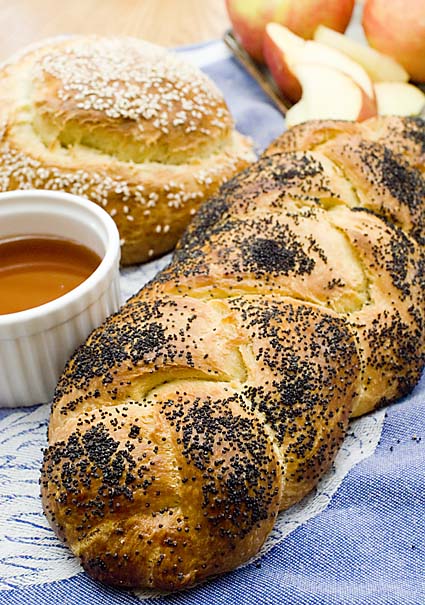
Print | Email | by Jeff, September 29, 2008
Filed Under Recipes, Special techniques | 123 Comments

challah-done-2-ways.jpg

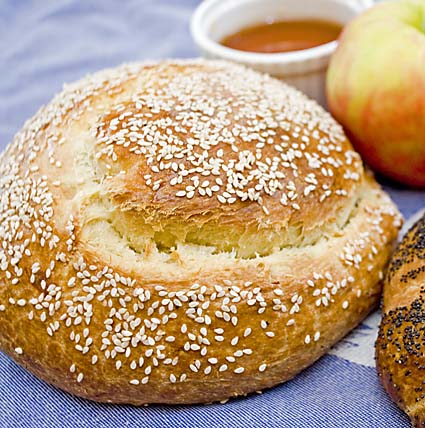
It’s Jewish New Year (tonight) and the traditional loaf, a round, turban-shaped one (round=continuity of life) took a back seat in this photo– so I decided to do a challah extravaganza and go through both shapes, which are easy once you see how they’re done.  Here’s the turban from a little closer:
6-turban-challah.jpg

They’re both made from the same dough but the New Year’s  turban always has raisins or other sweet fruit (to symbolize a sweet new year)– we’ll roll them into the dough so you don’t have to mix up a special one. First, roll out some pre-mixed challah dough from page 180 of the book (purchase by clicking here).  You can even make it with brioche dough if you’re looking for something richer, but the less rich dough is more traditional.  Roll a grapefruit-sized piece of dough as in Zoe’s post on raisin bread, sprinkle a handful of raisins, roll it back up, and and you’ll get something that looks like this:
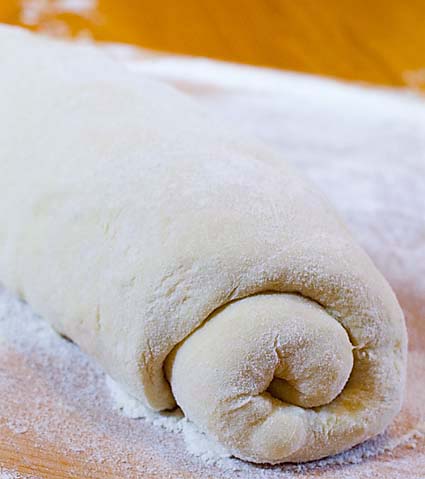
1-roll-in-the-raisins.jpg

Thin out one end by rolling and stretching at the end that’s going to be thinned:
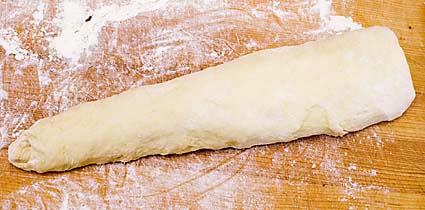
2-thin-out-one-end.jpg

Starting with thick end in the middle, wind the thinner end around it and finally, tuck it underneath to seal:
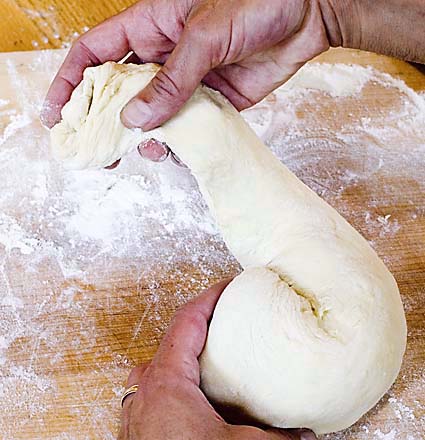
3-wind-around-itself.jpg

Put the loaf on a cookie sheet prepared with shortening or parchment paper, or my favorite these days, a silicone pad, which can go straight into the oven with or without the support of a cookie sheet.  Brush the loaf with egg wash and sprinkle with sesame seeds:
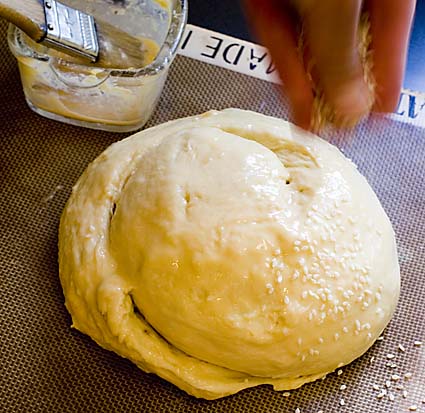
5-sprinkle-with-sesame-sds.jpg

Allow the loaf to rest for an hour and 20 minutes, then bake at 350 degrees F (175 degrees C) for about 30 minutes, until nicely browned (larger loaves will take more time).  Here’s the finished turban-shaped loaf again, ready for eating with apples and honey for a sweet new year:

6-turban-challah.jpg

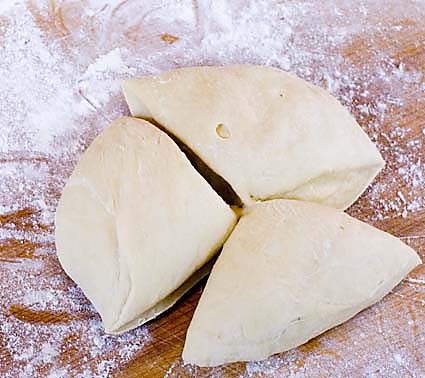
But if you want to make the traditional braided challah (without raisins), here’s how to do it:  First form a grapefruit-sized ball and cut it into thirds with a knife or dough scraper. 
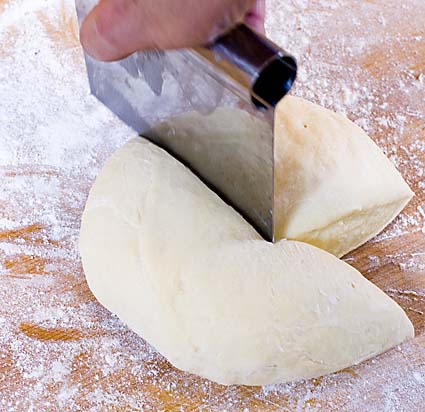
7-for-braid-cut-in-thirds.jpg

8-now-thirds.jpg

Gently roll and stretch each piece, dusting with flour so your hands don’t stick to it, until it’s about an inch thick.  You may need to walk away and let the dough relax for five minutes so it won’t resist your efforts.  When you’re done, lay them straight on a lightly floured work surface:
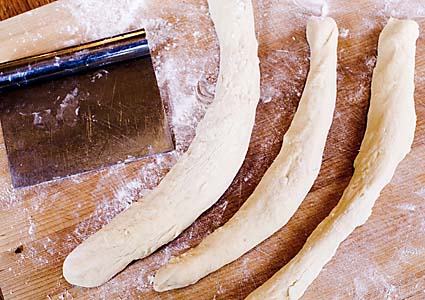
9-lay-them-straight.jpg

The key to a beatiful braid is to start from the middle, not from one of the ends.  Pull the strand farthest from you over the middle strand and lay it in the middle– that’s never changes, you’re always pulling outside strands into the middle, and you never move the middle strand:
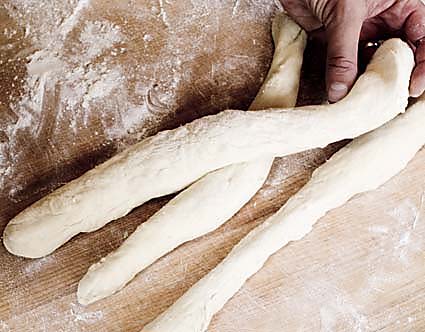
10-start-loafs-ctr-pull-top-strand-to-the-middle.jpg

Now pull the closer strand over to the middle:
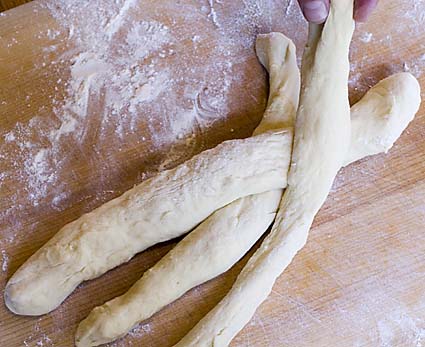
11-pull-bott-strand-to-middle.jpg

Keep going, alternating outer strands but always pulling it into the middle:
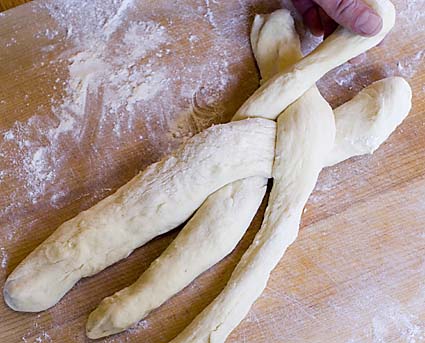
12-keep-going.jpg

When you get to the end, pinch the strands together:
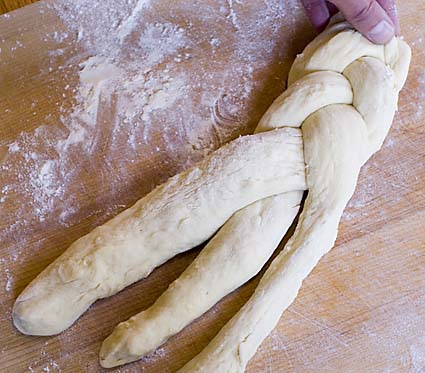
13-keep-going-and-pinch-at-end.jpg

Now (and this is the fun part), flip it over so the loose strands fan away from you:
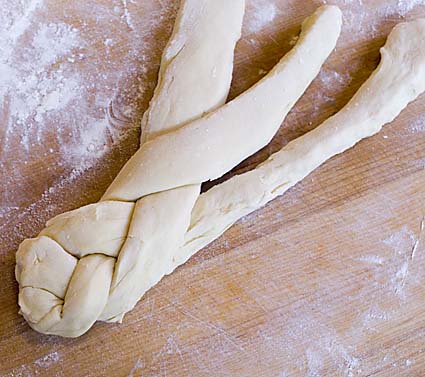
14-flip-it-over.jpg

Start braiding again by pulling an outside strand to the middle, but this time start with the strand closer to you:
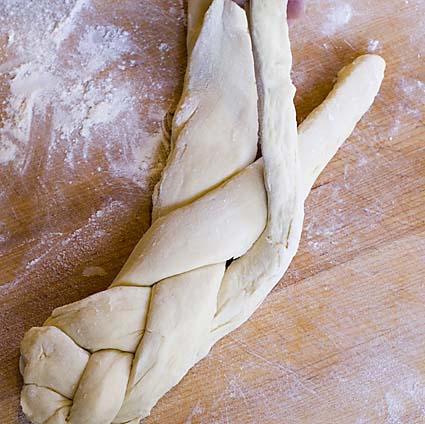
15-keep-going.jpg

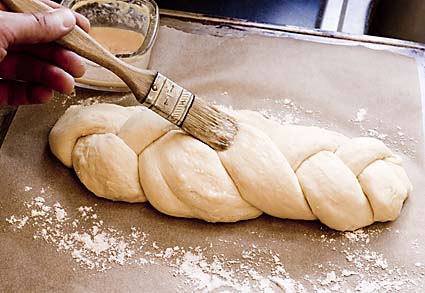
Don’t worry if things look a little mis-shapen, you can nudge it back into shape at the end.  Braid to the end again, and pinch together, lay it on a cookie sheet prepared with shortening, parchment, or a silicone pad, and paint it with egg wash:
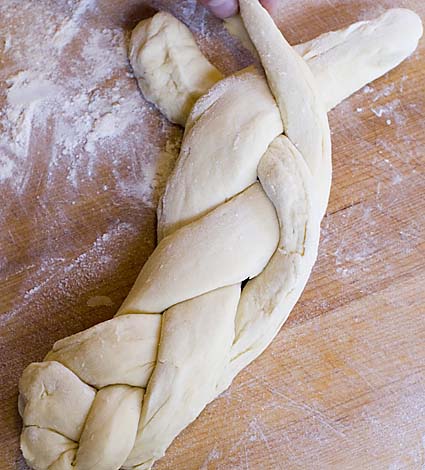
16-go-to-end.jpg

Using my fingers, I’ve gently nudged the loaf into a more symmetrical shape before painting the egg wash:

17-paint.jpg

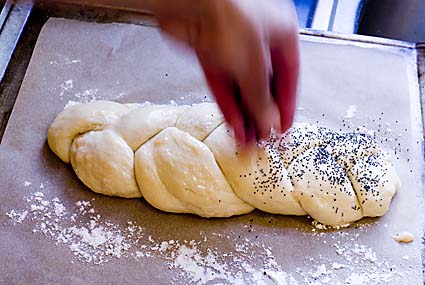
Now sprinkle with poppy seeds:

18-sprinkle-poppies.jpg

Allow the loaf to rest for an hour and 20 minutes, then bake for about 30 minutes at 350 degrees F (175 degrees C), and the colors create a beautiful contrast:

challah-done-2-ways.jpg

Follow us on Twitter.com!


Comments

Trish said...
September 29, 2008 at 7:05 pm

This challah bread is amazing! My family is hooked on it. We have even made a longer braid and formed it into a wreath which looks stunning.

Rosa said...
September 29, 2008 at 9:24 pm

What gorgeous breads! I love Challah so much!

Cheers,

Rosa

jeff said...
September 30, 2008 at 7:27 am

Thanks Trish and Rosa. Trish, how are you joining the ends of the braid to form the wreath? That’s always a bit tricky and if you have a great way to do it I’m sure readers here would love to know. Jeff

Lady Di said...
September 30, 2008 at 6:54 pm

I attempted to make a Challah for Rosh Hashanah dinner yesterday by cutting your Challah dough recipe in half – with DISASTROUS results! The dough was like soup after a couple hours in the refrig, so I panicked and added a bunch more flour. It still didn’t seem usable so I threw it back in the refrigerator and instead made a fast bread-machine egg dough, in order to have something ready for the evening meal! (It looked lovely but did not have the wonderful flavor of your Challah) Do you know why the dough might have turned out so loose? I have never made a half recipe before..(and I checked and rechecked my division!)Perhaps it needed an overnight in the refrigerator after the initial proofing instead of just a couple of hours to chill? Unfortunately I added flour before I could test out that theory. I’m curious how the dough I saved is going to handle now – I hope to try it out tomorrow. I was so disapointed, though, as I had great success when I made the full Challah recipe previously.

Jess said...
September 30, 2008 at 7:42 pm

That looks amazing; happy Rosh Hashanah!

I’ve posted before about how much my husband I are enjoying our AB5 bread, but I thought you might enjoy Jon’s latest quotes:

“how did we ever survive without this”

and

“If I hadn’t already, I’d marry you just for this”

and

“om nom nom nom”
(i.e., cookie monster noises)

My next experiment is going to be to try to make kimmelweck rolls. Those are sort of like kaiser rolls with caraway seeds and salt on top. They are used to make roast beef sandwiches with horseradish (“beef on weck”) in Buffalo, where I grew up, and I miss them!

What dough/method would you recommend to make a kaiser roll clone?

Jess said...
September 30, 2008 at 7:44 pm

Oh, I forgot to mention: I got great results from the beginning, but I bought some King Arthur flour a few weeks ago, and got *GORGEOUS* loaves. I don’t even let them rise for the full 40 minutes (just for the 20 minutes or so it takes the oven to pre-heat) and I still get great oven spring.

jeff said...
October 1, 2008 at 6:55 am

Di: I’ve divided that recipe many times, and always got the same result as the full recipe. I can’t think of any other explanation other than a measurement error. The slightest distraction makes me lose count. The dough with added flour should work fine but let us know here if it doesn’t.

Jess: Thanks for the quotes, what fun to read those. If you want a soft kaiser roll, do the Soft American-Style White Bread, or the Buttermilk Bread. Or even challah. If you want something crisp, use any of our lean doughs– the basic Master should work, or Light Whole Wheat. Jeff

alexandra’s kitchen said...
October 1, 2008 at 9:07 pm

wow. striking! i love challah

Candy said...
October 2, 2008 at 1:14 pm

Just saw your bread on Mary’s blog. Can’t wait to try them out! Looks delicious.

jeff said...
October 2, 2008 at 7:50 pm

Hi Candy: Maybe I’m being thick, but where is Mary’s blog? Jeff

Mary said...
October 2, 2008 at 10:01 pm

Jeff, I’m Mary and you stopped by my sight earlier today – I’m the Limpa bread lady. I wanted to tell you how beautiful this Challah looks. I think I’ll give it a try. I have braiding instructions somewhere around here. Happy New Year.

jeff said...
October 2, 2008 at 11:03 pm

Thanks Mary! Scroll up to see our braiding instructions. Jeff

Linda said...
October 3, 2008 at 3:36 pm

Jess who used King Arthur flour for gorgeous loaves — did you stick to the recipe as is, or did you adjust the flour amount at all? Thanks!

Jazzy said...
October 4, 2008 at 7:40 am

I have made this challah several time with wonderful results. I also used the same dough to make wonderful cinnamon rolls, and a little brioche….I love that the challah has “strands”…just a beautiful dough…I will try the round one for Yom Kippur!
L’Shana Tova!

jeff said...
October 4, 2008 at 8:18 am

Thanks Jazzy, and Shana Tova to you too. The idea in the book was to give people two ways to do enriched dough, basically, and enriched version (challah) and super-enriched (brioche).

You can do the round turban, which is traditional, or just a simple ball for Yom Kippur.

Thanks, Jeff

Tracy C. said...
October 4, 2008 at 6:50 pm

I finally got my book and made the Challah first thing. LOVED IT. See it here if you like http://eclecticpegasus.blogspot.com/

It is so, so tasty. And pretty too. I thank you guys so much to help us “regular people” have daily fresh baked bread. I thank you and my family thanks you.

jeff said...
October 4, 2008 at 9:30 pm

Hi Tracy: Thank you for visiting, and for making our stuff! Your challah pix are beautiful, great job. Jeff

PG said...
October 5, 2008 at 12:34 pm

I came here for the first time and have gone through many of your mouthwatering posts already.
I have heard a number of times about this book of yours. I’m quite curious. But, I would like to know one thing: can one use this recipe for whole wheat (partly or 100%)breads as well? Thanks!

jeff said...
October 5, 2008 at 1:10 pm

Hi PG, thanks for stopping in. Our book has a 100% WW loaf (p. 76), and our next book will have more (Healthy Bread in Five Minutes a Day is the tentative title). But you can’t just substitute out WW flour for AP flour in our recipes. WW flour absorbs more water so the liquids must be increased (you can experiment on your own, of course).

50/50 WW/AP is a much easier ratio to work with when you’re starting out, or even our Light Whole Wheat (page 74).

But the new book should be out 12/09! Thanks, Jeff

Linda T. said...
October 5, 2008 at 1:36 pm

This is just an idea to try for Jeff or Zoë, or somebody with a panini press. I checked out a book from the library called Panini Express, getting more ideas for panini fillings — I have made a number with my Artisan Bread, also tend to make the ends of my dough into rolls.
Anyway — he presents some breads there at the beginning. I was intrigued with one shown. He used an olive oil type wet dough, rolled out like smallish pizza dough — then baked it right in the panini press. This made a nice crimped flatbread. Although he then put two together and made a panini, I thought might be even more interesting as open face sandwich or add the toppings as a small instant pizza and bake or broil for a minute. (He suggested these, too.)

jeff said...
October 5, 2008 at 3:14 pm

Thanks Linda… I’m glad to hear that this works. I’m not surprised, because we do something similar with the naan (page 173). If you roll our wet dough thinly, it will bake through on a cast-iron or other hot surface without benefit of oven.

I don’t have a panini press– only question is whether the pressure would prevent the flatbread from rising and leaving it a bit dense– but it sounds like yours are working fine. Jeff

Lulu said...
October 7, 2008 at 4:23 am

So Bread Top Secret !

Dear Jeff,

I’ve bought the book for 2 month, before I learn this secret ingredient, my bread always become very HARD like a rock after few hours, no matter which dough I made.

Japanese has invent an secret ingredient to let their bread become soft, it’s named “YU- SHU” (Warm dough)[汤种],it’s just [flour + water + 60degree celsius=YU-SHU].

1. flour 1:5 water
—if u put 100g of flour, then u need 500g of water.

2. Stir it together using 65 degree celsius fire, very small fire, don’t let it boil.

3. Stir until it become sticky, and can see the line pattern when u stir.

4. Let it cool down before u mix with dough ingredients, u can put into fridge for days but throw away when it become gray. Then it’s done!

4. Add 20% of Yu-Shu into your dough ingredients and mix together. If u mix a 500g dough, add 100g of Yu-shu.

Now you can get a Soft bread!
I’ve tried to add Yu-Shu with the Oliver Dough (Pg134) and get a soft bread,
the bread still soft untill next day!
Sorry for my poor english~
but its really works!!!
Try it if u want to do a soft bread!

Lulu
Malaysia

jeff said...
October 7, 2008 at 5:32 am

Thanks Lulu, I’m honored that you’re visiting us all the way from Malaysia again.

I can’t quite figure out why this should soften the crust, but I guess I better try it. It seems that something that wet would make our dough overly loose at that ratio. It could be that you’re getting such a high-moisture result, that that alone keeps the crust soft.

In our books, the usual approach to getting a soft crust is to use shortening (oil, butter, or other fat) in the dough.

My overall advice of course, would be to only make as much bread as you can eat on the first day! Jeff

Martha said...
October 7, 2008 at 5:55 am

I made my first half-batch of challah bread recently. Truthfully, I expected a failure. I’m not a very good baker. But it was outstanding, as all your breads have been.

What amazed me was how easily the dough worked. Inspired by the cinnamon-raisin loaf, I adapted it by replacing raisins, which I dislike, with chocolate chips.

Oh man, oh man, oh man!

jeff said...
October 7, 2008 at 6:22 am

Thank you Martha! My kids want to be invited over to your house, they’d want chocolate chip baguettes! Jeff

Sloane said...
October 9, 2008 at 3:10 am

I emailed this question in…and figured I’d add question and answer to the comments page…
I bought a dough rising bucket from King A’s web site. I would have thought that the lid would have been vented. You are firm on not having an air tight lid while storing…so I should ditch the lid and lightly cover with plastic wrap? I admit that I snapped the lid but then I noticed these big air bubbles forming….so I cracked it open again.
Jeff’s reply…
There’s an easy solution— For the first 24-48 hours, just keep the lid cracked very slightly. My lids aren’t vented either, and this is how I do it. The lid is much easier to deal with that plastic wrap.

jeff said...
October 9, 2008 at 4:44 am

Thanks for posting here too Sloane, great to hear from you. Poke around, there’s quite a lot of content in our site to enhance the book. Jeff

sandra said...
October 9, 2008 at 10:56 am

I tried the challah recipe for the first time today. I messed up and brushed the shaped loaves with egg and sprinkled with seeds before I let them rest and rise. Will I have bad results now?

jeff said...
October 9, 2008 at 12:38 pm

No, Sandra, the result will be just fine. I can’t think of any reason why this would cause a problem. Maybe the color or finish will be a little different.

Will you let me know here? Jeff

sandra said...
October 9, 2008 at 1:52 pm

Jeff , thanks for answering my silly question. I ended up with beautiful loaves! I did have a little issue with them getting a little browner than I wanted . The turban loaf sort of over expanded on top and split a little so the shape is not perfect. The braided loaf is picture perfect. I was a little nervous about the braiding , but your instructions and pictures were so helpful! I am bringing them to a break the fast dinner tonight, so I will have to wait to see how they taste.

By the way , I love the book !

jeff said...
October 9, 2008 at 1:54 pm

Your welcome Sandra, and Shana Tovah. Hope your guests enjoy the bread, and thank you for trying our method. Jeff

TiV said...
October 10, 2008 at 12:37 am

Hello! Never tried or tasted Challah, but I am now wondering what happens if you change honey to brown sugar or ordinary caster sugar? Would the measurements be the same? Would the taste of original Challah change significantly?

jeff said...
October 10, 2008 at 4:39 am

Hi TiV: You can try substituting the sugars for the honey 1:1– that’s what I’d do. If you were really keeping score, you’d very slightly decrease the water in the recipe, maybe a tablespoon or two.

The flavor will change in a subtle way– see what you think. Jeff

lace said...
October 10, 2008 at 11:22 am

I made this Challah a couple a weeks ago and I could eat it everyday! It is so good.

I’ve only had one failure with all of the breads I’ve made. I had a small bit of basic bread recipe left over and thought I spread some nutella in it. It leaked out all over and burned. It was so gross.

jeff said...
October 10, 2008 at 11:39 am

But… how ’bout that Nutella on bread that’s already baked?

Jeff

Harry said...
October 11, 2008 at 1:50 pm

I made challah many ways, but this recipe is definitely the most tasty. The recipe calls for 1 lb of dough, but I used 2 lbs, and even then the result is an average sized loaf. Now I have two issues: 1. The baking time is about 50 minutes at 350. (I’ve check my oven and it’s off just 2 degrees.) The internal bread temp is 190, just what it should be. So why so long?
2. I can never get a smooth, glossy crust with this dough and with the egg wash. The challah comes out looking rustic, as does the master recipe breads. Should the egg was just use the yoke, rather than the whole egg?

Ruth said...
October 12, 2008 at 6:07 am

I tried this both ways…butter and oil and loved the flavor of both.

On a broader note…I love your book and my daughter borrowed it, loved so many recipes, she ran out and bought her own copy.

jeff said...
October 12, 2008 at 9:06 am

Thanks Harry, what a great compliment. You’re doubling the size of the loaf we make (admittedly a small one). We say in the book, “…larger loaves will require adjustments in baking time.” Maybe we should have said “increased” or even increased dramatically. What you’re seeing is just what I’d expect. About the glossy surface, you could try yolk-only, or try another trick. Paint the egg wash right after shaping, to let it dry. See if that helps. If not I’ve got some other ideas so write back with the result if you have time.

Ruth: Thank you for helping us get the word out on the book! Jeff

Elizabeth C. said...
October 23, 2008 at 2:26 pm

I have never made bread. However, I started making your challah in August this year and this has absolutely been my kids’ favorite. I then shared it with friends and they loved it. A Jewish friend, in fact, asked me to make 10 loaves for their son’s Bar Mitzvah last Saturday. It was a hit! I love, love your book!!!

jeff said...
October 23, 2008 at 2:45 pm

Elizabeth: I can’t thank you enough for your sweet note. Ten challahs, you are so ambitious— I’m so glad they were a hit because it gets challenging to mass-produce them (I feel obligated to drop some Yiddish into this conversation– Mazal Tov!). Thanks for telling us this story and come by anytime you have questions. Jeff

Elizabeth C. said...
November 4, 2008 at 4:35 am

I did not dare to mass produce this since I had not enough experience to speak of. Instead, I made 4 batches of the basic recipe (getting 3 loaves for each – the extra 2 loaves were shared with other friends). You can imagine me with the 4 buckets and adding one ingredient at a time the night before. Adding and counting the flour was the trickiest part. Then, I was up at 4 a.m. to begin shaping, resting and baking the loaves.

Am not familiar with Jewish traditions so when my friend asked me to make it for the reception, I assumed it was just to be served as a side. I was pleasantly surprised when she thanked me in front of their 150 guests and proceeded with the breaking and sharing of the challah.

BTW, I gave a copy of your book to my Jewish friend (and she is an excellent cook and baker) but she says she can’t replicate the challahs I make. Hmmm …

jeff said...
November 4, 2008 at 5:24 am

Elizabeth, you are a good friend! 4 AM?

Were you an experienced baker before this. Getting a perfect braid takes a bit of practice. I bet the flavor she’s getting is good.

Elizabeth C. said...
November 4, 2008 at 6:25 am

Jeff, yes I’d like to think I am a good friend. Her daughter will have a Bat Mitzvah in 2 years time — I hope I will not be asked again because it took a lot of effort.

Nope, I am not an experienced baker at all. I am good at braiding only because I used to braid my daughter’s hair.

Have a great Tuesday!

Jess said...
November 24, 2008 at 3:57 pm

This is probably too late to be helpful, but to answer Linda’s question: I followed the recipe verbatim when I got gorgeous loaves with the KA flour, EXCEPT that I weigh the flour, rather than measuring.

Judy K said...
November 29, 2008 at 7:33 pm

I’ve really enjoyed making the breads in your book. All have been spectacular. One question, I made Challah for Thanksgiving. After braiding I let it rest on the counter for an hour and a half then brushed with egg wash and baked. The parts that were egg washed looked great but due to the spring in the oven the majority of it looked rather pale. It still tasted amazing but how can I get it to be uniformly brown?

jeff said...
November 30, 2008 at 9:52 am

Judy: A longer counter rise would shift some of the rising to the counter, so proportionally there’d be less oven spring.

But I kind of like that color contrast!

Another idea would be to use convection if you have it in your oven; that promotes browning. Jeff

Judy K said...
December 3, 2008 at 4:30 pm

Thank you, Jeff. I’ll give that a try.

Mickey said...
December 7, 2008 at 8:00 pm

Hi, I wanted to break my dependence on our bread machine and so bought your book. I wanted to try the challah, but wanted a larger loaf, so I made only a half-batch of dough, followed the instructions as best I could, and then put the 2 lb. loaf in the oven. After about 35 minutes, the crust was quite brown (and beautiful!), so I took it out of the oven. The outer ends were utterly delicious, but in the middle of the loaf, the dough was still raw.

Any suggestions for how I can get the whole 2-lb. loaf to bake longer? Go down to 325 degrees? It’s a superb recipe, so I really want to make it again, but don’t want to scoop out raw dough in the center of the middle part of the bread (which wasn’t appreciably higher than the ends).

Thanks for your help. I bought the book partly on a recommendation that the breads are fantastic and partly because someone told me that the authors actually answer questions. Wow!

jeff said...
December 7, 2008 at 8:15 pm

Welcome to the site Mickey. Yes, we do in fact answer all the questions!

I’m really thinking that your oven thermostat is off and you need to check with a reasonably-priced oven thermometer ($15; we have one in our Amazon Store connection on the home page, but it doesn’t matter where you get it). It seems like you’ll get over-browning before the center’s set only if the oven is too warm, and that’s my best guess.

Two-pound loaves will take considerably longer than 1-pounders, so it’s possible that you just need to bake closer to 45 minutes. But you don’t want the crust to burn.

I’d start by checking the temp. Another option is to see what happens when you make a one-pounder.

Let us know? Jeff

Paul Nordstrand said...
January 5, 2009 at 4:44 pm

Just finished my 4th boule, it is lovely. Will have it with pea soup. Yum, winter food and baking warms the house. Thank you for your generous sharing of your creative skills. My copy of your book is coming soon and I have enthusiatically recommend you to our local, independant book store.

jeff said...
January 5, 2009 at 9:13 pm

Paul: Thanks for all the kind words– stop by anytime with questions! Jeff

Pat said...
January 10, 2009 at 1:57 pm

Can anyone tell me what size container I need to get to store 5 lb of flour? I’ve always stored it in a glass jug, but I can’t get a measure in it, so I’d like to buy some new containers to store it now.

Also, my book came and I’m trying some of the recipes! Smells good here now!

zoe said...
January 11, 2009 at 8:31 am

Hi Pat,

I use glass jars that hold about a gallon of water. I hope that answers your question!

Thanks and enjoy the bread.

Zoë

Judy said...
January 13, 2009 at 2:55 pm

I just saw braiding instructions for four, five and six strands on youtube. WOW! Makes a beautiful presentation.

Judy said...
January 16, 2009 at 6:37 am

Hi Jeff and Zoe,

I so appreciate your answering my questions!!!

I took my first challahs out of the oven last night. they didn’t rise much. The dough was dry. I think I didn’t add enough water, using KA flour.

It’s almost 5 days since I made the dough, and I the remaining dough portions in the freezer for next time.

Questions:
1. Could I have added more water when I took the dough out of the refrigerator to shape? I could feel that the dough was dry.

2. Can I add more water to the dough when I take the remaining packets out of the freezer to shape next time?

3. I am new to using a stone. I didn’t grease the stone when I used it with the challahs, should have? The bottom stuck. I saw the directions later and Pampered Chef instructions said to grease the stone the first few times. This is my second time using it. I tried baking some boule right after, to take advantage of the hot oven (after heating it up), so I was concerned about greasing the stone. I used parchment paper on the boule. Is it ok to grease the stone for the challah and then cook the boule on it right after?

4. Last question (I hope) :) I tasted the challah’s bottom that fell off. It isn’t sweet enough for me. My former recipe was to double the amount of sugar in the Fleischman’s bread machine recipe. Can I go up to 2/3 cup honey? If so, are there any other adjustments?

While we are talking about honey, I heard that a honey bee works its whole life to make one tsp. of honey. So my salute to the honeybee!

Oh, I think the stone and broiler pan absorb some of the oven’s heat. I took out the broiler pan when I noticed the challah wasn’t cooking well and the oven temp went up. I had figured that I’d leave it there while the challah baked to warm up for the boule next. Not a good idea.

Thanks for answering my questions. I love it when my husband oohs and ahhs over my challahs!

Judy

jeff said...
January 18, 2009 at 8:38 pm

It’s probably risky to add water at that point. Might have deflated the dough mass, with no additional “food” for the yeast to regenerate the bubbles.

Wow, I’d never grease a stone— all that grease will smoke, smoke, smoke till it burns off. Eventually the stone will “season” and become kind of non-stick. I like your parchment idea better.

I don’t think you’ll have to change anything after increaseing the honey, but you might (might) have to increase the flour slightly. very slightly.

The stone absorbs heat (slows the pre-heat) but I’m surprised you found that with the broiler pan.

Judy said...
January 19, 2009 at 10:12 am

THANKS, Jeff! I’ll try a future batch with 2/3 cup honey. Because I use King Arthur Flour, I may not have to use much more of anything. I’ll have to check the dough consistency.

I have some gluten, I’m wondering if I could add some to the challah recipe or deli rye to get a higher rise. Or if that would cause problems of overrising in the fridge.

jeff said...
January 19, 2009 at 11:16 am

Judy: With VWG, it’s not so much a matter of over-rising, it’s more a question of throwing off the water balance. If you use VWG in the challah, be sure to increase the water so that the consistency stays the same.

Judy said...
January 23, 2009 at 6:12 am

Hi,

In reading the posts, I see that TiV asked about switching the honey to regular sugar. I was wondering how it came out. Sugar is much less expensive than honey. THANKS

jeff said...
January 23, 2009 at 7:09 am

You can swap honey for sugar in a 1:1 volume switch, the slight water change won’t make much difference. Flavor won’t be quite the same though.

Nina said...
February 25, 2009 at 6:07 pm

I am about to make my first Challah dough (l.5 recipe).

In the book you say to do the egg wash and seeds 20 min. prior to baking.

In your online version, you say to egg wash and seed prior to resting.

Which one is correct and does it matter?

In the book you say that melted butter makes a stiffer dough and using oil causes the dough to spread sideways while resting. Online here (I forget exactly where I read it), you say that by using melted butter, the dough may not stretch and breaks off – again, which is correct?????

Thanks.

jeff said...
February 25, 2009 at 7:04 pm

Prior to baking is what we’d intended, but it won’t make a lot of difference. Sorry for the confusion.

2nd question: both statements are correct! Melted butter-dough is stiffer WHEN COLD and tends to appear “fragile” when pulling it out of the cold bucket. Once they both warm up, they behave differently too— the butter tends to hold its shape better, the oil to spread sideways– mainly a cosmetic difference.

Lynn said...
March 27, 2009 at 5:00 am

Easter is coming up, I love the look of the braided bread with the colored hard boiled eggs in it…
Is this the dough for that, or should something else be used? Do you have any pointers?
Thanks!

jeff said...
March 27, 2009 at 7:40 am

Lynn: These kinds of recipes usually call for an enriched dough, so Challah or Brioche are perfect, depending on how rich you want.

Linda said...
April 3, 2009 at 1:36 pm

Hi Zoe and Jeff,

I totally love your book. I have been baking bread for many years the old fashioned way and can’t believe how great all your recipes come out. My husband said the bialy’s are the best he has ever had. (he’s from Brooklyn and Manhattan).

My question is about the Challah. I made your recipe and it’s great. However, I have been making a recipe for the Jewish New Year which has about the same amount of flour and 3 egg yolks and 3 eggs instead of the 4 in your recipe. It also has 1/3 cup honey and 1/3 cup sugar instead of your 1/2 honey.

Do you think that my recipe ingredients will work with your recipe technique?. I like your recipe for everyday and mine for “the sweet New Year”.

Thanks for your time.
Linda Berman

zoe said...
April 3, 2009 at 7:41 pm

Hi Linda,

your recipes sounds sweet and wonderful. It is certainly worth a try! I’d probably add a couple more tablespoons of water or the dough may be too dry.

let us know how it goes!

Zoë

Linda said...
April 4, 2009 at 4:22 am

Thanks. I’ll let you know.
Linda

Maire said...
April 11, 2009 at 11:31 am

Hi there,

I just made the challah recipe this morning for Easter. It tastes great! But my version looks funny. You can see a pic at the linked website (or here http://www.flickr.com/photos/14540678@N07/3431542209/). You can see that it kind of exploded in the middle while baking. Do you know why this might have happened? Did I let it rise for too long? Or did I braid it too tightly? Or do I need to make a longer, skinnier version? I still have a ball of dough in the freezer, so when I make the second loaf in a few weeks, I’d like to fix the explosion if possible :) .

Thanks again for the great book and the great website!

Maire

zoe said...
April 11, 2009 at 10:17 pm

Hi Marie,

The other times that I have seen this happen has been the result of not letting it rest long enough. How long did your braid rest before you put it in the oven?

Thanks, Zoë

Mhays said...
April 14, 2009 at 3:26 pm

I just tried the challah recipe using butter – I was hoping for a homemade challah result, but got something like a bakery challah.

By this I mean that I was hoping to get a slightly stringy, slightly chewy texture as opposed to a texture similar to regular white bread. Does the recipe produce the stringier “Bubbe” style challah, or did I get the expected result? Is there a way to get a result with more texture?

zoe said...
April 14, 2009 at 8:16 pm

Hi Mhays,

The only way to get that stretchy texture with an enriched recipe is to knead the dough. You can put the whole thing in a stand mixer and knead it for several minutes and it will produce a texture closer to Bubbe’s. It is the butter in the dough that causes the gluten to break down.

Thanks, Zoë

Sam said...
August 6, 2009 at 7:20 pm

I am having problems with my challah sticking to the stone… i have tried coating the stone in flour (it stuck) cooking the challah on greased or floured baking paper on the stone (the paper stuck to the challah AND the base didn’t get crispy).

Would love any suggestions on fixing this…. otherwise the recipe is great!!

jeff said...
August 7, 2009 at 5:07 am

Hmm, I’ve never had this. One option would be the silicone mats, nothing sticks to them. They’re available on Amazon at http://www.amazon.com/Silpat-2-Inch-Nonstick-Silicone-Baking/dp/B00008T960?&camp=212361&linkCode=wey&tag=arbrinfimiada-20&creative=380725.

But my guess is that your problem is not enough dusting flour as you shape your challah “ropes.” Be more liberal with the flour and the sticking problem will disappear, I’d guess. Jeff

Judy L, TN said...
August 24, 2009 at 6:49 pm

Hi Jeff and Zoe,

I have been learning more about hydration and baker’s percentage since Jeff’s great explanation. Wow, this is a great way to scale recipes!

But, I don’t know how to scale enriched dough recipes like challah. Do ingredients like oil, honey, and egg count as liquid? I’m not sure about honey, because it’s interchangeable with sugar. I want to learn more about this, increase my baking knowledge and so work with scaling your recipes to different yields.

Also, I notice on this page that it says to do the egg wash and seeds on top before the long rise.

I’ve been doing that after the rise, because I have been afraid of leaving uncooked egg on it for that long.

But when I do it after the rise, I’m sometimes deflating the dough–especially if I have overproofed the loaf.

Which way should I be doing it?

I would love your comments on both questions.

Thanks so much,

Judy L, TN

zoe said...
August 25, 2009 at 8:22 am

Hi Judy,

Baking percentages are a great way to bake, but it does take a bit of getting used to. When calculating the percentage the flour (or combination of flours) are 100%. Everything else is on its own. So in other words the eggs are a percentage and the water is another. You don’t combine them as the “liquids” they are all calculated on their own. This is one reason we don’t use baking percentages in the book, it can be rather confusing and intimidating for home bakers who are not used to thinking of recipes in this way. But, I encourage you to read more about it and have fun baking with percentages. I know that King Arthur used to have a page on their website dedicated to the subject, but I’m not sure if that is still available?

I’m not sure where you are seeing to egg wash before the long rise? What page are you looking at? On page 182, step 8, says to add the egg wash and seeds, this is after the rise. You are right, it definitely goes on after the rise.

Thanks Judy! Zoë

Judy L, TN said...
August 25, 2009 at 2:44 pm

Hi Zoe,

Thanks so much for your info. Ok, then, honey and oil are considered “not water,” and I would compare them to the total amount of flour on their own.

The place where I saw to put the egg wash on first, at higher up on this page:
“Using my fingers, I’ve gently nudged the loaf into a more symmetrical shape before painting the egg wash:
Now sprinkle with poppy seeds:
Allow the loaf to rest for an hour and 20 minutes, then bake for about 30 minutes at 350 degrees F (175 degrees C), and the colors create a beautiful contrast:”

I can’t find anything on the King Arthur website for baker’s percentage. I also checked the baking community postings when I did a search.

I found plenty of explanations of lean dough, but nothing about additional ingredients. And all the postings on the blogs are really old, so I don’t know if the contact info of those blogs are current.

You guys sure ignited a spark in me to learn more about culinary skills! I’m also ordering the book, “Ratio.” I wish I could go to culinary school! I spend hours on the computer, educating myself and watching demos on YouTube! You guys ROCK!!!

Judy L, TN

zoe said...
August 25, 2009 at 10:39 pm

Hi Judy,

I’ll let Jeff answer as to why he painted on the egg wash first in this case?

I’ll look through my baking books and try to recommend some good reading material about baking percentages. It is wonderful that you are wanting to get more in depth information.

Thanks! Zoë

jeff said...
August 26, 2009 at 7:53 am

Judy: In the book, we have you painting with egg wash and sprinkling seeds AFTER the rest… I misspoke here on the blog. Fact is that it doesn’t much matter. Some books have you doing two egg washes, about 30 minutes apart during the resting time. That second coating, right onto the dried egg, gives you a shinier result. Sprinkle seeds after the second coating (right before it goes into the oven). Jeff

Judy L, TN said...
August 26, 2009 at 9:46 am

Thanks, Jeff and Zoe!

I think it’s wonderful that you are so patient and don’t mind teaching!

I don’t know where this passion for baking will take me, but it’s in a totally different direction. I’m willing to see where it goes. I heard a quote on “Writer’s Almanac (NPR) the other day, from the book, “The Alchemist.” It’s “To realize one’s destiny is a person’s only obligation.”

Be well, Judy

Judy L, TN said...
August 26, 2009 at 11:04 am

Hi Zoe,

How about this unexpected site for explanation of baker’s percentage for liquid ingredients:
http://www.cookies-in-motion.com/Baking-Recipes.html

??

Also, I am trying to figure out how much “shrinkage” challah dough will have. I weigh out my dough to be one pound. I’ve never weighed the final product. I’m making one for the shul receptionist, and I’d like to give her a one-pound beautiful challah. She’s been very helpful.

Does challah lose much weigh/moisture in the baking process?

Congrats on the courage to cut your hair! Very cute. I guess your next book picture will be sans glasses AND long hair. :)

Thanks!

Judy

Judy L, TN said...
August 26, 2009 at 11:05 am

Jeff, thanks for the egg wash info. I’ll be sure to use that when I want a very shiny crust!!!

Judy L, TN

zoe said...
August 26, 2009 at 7:53 pm

Hi Judy,

I skimmed over the link and it does look like good information.

The dough will not lose much of its weight when baked, maybe an ounce or two.

Thank you for the kind words about my new hair. I’m finally getting used to it and think I like the new me! :)

Thanks, Zoë

Judy L, TN said...
September 9, 2009 at 10:50 am

Hi Jeff, and Zoe,
It’s challah baking time again for me! I did a few this morning, and have a question about the rising of the dough the first time. I guess this question is for all your doughs.

Why can’t I just put the dough bucket in the fridge overnight? Why does it need to rise on the counter first? Won’t a “cool rise” work? Sometimes, I’ll mix the dough in the evening to use the next day. As days get shorter, it would be nice to throw the dough into the fridge ASAP.

Also, if I shape a challah, do I need to let it rise on the countertop first, if put it in the oven overnight?

Thanks so much! Have a wonderful holiday and a healthy year.

Judy

Judy L, TN said...
September 9, 2009 at 10:52 am

oops, I should have said, why can’t I put the dough bucket into the fridge immediately, instead of having it rise on the counter for a few hours first.

Judy

zoe said...
September 9, 2009 at 12:59 pm

Hi Judy,

You can do a cold rise for the first rise in the bucket. We don’t talk to this in the book, because many people want to bake as soon as that initial 2 hour rise is done. You just need to make sure that you are allowing a long enough rest, which will depend on the chill in your refrigerator.

I have never done an overnight rise in the oven. I will have to try it, but I’d fear that it will over proof. Are you also doing this with doughs with egg in them? Not sure that is safe with raw egg? Hmmm? I need to look into this.

Thanks for provoking thought again! :)

Zoë

Judy L said...
September 11, 2009 at 7:58 am

Hi Zoe and Jeff,

Glad that you think my questions are thought provoking! You aren’t giving up on me! :)

No, I don’t want to do an overnight rise in the oven. I just want to do challah dough overnight 1st rise in the fridge. I’ll yest it out, but maybe in a month, after this furious baking time. Wish you had a shortcut for honeycake! :)

I do have a question about the dough I just baked. I froze one pound of challah dough–looks like a month ago. I just took it out this morning and shaped it into a braid. It didn’t rise much. It even looked puffy, so I think it rose all it could! I wouldn’t have known this before. In the future, I won’t depend on frozen dough to rise that well. How can I add yeast to the defrosted dough to give it some OOMPH!

ThanKs, Judy L, TN

zoe said...
September 12, 2009 at 6:11 am

Hi Judy,

Love honeycake, if I come up with a shortcut I’ll be sure to share it with you! ;)

I’ve never married two batches of the enriched doughs, which is typically what I would do to a lean dough (no-dairy or eggs) to add more yeast. You can try adding a bit of a yeast, flour, water slurry, but just know that it is an experiment and may mean you have to throw out that last little bit?

Have fun playing with all the dough! Zoë

Michele said...
September 14, 2009 at 10:50 am

I made your challah recipe and it’s fantastic. I would like to double, or really even triple the recipe (using approximately a 5 lb. bag of flour). Would everything get doubled and tripled evenly? Even the yeast?
Thanks.

zoe said...
September 14, 2009 at 8:39 pm

Hi Michele,

Yes, as we say in the book, all of our recipes are easily doubled or halved. You can also triple the recipe as long as you have a bucket large enough!

Thanks and enjoy all the challah! Zoë

Linda said...
September 15, 2009 at 9:37 am

I have a friend who would like to make this challah dough but would like to substitute non-dairy
margarine or oil for the butter. How would that work out? I am also interested for the Parve factor. She has someone with a milk allergy in her family.
Thank you so much in advance for your help!

Michele said...
September 15, 2009 at 10:53 am

Just replying to Linda – I always use parve margarine and it comes out fantastic.
Another question – when I put the dough in the fridge, the top of the dough gets a hard crust on it. Any way to avoid that?

jeff said...
September 15, 2009 at 12:10 pm

Linda: The recipe in the book calls for either oil or butter; margarine works too.

Michele: To avoid the hard crust, you can seal the plastic container after the first two days of fermentation– there usually isn’t enough gas production after that to pop the lid. Or, transfer to smaller containers as you use it up– less air space and exposure. Jeff

Linda said...
September 15, 2009 at 12:39 pm

Thank you so much for such a speedy answer!

Judy L said...
September 15, 2009 at 7:13 pm

Hi,
Replying to Linda, also. I always bake my challah with parve Fleischman’s unsalted margarine. I melt it, and it works great!

Judy

Marsha said...
September 20, 2009 at 5:04 pm

Love your olive oil dough and challah! I make a full batch of each quite often. Is there something special I need to do after freezing challah dough to get a better rise?

jeff said...
September 21, 2009 at 6:37 am

Marsha: You do lose a little rise with each freezing episode, so freeze in portion-sized bags or containers, that way you’re not freezing, defrosting, and re-freezing. And don’t shortchange the resting time when using defrosted dough. Defrost in the fridge overnight, not on the counter. Jeff

Linda said...
September 21, 2009 at 12:33 pm

I made two challahs from one batch of dough for Rosh Hashana. A raisin challah which came out just perfect. A beautiful dark brown crust which tasted exactly like a bakery challah. It kept it beautiful turban shape. A great success. I also applied a egg wash three times, I let it dry on the dough the first two times, and then brushed on the egg wash right before placing it in the oven. The crust was really lovely. I also made a
plain one…it did not keep its turban shape and had a very distinct “yeasty” flavor, which was not pleasant. I have no idea what happened. I did bake the plain challah first and the raisin second, leaving the raisin challah to rise longer…I am stumped. Both loaves tasted and looked completely different. Any thoughts?

jeff said...
September 22, 2009 at 9:44 am

I think you’re preferring the longer rise, there’s no other likely explanation. Can’t imagine it’s the raisins. Some people find the challah not quite to their liking with short rests, so go with the longer one. Jeff

Linda said...
September 22, 2009 at 11:26 am

I made cinnamon rolls with the rest of that batch of dough yesterday, the dough was 5 days old. They were perfect…
I think the yeasty, almost fermented, flavor of the plain challah will remain a mystery…the only other thing I can think of is I may have over handled the dough.
I formed the turban and did not like it and did it over again…other than that. I am stumped.
Thanks for your help though!

zoe said...
September 22, 2009 at 7:24 pm

Hi Linda,

Despite making these doughs over and over and over again, once in a while I have some that taste very different. It may just be that one batch that you experience that yeasty flavor? I’ll be interested to know, keep in touch!

Enjoy, Zoë

Linda said...
September 23, 2009 at 6:04 pm

I will Zoe…thanks…it remain s a mystery to me. The raisin challah was so good. and so were the cinnamon rolls…
The plain…what can I say??? Yeasty beyond belief..
I will let you know. I used SAF yeast and Heckers all purpose flour…other than that all was the same!
Thanks for your help!
L’Shana Tova!

zoe said...
September 23, 2009 at 9:31 pm

Hi Linda,

It will remain a mystery? I’m assuming that it was just that batch, however if it should happen again let us know and we’ll explore other options!

Thanks! Zoë

Janknitz said...
September 26, 2009 at 11:25 am

Can I weigh in on the (old) egg wash discussion? I always use the egg wash twice. The first time is right after shaping my challah, and the second time is right before baking. Sprinkle seeds on, if any, after the SECOND egg wash.

I find doing it twice makes sure that the areas where the oven spring occurs are covered, and gives my challahs a nice, even glaze. If you only glaze once right before baking, you get more of a two-toned effect. Some people like that, but I prefer the overall more uniform look.

For eggwash I use the yolk and 1/2 an eggshell’s worth of water beaten together. There is usually plenty of eggwash for both rounds, but I pop the eggwash in the fridge between uses just for safety.

Lindsay said...
December 22, 2009 at 1:00 pm

I just wanted to chime in and say that I made a half batch of the challah dough and it was fine. I made cinnamon rolls yesterday with incredible results. The dough was easy to work with and the taste and texture were great. Today I’m using up the rest by making challah, and I’m waiting for it to rise now. The braiding was surprisingly easy and professional looking.

I’d like to thank for you making this book. After several sad failed attempts at making bread in the past, I can now consistently make perfect baguettes, pizzas, focaccias, and more at home. It has really boosted my baking self-esteem.

zoe said...
December 22, 2009 at 8:38 pm

Hi Lindsay,

Thank you so much for the wonderful note. It is so great to hear that you are baking with confidence and so often!

Enjoy all the bread! Zoë

Cindy said...
January 13, 2010 at 10:08 am

I must tell you about the challah that I made recently. I used the regular recipe and was down to the last bit of dough. I decided to encase some brie with it. I had some left over, so I just made a little roll! Anyway, it was to die for! All of the recipes that I’d seen for baked brie used puff pastry. Well, this is way better – we just devoured it. Simply a must try!

jeff said...
January 13, 2010 at 2:12 pm

Cindy: You probably know that we have a number of cheesebreads in our books, but usually we grate the cheese and uniformly mix it into the dough. I like your variation because it gives you all these texture and flavor “boundaries” in the food. Great that it worked with the Challah dough– people have found that a pretty versatile base for getting creative. Jeff

Amanda said...
January 18, 2010 at 10:22 am

I’ve made several of your recipes, all with success. I love the taste of your challah bread, but wonder why mine cracked. I followed the directions but the braid cracked uniformily from one and to another at the top. Any idea what might have caused this?

zoe said...
January 18, 2010 at 1:00 pm

Hi Amanda,

The most common reason is that the dough had not rested long enough before baking. Try giving it another 15+ minutes next time before baking.

Thanks, Zoë

Amanda said...
January 26, 2010 at 11:10 am

Thanks, will give the breaded challah another try for a potluck this coming up weekend and will allow it to rest for longer.

:)

Cooking Rookie said...
January 29, 2010 at 10:02 pm

We’ve just finished my first Challah from your book – it was AMAZING! I messed up everything possible in the recipe, and still it was probably the best Challah I’ve ever had.
Thanks so much!
A picture and the list of all my mistakes (if anyone is interested in repeating them :-) ) are here:
http://cookingrookie.blogspot.com/2010/01/challah-in-5-minutes-day.html

jeff said...
January 30, 2010 at 11:03 pm

Cooking: That’s awesome! Jeff

gretchen said...
January 31, 2010 at 12:48 pm

Our house is a lot cooler than 70 degrees (closer to 60). Should I just lengthen the initial resting time?

BikiniBear said...
January 31, 2010 at 1:14 pm

Please…..Help! I’m not new to book, have been baking various breads for about 1.5 yrs and we love it. But..

When baking Challah with Raisins I like to make a double loaf turban Following all the directions in the book and using a parchment lined baking pan I place the dough in the well heated 350 degree oven and wait for 25 minutes.

After 25 minutes the bread is far from done so I add an additional 20 minutes and I am wondering if there is a correction to the temp of the oven I have missed or what am I doing wrong?

Any suggestions would be fantastic, I appreciate any input anyone has.

zoe said...
January 31, 2010 at 2:48 pm

Hi Gretchen,,

You can absolutely leave it out longer. If you are planning to refrigerate the dough over night before using, then it doesn’t matter if you let it rise fully on the counter first.

Thanks, Zoë

zoe said...
January 31, 2010 at 3:04 pm

Hi BikinBear,

If you are doubling the size of the loaf then you need to increase the resting time by about 30+ minutes and increase the baking time by about 20 minutes. By allowing the dough to rest longer you will lighten up the loaf and it will not be as dense.

Also you should check to make sure your oven is the right temperature with an oven thermometer. If the oven is not hot enough it will effect the baking time.

I hope that helps! Zoë

Ursinus Hillel said...
February 17, 2010 at 2:40 pm

Hey! This is a great challah recipe. I found it on another blog, and it’s fantastic. I’ve never made good bread before (it always ends up hard as a rock coming out of the oven.

I’ve tripled the recipe (because I’m feeding a lot of people), and I didn’t put all the flour in it that my calculations say should happen. The dough still ends up soft and delicate, but will a flour shortage cause problems?

Also, has anyone ever tried to do Challah with whole wheat? Are there alterations to be made?

jeff said...
February 17, 2010 at 5:48 pm

Ursinus: All I can guess is that your flour wasn’t off by all that much. If it was too flour-depleted, it would have been too wet to handle and would have spread sideways. We have whole grain challah in the new book, which you can buy at http://tinyurl.com/pe8yr9. A version of the recipe is at http://www.artisanbreadinfive.com/?p=1261.

Pam said...
February 27, 2010 at 2:53 pm

Using a food processor to mix the dough, I find it difficult getting all the dough out of the bowl and off the dough blade if I take the dough out just as soon as the ingredients are mixed. Is there help?

jeff said...
February 27, 2010 at 9:07 pm

Pam: I generally go a few seconds longer, till it forms a ball. But you’re right, there’s still a lot of scraping of dough off the bowl and the dough attachment, I don’t think there’s anything to do about it. Jeff

Becca said...
April 4, 2010 at 6:03 am

Hello Jeff & Zoe,

Apple & Honey Whole Grain Challah in the new book – hand mixed, Bob’s Red Mill flour, fresh eggs, organic Braeburns. The apples absorbed a bitter flavor from something. Perhaps bitter in the fermented yeasty sense someone refers to above. Any thoughts on what might have caused it, and how to avoid a similar reaction in the future?
Thanks, Becca

jeff said...
April 4, 2010 at 11:06 am

Becca: I have not experienced that. I’m guessing it will be less pronounced if you use all the dough within 2 days or so… bet this got worse with time. If it’s the yeast, try a low-yeast version, see http://www.artisanbreadinfive.com/?p=85 Jeff

marcia said...
June 8, 2010 at 11:07 am

I’ve made the challah a few times. I cut the yeast in half and let it rise for 2 hours. Then it sits in the fridge for a day or two. I’m using KA flour and measuring by weight. I have 2 issues. The dough seems very wet. It even kind of sticks to a silpat. Is this from reducing the yeast? Or do I just need more flour or less water? The same thing has happened several times, so I don’t think that it’s a mismeasurement problem. Separate from that, the challah is a little too dense and sweet for my husband’s taste. When I used to buy challah, our favorite was relatively light and not sweet. Can I change this recipe to accomodate his taste?

Thanks!

Write a comment