Weighing The Ingredients: Whole Grain Baguette Buns With Extra Sourdough Kick
In this post, I’ll go through the method for using a kitchen scale to measure in flour and other ingredients, which some readers, especially outside the U.S., have said they prefer. In this recipe for whole grain baguette buns, I used these weight equivalents for scoop-and-swept cup measures:
1 cup white all-purpose flour: 5 ounces / 140 grams (or 141.7, to be more precise)
1 cup whole wheat flour: 4.5 ounces / 130 grams (127.6)
1 cup water: 8 ounces / 225 grams (226.8)
Most home scales aren’t accurate enough to weigh small quantities of yeast and salt for single recipes.
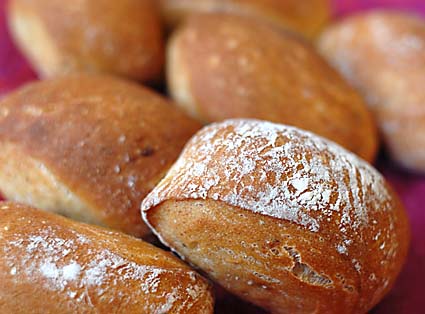
These whole grain baguette buns are from The New Artisan Bread in Five Minutes a Day, being cut from a baguette-shaped cylinder, which gives the buns crusty little edges that will impress your guests. They’re incredibly easy to make from any of the lean stored doughs that you already have in your fridge, mixed up from our book.
I was in a great restaurant recently, and they served baguette buns, which were delicious but the slightest bit stale. Breads this small go stale fast, and really, the best way to enjoy them is at home, an hour or two after they come out of the oven—and you can even eat these a touch warm and the center won’t seem unready. So here’s how to do it.
First, let’s use some old dough to kick up the sourdough flavor. In the book, we say “never wash the dough bucket,” because that old dough gives sourdough flavor a head start in the next stored batch. You can take that further, by using up to a pound of old dough in the next batch. The problem is getting that sticky dough to incorporate in the water before adding flour. An immersion blender is the best tool I’ve found for that job. I have the Braun MR430HC, but the Cuisinart looks good too. Same for the Kitchen-Aid Immersion Blender. Or just let it sit in the water, and then break it up with a fork.
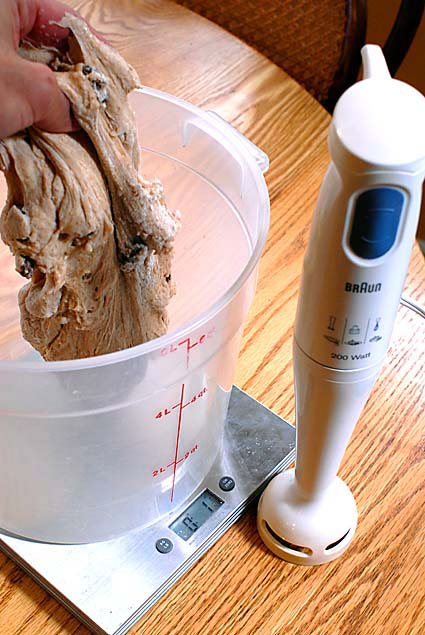
First measure in some dough. Since I’m going to show you how to use the new-fangled easy-zeroing digital scales to weigh out ingredients, we may as well measure out exactly one pound of dough (I use a Salter Scale, but the Escali is also good). Put your dough bucket on the scale, press the “zero” button, and add dough until it reads 1 pound:
Now, press the zero button again and add water by weighing it. Instead of spooning 3 cups of water (this will be our light whole wheat recipe on page 131 of New Artisan), just weigh the equivalent amount—it’s 24 ounces U.S. (1 pound 8 ounces). Now that the water’s in there, you can use the immersion blender to create a uniform slurry of the old dough, but first, throw in 1 tablespoon of yeast. We test with Red Star Active Dry, Quick-Rise, or Platinum…
… and 1 to 1.5 tablespoons of coarse salt (like kosher salt), based on your taste. Be very careful with the blade end of the immersion blender. Unlike a food processor, there’s no safety interlock to prevent you from touching the blades while they’re running. Don’t let children use an immersion blender:
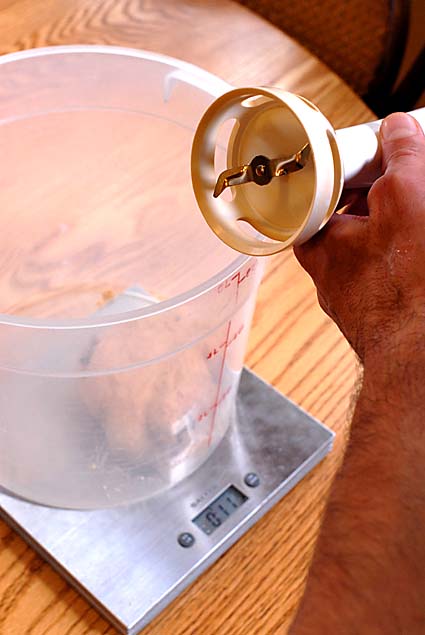
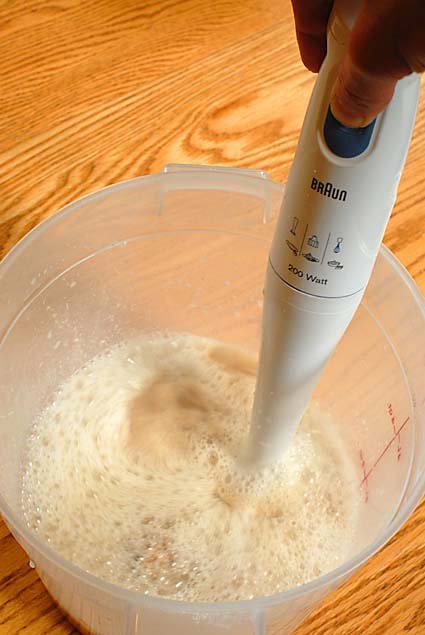
When the coast is clear, let it rip, keeping the head of the immersion blender submerged (or you will get splashed!):
Now put the bucket back on the scale, hit the “zero” button again, and weigh in 2 pounds (32 U.S. ounces) of flour (I used a mixture of all-purpose and whole wheat in a ratio of about 5:1 all-purpose:whole wheat to give the result in the Light Whole Wheat recipe on page 74). If you’re using cup-measures, it’s 5 1/2 cups of white flour and 1 cup of whole wheat. White all-purpose flour weight about 5 ounces per cup, and whole wheat weigh about 4.5 ounces per cup, but at this ratio, it’s very close to 2 pounds total flour (32 ounces). Learn more about mixing our doughs.
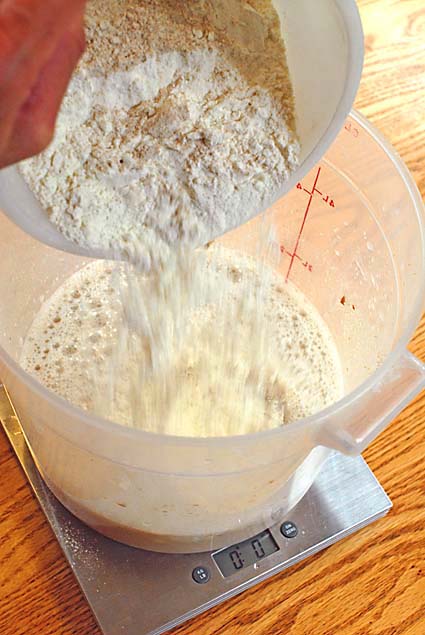
Mix it in with a spoon:
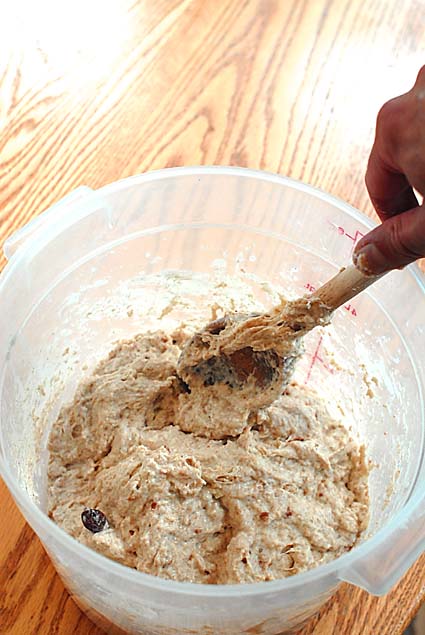
…and the dough is ready after about two hours at room temperature:
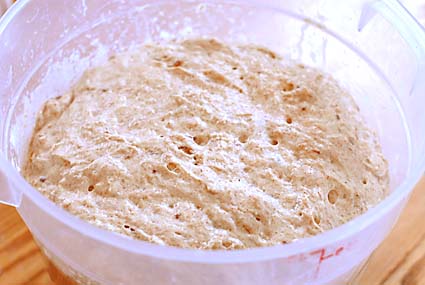
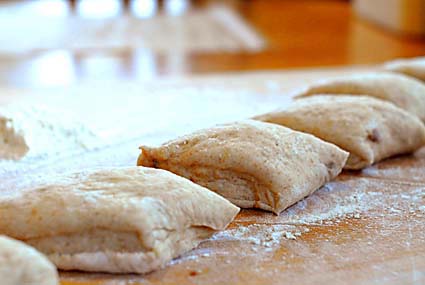
Store the bucket in the fridge for up to two weeks and tear off chunks as you need it (vent the bucket in the first few days by keeping it open a crack). For the whole grain baguette rolls, form a beautiful baguette using the letter-fold technique (see Zoe’s earlier post on this). Then, using a dough scraper or a knife, make angled parallel cuts about 2 inches apart along the length of the baguette:
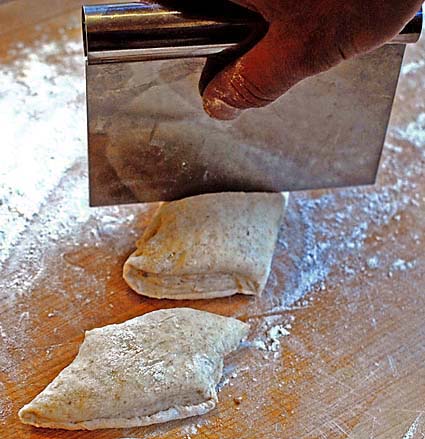
The buns will flatten from being cut, and they won’t appear to rise much before baking, but they get great oven “spring” (like all of our no-knead stored-dough recipes). Let the buns rest on parchment paper or a silicone pad for 20 to 40 minutes:
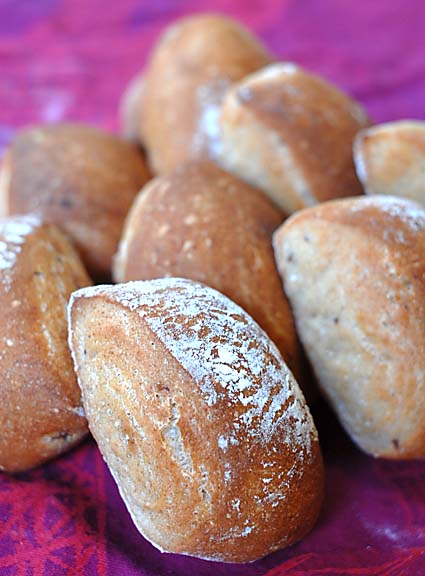
Preheat a baking stone to 450 degrees Fahrenheit (230 degrees Celsius) near the middle of the oven for 20 to 30 minutes, with a broiler tray to catch water on any other shelf that won’t interfere with the buns. Place the parchment or the silicone pad with the buns onto the stone, throw a cup of water into the broiler tray, and bake for about 20 to 25 minutes. You’ll get a gorgeous result, crusty and fragrant:
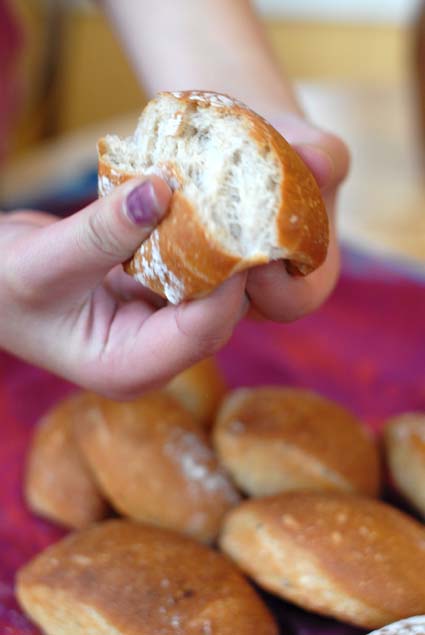
Wait at least an hour before breaking into them! Any sooner and the texture can be overly moist. Two hours is about perfect.
Note: Red Star Yeast (Lesaffre Corp) sponsored this post, and supplied yeast for recipe testing.
Note: BreadIn5.com is reader supported. When you buy through links on the site, BreadIn5 LLC earns commissions.
I’m a bread baking beginner, have made two half batches of your master recipe on page 26 of Artisan Bread In Five Minutes A Day, and have made one pound loaves on two different days both times. The suggested baking time is 30 minutes. If I want to make one two pound loaf instead, how long should I bake it? Should the oven temparature be 450 degrees as it is for a one pound loaf? Thanks!
Hi Jim,
We are thrilled that you are baking bread, thanks for giving it a try! When you increase the size of the loaf, you need to let it rest longer before baking and let it bake longer. The oven temperature stays the same. If you are baking 2-pound loaves then you will want to allow the dough to rest about 45 minutes longer and bake an additional 15 minutes.
You may also find it helpful to look at some of these posts: https://artisanbreadinfive.com/?page_id=1479
Thanks and enjoy, Zoë
Hi Jeff,
Thank you for your response. I have ordered Healthy Bread in Five Minutes as well since AB in Five Minutes is such a great book. I borrowed ABIFM from a library 7 days ago and I have made several batches of half-size dough already. They all came out great though I am a complete novice at bread baking. This tells me how well tested this recipe is. Thank you for your great work and sharing this with us.
Miho
Hi Miho,
It is wonderful you are already baking so much bread!
Enjoy, Zoë
Hello!
Love your technique, and want to start incorporating ‘old’ dough into my new batches for added intensity. I generally make a triple batch of the master boule recipe. What amount of old dough would be ideal to add to the water? 3 lbs for a triple recipe (1lb/recipe)? Also, how old should or could the old dough be? I imagine at least 5 days but not more than 2 weeks–but what have you found to be ideal for robust flavor? If it matters in terms of rise–this is usually for big pizza parties and I make a thinner crust. I use KA AP flour and just increase the water by a scant 1/4 cup per master recipe (in case that’s relevant too). I form my lightly aged dough into balls in the morning and store them lightly floured in a dough box till party time, and then we roll them out and bake them as the party goes. It’s pretty fun.
Thanks for your great book and website! Looking forward to your advise.
Hi Aleeza,
I usually keep about a cup of the old dough and just mix the fresh ingredients to it, but I have done a bit more with great results. You could certainly add a 1-pound piece of old dough to a triple batch. The age of the dough will depend on your preference for the flavor. I have used dough that is 5 days, but have also done this with dough as old as 3 weeks. The longer you wait the more intense the flavor. Because you are also adding fresh yeast to the batch you will not have to worry about the rising power of the older dough.
Thanks, Zoë
I am getting ready to mix up the Pain d Epi bread from AB in 5 and wanted to know if I can use the weight measurements for the all-purpose flour for the bread flour?
Hi Amanda,
1 cup of bread flour = 5 ounces (140 grams). It will be a tighter dough!
Enjoy, Zoë
I just got my Artisan Bread in Five Minutes a Day and have a question – as far as the sweep and scoop method of measuring flour – the Master Recipe is the only recipe that calls for this. Should I use this method to measure flour for all recipes in this book? I usually measure flour by spooning it into the cup and leveling it off – the way I learned in Home Ec a long time ago!
Hi Geri,
Yes, all of our recipes should be done with the scoop and sweep method. The Master recipe is the most detailed in the book, but the rest should be done in the same way.
Thanks and enjoy! Zoë
Hi Zoe, I have a mental block about white flour, the refined kind. Can I replace with wheat flour or even a mix of wheat, Spelt, Millet? Do tell me how I can lower the white flour in this.
HB: You can’t just swap in whole grain flour, you need to increase the water– esp if you’re using millet. Which of our recipes are you using, and from which of the books? Jeff
re: scoop and sweep method. i am sorry that i lost track of where the post appeared dtd 4/11/09? where he said (if i remembered right) that scoop and sweep is not recommended for your bread recipes. yet, i find that is what you say int he books.
pls clarify.
Hi Amy,
You DO want to use the scoop and sweep!
Thanks, Zoë
Since I bought your book and tremendously enjoyed the basic recipe, I have discovered I am allergic to gluten. Have you created any gluten free bread recipes?
thank you for the great bread I was once able to enjoy!
Karen
Karen: Our second and third books include some gluten free doughs (Healthy, and Pizza, click on the book images above). A sample recipe is at https://artisanbreadinfive.com/?p=1396
happy to see this post using sourdough. i have a sourdough starter which was the basis of my bread baking.
been raving about your book! and methodology!
A while back I posted about having problems when I weighed AP Unbleached white flour (Gold Medal). I bought a new scale and started weighing the flour after I measured it–and so far I’m averaging 4.68 oz/cup. The bread is working fine. Yes. I use the scoop and sweep method to measure.
I’m starting to experiment and it has been fun!!!!
Hi Christina,
Are you stirring the flour before you scoop it? If you aerate the flour before scooping you will end up with less flour in the cup!
Enjoy the bread, Zoë
Hi,I don’t have refrigerator room for a 5/6 litre container for the master dough, can the quantities be halved? Many thanks.
Hi Tracey,
Above every recipe in our books it says that the dough can be doubled or halved to suit your needs.
Thanks and enjoy all the bread! Zoë
Safety tip for the immersion blender. I disconnect the “business” end from the “power” top until ready for use. I make sure that the blades are immersed and then reconnect the top. When done, I remove the top from the bottom, and then remove the bottom separately. That way the blades are never in a place where fingers can enter.
New to ABin5, have the NABin5 & HBin5 and enjoying exploring them. We often make WW bread from wheat we mill rather than WW flour purchased online or in grocery stores. We were told quite some time back that the commercial flours bought off the shelf, unrefrigerated, had by necessity had some of the germ removed to prevent them from becoming rancid. With that in mind and to maintain the proper hydration, is there a need to alter the recipe (pg 79 of HBin5)?
Hi Ross,
I’ve found, from hearing from other readers who mill their own flour, that the biggest difference is how fine the commercial flour is. As a result of the fine ground flour it absorbs more water. So, you may find that you need to decrease the amount of water slightly in your dough. I’ve also heard that increasing the VWG slightly helps produce a bread with better structure and rise.
Thanks, Zoë
This 1 pound dough is equivalent to 453/454 grams? The bread I made turned out super hard and i had to wait for 2 days before i could bite into it. I may not have taken out the right proportion of dough as ‘grapefruit’ amount is quite vague to me. Thank you.
Prakash: Yes, 454 grams. But that has nothing to do with the consistency your getting. Which recipe from which of our books (and page number) are you working from? Exactly what flour are you using? Where are you located– what’s available there?
Sounds like the dough consistency is wrong, not the amount of dough you’re pulling out of the bucket. Jeff
Do you have weights for rye and durum flour too? It’s less cleanup to use the weight instead of scoop and sweep since I can pour right from the bag.
Hi Chris,
Which book are you using? If you have HBin5 there is a conversion chart for all the flours to weights.
Thanks, Zoë
Hi, Zoe & Jeff
I have a question about fresh and refridged dough.
My kids’ favorite is Bran muffin bread (Healthy book) and loves dinner roll shaped than slices of bread. I usually make this rolls with fresh dough, 2.5 oz each (measured by a scale) about 24-27 of them. Today, first time, I made dinner rolls shapes with refridgerated dough (overnight). Again, 2.5 oz each but I could make only 16 of them and when they are done, it was huge dinner rolls!!! We all still love them and they are fine.
Usually recipes say, how many lb of how many loaves for the one batch, but once it’s refridged, dough is not same weight as fresh one?! Please give me a tip to solve this problem!!
Thank you very much!!!
Remi: So you just want to make smaller ones? Try a visual cue (like “golf-ball” sized). Or something like that. Or do you mean you are weighing them before baking?
I’m not seeing how refrigeration could change the dough weight in the short term. With long-term storage in an open container, it will dehydrate and lose some weight that way. I can’t imagine that’s what’s happening? Jeff
I would like to thank you, for putting up this website. i got in to this will give me a kickstart.
I make your semolina bread. I use unbleached all purpose flour & semolina flour using the scoop & sweep measuring. When baking I use a scale to measure the dough. I get 3 lb loaves and the last is only a little over 9oz. I tested the scale & it is accurate. What am I doing wrong?
Hi Gerri,
It may not be an error on your part at all and the recipe could make just shy of 4 pounds. Does the dough seem to be the right consistency when it is baked, or does your dough feel as thought it is too wet and in need of more flour?
If you prefer larger loaves, bake the dough as 3 loaves. You may need to let the dough rest longer and bake longer.
Thanks, Zoë
Conversion error: Five Minute Bread (UK) ISBN 978-0-09-193894-9
The Master Recipe (p 44) gives a bakers percentage for water of 78.3% if the imperial units are used and 83.3% if metric units used.
Which is correct?
The same errors occur elsewhere in the book
Nick: Stay closer to 78% hydration and you’ll be in good shape. Jeff
Can you post the weight conversions for all the gluten-free flours that you use. They are not in the Healthy Eating cookbook. In particular the conversion for soy. As some of the others are on the web site.
Thank you.
Avas: Conversions for brown rice flour, sorghum flour, tapioca flour (starch), conrmeal, corn masa, and teff flour were published in our third book (https://amzn.to/eo10NJ)– though not soy, which doesn’t appear in the third book. Our publisher will seriously kill us if we make all our content available for free here on the web– so sorry, just can’t do it! Jeff
Hi there. I’ve started using a scale recently, which made huge improvements in the ease and results in baking. I was wondering if you could share the weights for 1 cup of semolina or oat flours? It’s not in ABi5 or HBi5, and from your post above, it sounds like it’s not in the third book either. I’ve tried Googling it, but of course there is a wide range in the results…
Frances: Have never weighed either of those, and don’t have any in the house at the moment. Just weigh a cup of what you have the standard way you measure (hopefully scoop-and-sweep), and record the weight. Adjust as needed if the recipe isn’t coming out the way you like.
Hi _ i just love your book ABin5 and have been baking happily here in Australia for weeks now. I have just purchased a baguette pan on which I can bake 3 baguettes. Are there any special techniques I need to know? The pan is made from perforated metal.
many thanks for this fabulous method.
Sallie
Sallie: Those should work with our usual directions, same baking times… Glad it’s working well for you!
Measuring by weights make this process even easier but I am a little confused. First, a question about weights on the flour packages. All my wheat flour packages (bread flour, whole wheat flour, white) all say 30 grams/1/4 cup, no matter what kind of flour it is (120 grams/cup) Your converstion chart has different weights for the white and whole wheat, and neither of them is what you give in the charts. Second, the weights you give in the basic Second, the master recipe on page 54 aren’t consistent with your chart. Example: you say 270 grams (2 cups) white flour while your chart puts the weight at 130 a cup. I know these are really minor differences, but one of the great points of weighing is the accuracy you can achieve. So much better and easier than measuring, as you point out.
Love the books. I’m a fan, if not an addict. But I’ve said that before.
Thank you,
Hi Roz,
We measure our flour by the scoop and sweep method, which may be different from how the bag of flour expects you to measure (usually spoon and sweep). No matter how they are measuring, whole wheat, white and bread flours don’t actually weigh the same, so that is a mystery.
You are right, there is a discrepancy between the chart and the master recipe. 1 cup of unbleached AP = 140 grams, as it appears in the chart. 2 cups of the flour should be 280 grams.
It should not make a difference in your dough, but it is good to know!
Thanks, Zoë
Hi Zoe,
Can your recipes in the book “Healthy Bread in Five Minutes a Day” be converted to White Whole Wheat Flour?
I’m not a big fan of using any regular white bleached or unbleached flour. I would like to use White Whole Wheat since it is not as dense as Whole Wheat itself.
Great website. Thank you!
Brenda: Yes– we have a discussion of that in the book.
Thanks for the reply! Looks like I will be buying your book.
Brenda: It’s the second book that has what you’re looking for– Healthy Bread in Five Min/Day (https://bit.ly/3wYSSN). Also, you can’t just swap WWW for AP white flour, that won’t work. WWW swaps for regular WW.
I love the idea of not washing the bucket and using old dough. I substitute some ground flax for some flour. Can I reuse some old dough or is flax perishable? I only sub out 1/4 cup flax for 1/4 cup flour.
Thanks! I have all 3 of your books and love them!
Pat: Flax goes rancid in the cupboard pretty quick so I see your concern. But I’m guessing with constant replenishment it’s not going to be a problem. Look for fishy off-smell and dump it, starting over, it develops.
Same answer regarding caraway seeds, but those don’t get fishy.
Also what about rye bread with caraway seeds. Can I keep reusing my old dough and incorporating them into new batches?
I believe there’s an error in your conversion factors?
You have “1 cup water: 8 ounces (225 grams)”
In fact a cup of water is 8 fluid ounces and weighs 237gms – a significant difference in your recipes, as I found out!
The weight can be easily confirmed with a digital scale.
Chris: Some error is unavoidable due to rounding. 8 ounces by weight, if you had an accurate weight that was exactly measured, rounds to 227 grams, not 237. Some references state that a cup of water (8 fluid ounces) is 8.2 ounces by weight, which rounds to 232 grams, but for the cup-measures we find in supermarkets, 8 fluid ounces are very close to 8 ounces (by weight). So that’s what we went with– rounded to the nearest five grams, 225 was the closest (assuming a true 8 ounce cup by weight).
Part of the confusion in English measures is that fluid “ounces” and weight “ounces” use the same word– ounces, but their not the same.
But sounds like your cup-measure is on the higher end of this estimation–not what we found in our supermarkets. For which recipes does this give you trouble?
“Part of the confusion in English measures is that fluid “ounces” and weight “ounces” use the same word– ounces, but their not the same.”
Actually Jeff the UK/English measures ARE the same – but the US measures are NOT the same as their UK counterparts. In the US system an ounce weight is 28.4 grams, but the fluid ounce is 29.57 milliliters and since water weighs 1 gram/mL it follows that 1 Fl oz of water weighs 29.57 gms.
https://simple.wikipedia.org/wiki/Fluid_ounce
So what does this mean? Simply this – 8oz of butter/flour etc weighs 227.2 gms, and 8 fluid oz (1 cup) of water weighs 236.6gms (8.33ozs).
You can confirm this easily by carefully weighing 2 cups of water – I’ve used both a Pyrex jug, and Tupperware measuring cups – and you’ll get ~473gms. Or look at a can of soda – it says 12fl oz, 355ml(=gms) so thats 237 gms/8oz. Or weigh an empty can vs full can.
If you add 3 cups of water to 2lbs of flour as in the original recipe, you get 710gms/908gms or 78.2% water. If however you use your equivalent of 225gms you get only 675/908 or 74.3% which I found to be too low.
Sorry for the boring geeky detail!
Chris: Our goal with the standard recipe is a hydration of 75%. I can’t tell the difference between 75.0% and 74.3%, which is why we fudged this. If you’re not loving 74.3, just up the hydration a bit. I don’t have any problem with 78.2 either, and some of this depends on the protein levels in the flour available to you. Our general point was that white dough in the 75%-78% range would store well under refrigeration; from there users can alter our proportions to their taste and how they like the dough to handle while shaping.
Your other point is well taken; I should have said “the U.S. version of English measures.” Yes, English and US-English are different. We Americans should have listened to President Carter in 1977 and switched to metric and this would all be moot! Are you in the U.K., and if so, are you using the U.K. version of the book? On Amazon UK at: https://www.amazon.co.uk/Five-Minute-Bread-revolutionary-kneading/dp/0091938945/ref=sr_1_1?s=books&ie=UTF8&qid=1294401650&sr=1-1
No I’m not in the UK Jeff – I just prefer to use weights rather than cups.
Thanks for taking the time to respond.
I learned about your books and website when I was searching for information on no-knead bread. I am dying to get ABin5 but I would really, really prefer the recipes in weights, rather than volume.
I know I could get the book and write down the conversions on every page but… not so appealing. Does the UK version have the ingredients for each recipe listed by weight? Is it possible for me in the U.S. to get this version? Thanks so much!
Hi Jenny,
Yes, the UK version has all the recipes in weights. You can order it through Amazon.uk. I’m not sure if there is any other way to get that version?
Thanks, Zoë
It sounds like the UK version is just what I want! I’d love to get it on the Nook. I’ll have to investigate a bit.
Hi! I have and LOVE all 3 of your books! My question is this….on some recipes,such as the one I am doing today,( brioche,p.254 pizza and flatbread)there is a line through the vanilla when weighing ingredients in metric weight. Does this mean to omit the vanilla?or measure by u.s. volume for this one ingredient.
no, it means that there’s too little of a quantity to accurately weigh such a small amount on most home scales. Do by US volume.
Weighing my pizza dough recipe together is the only way I do it. I do everything inn grams & bakers percents. I just bought the Pizza & Flatbread book and can’t wait to try some of the recipes & ideas. To make dough to keep in the fridge for a while, I used my normal total weight recipe but cut the hydration back from 67% to 60%, increased salt slightly, and reduced yeast slightly so everything should be a bit slower.
I love making my own lunch pizzas but I want to be able to have fresh, not pre baked crusts to make them with.
As newly retired folk, my wife & I like to cook & bake and we try to avoid processed foods (anything in a box really) so we’re always looking for scratch recipes from fresh ingredients.
Fantasic John, happy retirement, you’re doing it right…
I mixed the dough for the Peasant bread in your first book. I have the Kindle version. It seemed to be very, very dry. I refrigerated it overnight and then I weighed out 1 1/2 lb and added about 2 tbl of water. Needless to say, it was very difficult to mix in. The loaf is edible but not great. Is there any way to fix the balance of the dough so it’s correct? I’m sure that in using the scoop and sweep method I probably added too much flour. I’m used to weighing ingredients in grams so now that I see that you have weight measurements in the book I feel confident that the next breads will be great. I just wanted to try and salvage what I have and would appreciate any suggestions. Thanks.
Sure, work in water with your fingers in a bowl or dough bucket. Maybe a little more than you need, so you can add back a little flour and set up another fermentation (this working-through will knock all the gas our of our dough.
It may be a measurement problem, but it might be your rye and/or whole wheat– sometimes the products available soak up a lot of water because they’re high-bran and coarsely-ground. Just adjust the water as needed in the initial mix to get a consistency like you see in our videos:
Gluten-cloaking/shaping: https://artisanbreadinfive.com/2010/03/08/new-video-shaping-the-ball-from-a-very-wet-dough
Gluten-cloaking/shaping with whole-grain dough: https://artisanbreadinfive.com/2010/02/16/new-video-how-to-shape-a-loaf-using-whole-grain-dough
The Scoop-And-Sweep Technique: https://artisanbreadinfive.com/2010/04/28/how-we-measure-our-flour-using-the-scoop-and-sweep-method
But the gram equivalents: 680 grams water, 60 grams rye, 65 grams WW, 780 grams all-purpose. You may still need to adjust, depending on your products.
Thank you. I’ll try adding water and letting it go through another fermentation. I know that my white whole wheat is pretty coarse. I’ll try weighing the next time.
Can these be made in a Dutch oven? If so, cover for 15 mins like the boule then finish cooking uncovered?
Hi Melanie,
It will be difficult to create any space around the buns in a Dutch Oven, but if you are just doing a few you can certainly give it a try. Yes, you’d start with the pot covered and then remove the lid to allow them to brown for the last 10 minutes or so.
Thanks, Zoë
Somebody else may have posted this already, but if not: you give 1 cup of water as weighing 225g. This is inaccurate, it’s actually 236. So in your regular recipe that asks for 3 cups, bakers like me, who want to go by weight not volume, would be off by 33g, which is a lot! Maybe that’s all correct in your books, I don’t know, but if someone goes by what’s on this page, they could be in trouble…
I know some references say that an 8 fluid-ounce cup of water weighs about 8.2 ounces (rounded), which is about the gram-weight you’re giving. But when we actually weighed the water in commercially-available U.S. liquid-cup measures, we found it was very, very close to 8.0 ounces, which is 226.8 grams. Rounding to the nearest 5 grams, we used 225 grams in the books and in this post. Since we tested our recipes with those same commercially-available cup-measures, you’ll get results closer to what we obtained if you use the smaller number.
Honestly though, I’m with you, I’d prefer we do everything by weight, in grams. But that won’t fly with a significant fraction of U.S. bakers.
Oh my. Thanks for the clarification. I may be in trouble then–I have a dough sitting in the fridge I made according to your boule recipe (first time I’ve made it), and I converted everything into grams; I used 236g per cup of water. I’m looking at something closer to soup… I thought it looked thinner than in your videos! I was going to bake tomorrow. Can I salvage this? I’m worried I’ll just have this thing running all over the place…
Yes, that’ll be too wet, but you can always work extra flour into it (best early in the batch life, like now). If you’re going by weights, and you’re doing the basic boule recipe all white all-purpose flour, then the ratio of the water-weight to the flour-weight is 0.75. In other words, 750 grams of water for 1000 grams of all-purpose flour (or 1.5 pounds/2 pounds). See this post for more about hydration with different flours: https://artisanbreadinfive.com/2008/02/10/qa-flour-and-water
Our most recent book has everything in weights (US and metric), plus US cups (on Amazon at https://amzn.to/17Rw23Y).
Am I able to make English Muffins with the Master Recipe Boule??
Thank you
Hi Marge,
Here is a post on making English Muffins: https://artisanbreadinfive.com/2013/11/01/english-muffins-on-the-stove-top-with-gold-medal-flour-and-red-star-yeast
Thanks, Zoë
Thanks for this wonderful way of making bread. I use it all the time and just make communion bread with the 100% Whole Wheat Sandwich Bread recipe (although I make it free form and partly with all-purpose flour). I haven’t seen your new book, but I’ll look for it. Does it have an ebook version?
Sure does! Click on “Kindle” when you go to https://www.amazon.com/gp/product/1250018285/ref=as_li_tf_tl?ie=UTF8&camp=1789&creative=9325&creativeASIN=1250018285&linkCode=as2&tag=arbrinfimiada-20
The first time you make any bread recipe it is easier later if you measure by volume and then get the weight in grams (even the yeast and salt). If you measure in grams you will be much more accurate and grams will weigh smaller amounts. I try to convert all of my baking to weight in grams and once I got everything right I have never had a problem duplicating a recipe.
I’m trying, quite unsuccessfully so far, to learn to bake without gluten. The rest of the recipes in Hbin5 show ingredients by weight, but I don’t know how to convert the ingredients in your gluten-free recipes to weight rather than volume measurements. Googling volume-to-weight produced results that disagreed, sometimes by quite a lot. Can you help me with this, please? Thank you!
Hi Christine,
Here is a post about the GF crusty boule and at the end of the posts there are weights for the flours. You may also want to watch our GF video. https://artisanbreadinfive.com/2010/01/05/gluten-free-crusty-boule
Thanks, Zoë
Hello,
Just curious about a measurement…in ABin5 on page 170 you say that 1/2 cup of rolled oats is 55 grams. However, for the oatmeal maple bread on page 162, you say 1 1/2 cups is 140 grams. If 1/2 cup is 55 grams, then shouldn’t 1 1/2 cup be 165 grams? How many grams in a cup of rolled oats?
Thanks!
Hi Lindsay,
Thank you for letting us know. The measurement on page 162 should read 165. We will add it to the corrections page.
Enjoy the bread! Zoë
140 g flour
130 g wholemeal flour
225 g water
and yeast?
yes, scroll down to see the rest. And salt.
Wonderful! That reminds me the ‘petits pains’ I used to eat in France. Do you know about Carrefour ? It’s a huge supermarket chain in France. They started ‘petits pains’ years ago. You got the natural ones, then you can choose from Bacon, black Olives, Cheese, Herbes de Provence, Walnuts and whole wheat. So yummy! Germany has so many ‘Brötchen’, called buns here, you sometimes get a hard time at the bakery choosing what you want. So glad you enrich the possibilities baking buns! More, please 🙂 And thank you so much for sharing !
Hi! Experienced bread baker here, having a whole new learning experience with this kind of quick [yeasted] bread. One word re weight of flours and other dry ingredients: flour, brand to brand, year to year, season to season, and especially grain to grain weight of a given volume can vary a great deal. I’ve used one brand of all-purpose flour for years and can count on it being 120 grams/cup — a well-sifted cup, that is. I use several kinds of whole wheat flour that are anywhere from 120 grams to over 140 grams/cup. (And for you UK folks, these are US cups, which are slightly different.) I can suggest two things: check what the ‘nutrition information’ says about the weight of a given amount of flour, and if you’re working with a tricky recipe, test it by double sifting and then measure exactly a cup (or other, preferred, volume measure). PItA (pain in the a^^) but it helps.
If I had my choice, I’d do the books only in grams, weight is clearly easier to work with, and grams are easier than pounds and ounces. So agree with everything you’ve said, but we’re limited because U.S. bakers are still just now transitioning away from U.S. volume in recipes.
Can I use sourdough powder in the basic recipe?
It won’t harm anything, but as I understand, it doesn’t have much leavening power on it’s own, so I believe you have to use at least some commercial yeast. Or use a natural sourdough starter that has good leavening power. See my post on that by clicking on the “FAQs” tab above and selecting “Sourdough starter: Can I use it with this method?”
We haven’t tested with these products, so you’ll have to experiment.
Have you ever thought of doing a book on freshly milled wheat from a mill like the Grain Maker (https://grainmaker.com/)? It’s kind of trial and error and more often than not the end product is inferior in texture and rise than the whole-wheat from the store alternative. It’s really hard to find tried and true recipes for 100% fresh ground flour.
Hi Jonathan,
The issue is consistency. Home ground flour tends to be coarser than commercial flours and each grinder gives a different result. Given that, it is hard to predict the amount of hydration a recipe will need to produce a nice loaf. We’ve also found that home ground flours require additional gluten to produce the structure needed for a nice rise. Vital wheat gluten will help.
Thanks, Zoë
I have a copy of Artisan bought after 2009 and there are no recipes by weight. I just bought a Kindle copy today (2017) and no no recipes by weight. I read on this site that there would be with editions after 2009.
I’m confused, because I use King Arthur Flour and its weight for
APF and bread flour is 120g. For whole wheat is 113g. That is a big difference than the weights you give.
So is there a place where I can use weights that have been tested in the breads in the book?
Thank you.
Hi Andree,
The kindle book you bought was the “New Artisan Bread in Five” or “Artisan Bread in Five”? Only the NEW one has weights. If that is what you bought, I will have to consult the publisher and find out why it doesn’t have all the weights, I am under the impression that it does.
King Arthur spoons the flour into their cups, which results in a smaller amount. We do the scoop and sweep method, so the cup will be heavier.
Thanks, Zoë
thank you. I’m talking to Amazon now about exchanging for the NEW (and it’s $5 cheaper!). And the explanation about the weights: fascinating. I’ll follow your weights, then.
(I actually never thought you would respond! Only an hour or so response. I’m amazed.)
I got it the right book now and I’m thrilled.
I’m also using my standing mixer now for mixing. Years ago, I did it by hand and it just got to be too much in my life for that. So now I’m back with your recipes in our lives.
I can’t tell you how happy I am with the book, the breads, and now, with you because of your timely help.
Hi Andree,
Wow, that was so fast, I’m so impressed that Amazon was so responsive. Enjoy all the bread! 🙂
Cheers, Zoë
I am thinking that not all unbleached all purpose flours weigh the same. 1/4 cup in King Arthur weighs 30 g.
Gold Medal weighs 35 g. So I think I put way too much flour in my crusty light whole weigh bread. It asked for 5 1/2 cups. I looked at your recipes to figure out how much a cup weighs So sad. I tried to add more water 1 hour into the sit on counter phase and we will see how it turns out. Do you have a chart on comparing flour per 1/4 cup weight or something similar. I think I will need to be aware of what brand I am using.
pg81 “new healthy bread book’
Sounds like you’re reading those weights off the package label, and those suffer from rounding error. Just use the weights we recommend but make the adjustment we recommend for the flour you’re using in the Chapter 5 chart. I don’t have access to the book until tonight, but meanwhile, do you see where I mean?
I had to return that book to the Library. So I only have my copy of The New Artisan Bread in Five Minutes a day. But I did make the WW Banana Bread out of the New Healthy. Didn’t have enough bananas and It was a mistake. Seemed like lots of flour because dough wasn’t very moist even though I added water to make it 4 cups liquid. Next time more Bananas.
I am thinking I just need to use General Mills and Peillsury flour to avoid the stress I am making for myself.
I love the bread the has turned out great. 🙂 Thank you
Thank you, so glad you are trying so many different types of bread from the books!
Enjoy, Zoë
I halved the recipe. Should be 2 one pound loaves. Mine weighed .6 lbs. what happened. I measured carefully.
That version of our recipe makes about 3.6 pounds of dough, not quite 4.0, so the loaves should weight about 0.9 lbs each. I can’t explain what happened here. Inaccurate scale? But the real question is how the bread came out. If it was good, maybe it doesn’t matter, just use a little more dough for each loaf.
Is the “new” recipe still 6 1/2 cups flour and 3 cups water?
Hi. Yes, the master recipe hasn’t changed, although we reduce the amount of yeast, but not a must.
https://artisanbreadinfive.com/2013/10/22/the-new-artisan-bread-in-five-minutes-a-day-is-launched-back-to-basics-updated/
Thanks, Zoë