German-Style Rolls: Brotchen (the crusty secret is an egg white glaze)
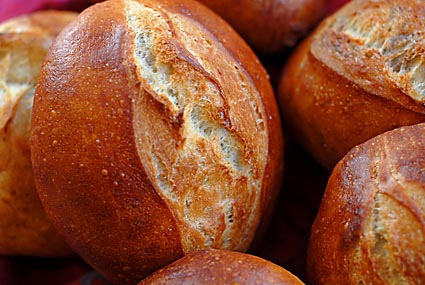
Many people have been writing to ask for German-style hard rolls. The most common are Brotchen (little breads). They’re made from egg white-enriched white dough, and brushed with more egg white before baking at high temperature with steam. In the book, Zoe and I concentrated on French-style crust techniques, which tend not to use egg white for high-temperature crisp crusts on lean breads. Turns out that the egg white creates an incredible crust and crumb.
Brotchen
First off, mix up a batch of our plain white-flour Master Recipe but make one variation: Put three egg whites into the bottom of the measuring cup before you measure out your three cups of water– so it’s three cups of liquid, including the three egg whites. Everything else is the same.
On baking day, preheat the oven with a baking stone near the middle of the oven to 450 degrees F for at least 20 to 30 minutes (place a broiler tray in the oven on any other shelf that won’t interfere with rising bread). Cut off 3-ounce balls of dough (like a small peach) and briefly shape them (as in our videos), finishing by squeezing to form an oval. Refrigerate the rest for up to five days before freezing in one-pound packages (there’s raw egg in here). You can also form a perfect little oval by using the letter-fold method, though I didn’t do it here (too lazy!).
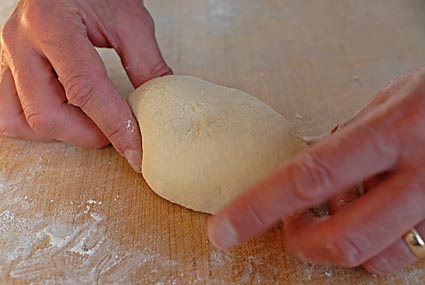
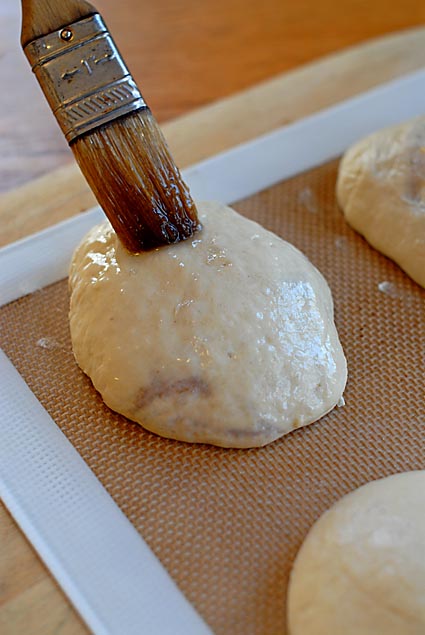
Allow to rest/rise for at least 20 minutes or as long as 60 minutes. Then use a pastry brush to cover with egg white. If you want seeds or salt, now’s your chance:
Now slash with a single cut the long way, using a serrated bread knife. Slide quickly so the knife doesn’t catch:
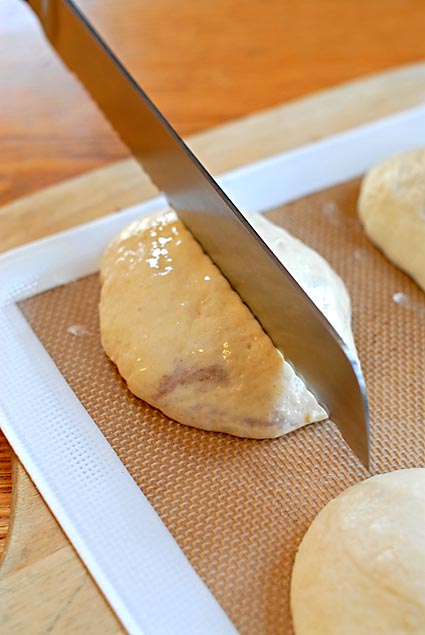
I spaced my brotchen on a silicone mat, but you could also do them on a greased cookie sheet, or a piece of parchment paper. It’s best not to do these on a cornmeal covered pizza peel; that’s just not the effect you’re going for.
Put the cookie sheet, silicone mat, or parchment paper on the preheated baking stone and pour a cup of hot water into the broiler tray just before closing the oven door. Bake for about 25 minutes. The result is incredibly crisp, shiny, and richly browned. I’m guessing that home bakers with problem ovens will find this method to be a miracle charm for getting a great crust on small breads.
I haven’t tested it on large loaves but I’m guessing that there might be trouble with over-browning if a loaf need more than about 35 minutes. More on that later.
Follow Artisan Bread on Twitter!
Note: BreadIn5.com is reader supported–when you buy through links on the site, BreadIn5 LLC earns commissions.
Made brotchen for my German friends who have been missing it terribly since moving here to the states. The first thing out of the 17yr old boy was “oooohhhhh this is soooo good – you did good Cheryl don’t change a thing!!! I sooooooooo miss this!”
It does a girl’s heart good. Guess there will always be a bucket of brotchen either in the fridge or some frozed for use with German style Frustuck.
Thank You So very much Zoe and Jeff
Cheryl: Glad this is brightening up your Frustuck! At least ein bisschen. Jeff
How does one ask a question or present a comment? Is this the way?
Hi Dieter,
You can ask a question on any post, including right here.
Thanks, Zoë
It’s called “Frühstück” or “Fruehstueck” in German.
Thanks James, now gotta find that umlaut, now what did I do with it… 🙂
We used to live on Long Island where the bread was just fantastic. My husband always had his sandwich on a regular deli hard roll which he loved so much. Now we live in North Carolina and there is no good bread down here. I love your recipes . That basic dough makes the greatest bread so fast and now I can tolerate living in NC but I was wondering if you could tell me how to make that deli hard sandwich roll.
Hi Dee,
How do they differ from the Brotchen that are in this post? I would have referred you to these, but you seem to be looking for something different.
Thanks, Zoë
Made these for Thanksgiving dinner today. Followed instructions exactly. Perfection! One full recipe yielded 17 3-ounce rolls.
I just tried making brotchen and the rolls after 25 minutes were not dark brown? Any suggestions? Also, I have them on a silpat but didn’t know how to get the silpat onto the baking stone? It is hard to move off of the cookie sheet that I had it sitting on. It seemed to flimsy to pick up and move without anything under it.
Amanda– you can’t slide things off a Silpat– too much friction. Even though the Silpat seems flimsy, you can just pick it up and drop it on the stone. Those are meant to leave the items right on the pad and bake them that way, at least until they set when you can pull the Brotchen off and sit them right on the stone, or a bare baking shelf. That can help with browning. If you’re nervous about moving a fully-loaded Silpat, put a cookie sheet under it and move the whole thing.
Most likely, your oven temp is too cool– check with something like https://bit.ly/czmco2 That explains why they’re gummy and under-browned. Till you get that worked out, you can always just bake longer.
Also, bread and rolls made with wet dough need to be allowed to completely cool before breaking in to them– or they’ll be gummy.
Just broke one of the rolls open and it is not light and airy…kind of dense and gummy. Not under cooked kind of gummy, though. I baked them for 25 minutes and they weren’t dark brown so left them in for about another 5 minutes but it didn’t make them more brown.
Me too! Did you get a reply?
Hi Karen,
Happy to help, just let me know what’s going on with the bread.
Thanks, Zoë
I would like to try your Brotchen, but I am wondering if it is still OK to leave on the counter for 2 hours because of the eggs. And then is it still good for up to 14 days? Thank you, Always a Fan
Hi P,
The Brotchen in this post is made with the master recipe and has no eggs in the dough, so I am not sure I understand the question? The egg wash is brushed on just before baking, is that what you are referring to?
Thanks, Zoë
Zoe,
This recipe has egg whites added to the warm water. That and the cornmeal is the difference between the brotchen and the master recipe. Happy Baking, Michele
Michelle: Sorry we missed your followup. Yes, two hours is OK for egg doughs, beyond that and USDA recommends finishing the rise in the fridge. As we say in the book, this becomes a five-day dough with the addition of the egg.
“First off mix up a batch of our plain white-flour Master Recipe but make one variation: Put three egg whites into the bottom of the measuring cup before you measure out your three cups of water– so it’s three cups of liquid, including the three egg whites. “
Hi P,
My apologies, with the addition of eggs in the dough we generally say to save the dough for about 5 days and then freeze the remainder.
Thank you! Zoë
Thank you for the clarification. Please tell me how to make the egg wash with water or milk, whites only, etc. I came across a website for different kinds of egg wash that yield different results. It was too many choices.
https://www.recipetips.com/glossary-term/t–34280/egg-wash.asp
Thanks again.
Correct me if I am wrong, but Ive always done 1 TBS liquid per egg, for a wash.
Hi Jeff,
That will work just fine, there is not just one ratio for an egg wash, so feel free to use what has worked for you in the past.
Thanks, Zoë
Also if I do add water or milk please tell me the proportions. Thank you!
i just made this and here’s the result:
made the 32oz flour recipe and then about 17-18 three oz breads – have a scale and measured everything.
batch 1 – forgot to slice the tops. put them in 450 convection broil and they were ready in 12 mins. i stuck a Thermapen in them and it showed 210 degrees. the tops were darker than this picture, almost too dark for my taste. almost burned them. luckily i took them out before the tops burned.
batch 2 – sliced the tops, put them in 400 convection (so the temp shows 375F), with water bath. kept them for 23 mins to get to 211F. look perfect.
batch 3 – same as batch 2. but it took only 20mins and 30 secs to get to 211F. still looked like batch 2
all 3 were were sticking to the parchment paper after they were baked. i have a stainless steel pizza peel and have hard time sliding anything off of it. but this time the rolls even stuck to the parchment paper. i will try to oil the paper next time around.
George: Check your oven temp with something like https://bit.ly/czmco2 Sounds like your oven might be too hot.
hi jeff,
my oven is new and it gets calibrated each year i dont think that was the problem. they turned out great at 400F convection. My wife thought they were not salty enough and she is not a salt lover.
Hi George,
What brand of parchment are you using? If oiling the paper creates smoke in the oven, you may just want to dust it with a little cornmeal under the bun.
You can add more salt to the next batch to suit your tastes.
Thanks, Zoë
I’m thrilled that you have posted this recipe! I have made one batch and loved the results. However I was wondering instead of using the whites from 3 fresh eggs, can I use egg whites only that come in a carton? I hate wasting the yolks 🙂 Thank you!!
Anna: Wasn’t aware of an egg whites-only product, but it sounds fine…
Thanks for your quick response Jeff. I am referring to Egg Beaters 100% Whites and other similar brands. I will give it a try and let you know how it works.
I miss my Brötchen so much as a German. I made them this morning and loved the outcome! I live above 7,200 feet and so far I have been making your recipes from both bread books with great success and no modifications. Thanks for bringing this joy into my life!
Hi Melanie,
Thank you for the note and it is interesting that you need no modification at that altitude!
Thanks, Zoë
I bought your book but I don’t remember seeing this recipe in there?! I’m already loving baking with your recipes!
Laura: It’s not in the book! The website contains bonuses the books don’t have.
I can’t believe you have a recipe for brotchen! I’m anxious to try it. Do you think that I can get good results with a whole wheat version? Or perhaps with KA white whole wheat? We eat so little “white” bread and I know my, originally German, husband will love these, so I want them to be as healthy as possible. When we went and spent a month in his Oma’s little home town in Germany he would go out to the bakery every morning and bring brotchen back for our breakfast. Wonderful memories. This would be a great treat for us.
Hi Lynn,
You can certainly make this with our whole wheat doughs, but the texture will be a bit more dense. You may want to try it with the master recipe from HBin5, which is mostly whole grain, but has some all-purpose. Which book are you using?
Thanks and enjoy! Zoë
hi my deer.
can i used cover of egg in industry?
Rasa: Don’t think I understand the question???
Can I bake these on a cookie sheet? I don’t have a stone?
Help!!
sure can, just grease well or use parchment or a silicone pad.
My daughter and I went to Germany in January 2013 and LOVED the brotchen! I was very eager to find a recipe to make it when I got home and found yours!
The first time I attempted this I made a third of the batch and baked it on a cookie sheet because I didn’t have my flat stone yet. I didn’t like how the bottom turned out (very pale and biscuit looking) and handling the fresh dough was sticky and difficult. But everybody liked the taste.
The second third of the batch had been refrigerated and this made it MUCH easier to form the shapes and also cut the tops with a serrated knife. Too bad I had been baking something else and forgot to up the temperature from 350 to 450! When I realized my error I bumped up the heat and cooked them a little longer. This time I used a silicon mat on top of a baking stone and I liked the crust even better but it still was not right due to my temperature error. But we ate it!
So third time’s a charm I did everything correctly and it turned out great! I still would love to have that tiny waffle print on the bottom of my rolls instead of them being flat like a biscuit. I’m going to research mats and see if I can get a textured one like the above pic.
So today I started another batch and have done everything right! We will be trying to also make a bigger loaf using my stone bowl I’ve had for ages. I will post an update later!
Hi Laura,
So glad you are enjoying the rolls. There are baking pans that are textured, which will give you the look you are wanting. Here is an example of a textured bottom: https://www.amazon.com/Baking-Pan-Textured-Bottom-360/dp/B0083IFTTI/ref=sr_1_4?s=kitchen&ie=UTF8&qid=1366513918&sr=1-4&keywords=SNB You can ask at a kitchen store if they carry them or can order one. You will get a crisper crust if you don’t use the mat and just bake directly on the pan.
Thanks, Zoë
Is there any way to make this gluten free using your Gluten Free Crusty Boule recipe?
Absolutely, same temp but might need a little more baking time; it’s wetter.
Question: Do you use yeast or baking powder? I actually have not found the detailed Broetchen recipe on the website.
Hi Gunther,
The recipe is given as a link in the post: https://artisanbreadinfive.com/2008/04/27/great-coverage-in-the-week-magazine-but-there-was-one-little-problem
All of the recipes from our books are made with yeast.
Thanks, Zoë
I made these for Christmas Eve tonight as we have a traditional german meal on Christmas Eve. I also made the Bavarian bread but haven’t cut into it yet. The brotchen are good– better than we could have found anywhere locally, but it wonder how it would work with pastry or cake flour? I read on another website that the protein content in American flour is much higher than german flour. So….with that in mind, I may try this method with a lower protein content flour and see what happens! But they are good good good!! They will go well with our meal!
So glad to hear. Honestly, I think you may have trouble getting them to hold their shape with pastry or cake flour, but I could be wrong (with something this small). You will have to adjust the water downward or the dough will be too wet.
You’re right in general about Euro flours, definitely lower. Though my guess is: not as low as pastry or cake flour.
I mix flours together to get the effect you’re looking for.
I mix 1 1/4 cups all purpose flour with 3/4 cup cake flour to make biscuit flour. This has a lower protein content than all purpose but more than cake flour.
I can’t get biscuit flour overseas but mixing AP and cake gets me very close to what I need.
In the US, White Lily flour (found in the South and available through mail order) makes a biscuit flour that’s probably close to the protein level of the European flours you want to reproduce.
The only thing I would have been concerned about is whether the mixture has enough gluten to maintain structure during storage, assume you’ve been able to store this dough?
You don’t know how happy you’ve made me! Loved and missed brotchen terribly since our time in Germany 20+ years ago! They always served schwenkbraten on them–found the recipe for schwenk years ago, but never found one for brotchen. Feeling ever so grateful right now! Thank you!!!
I’m making the brotchen tonight, trial run for Thanksgiving. In the book, pg 88 you say decrease temp to 350 and up cook time 25% with egg enriched dough. But in brotchen recipe page 89-90 you show 450 temp while using egg enriched dough. First go and I’ve cooked nearly 40 minutes at 350 and no browning. Can you clarify which temp for egg enriched brotchen.
The Brotchen calls for just egg whites; when we said “egg-enriched dough” we were thinking of challah/brioche, which has yolks and is prone to burning. Which are you using? Also have you checked oven temp with something like https://ow.ly/8CVPU ?
Yes, I use that exact thermometer and wait for the oven to heat to temp on that vs the built in. I was using egg-whites only recipe. Thanks Jeff.
This recipe is perfection. Brotchen is one of my favorite memories of Germany. I was hopeful when I saw this recipe, but was also a bit skeptical. It was just like I remembered. I used Antimo Caputo Chef’s Flour. I don’t know if that made a difference.
Hi Anna,
So thrilled you enjoyed the recipe! I am curious to give “00” flour a try for this recipe.
Thanks, Zoë
I’m searching for a source of European flours available to home bakers in the US. All I’ve found so far is Type 405, but this isn’t suitable for making the beloved brotchen. And spaetzle, or maultaschen need a courser grind.
I was SO encouraged by Melanie’s comments (June 2012) – a German who highly praised your Brotchen recipe. I just might have to add your cookbook to my collection. Thanks for any tips on my flour search. (KAF offers tiny pouches of “specialty” flours, but they are crazy-expensive.)
Yes… and that’s why I always make do with supermarket or coop flours. I just haven’t explored Euro flours.
Because I am an American living in Europe I might be missing something. But Type 405 is all they sell here for white flour. Another recipe I read for brotchen strictly ordered 405 for all of her recipes.
Hi Lillian,
From what I can figure, 405 flour is closer to our cake flour and won’t have enough gluten strength to hold up to our recipes. If you can find 550 flour it will be better suited to your bread baking.
Thanks, Zoë
Aack. Is this salvageable? Or can I at least figure out what I did wrong? This was my first attempt with your online Broetchen recipe – eggwhites making up part of the water in the full recipe of the master (using my first printing of ABin5, which I’ve always succeeded with.) I also was incorporating 8 oz old, grey dough into the egg-white water.
After mixing the flour into the water with the danish whisk, it seemed drier than usual, but I let it be. It never rose much at all, perhaps half again the hight of the freshly mixed dough. It was SUPER stretchy when I checked it after 2 hrs, and did show some good sized air pockets. I thought perhaps it was too dry/stiff to rise easily, so put half the dough into a Ninja food processor with dough blades and 1/8 C water, attempting to hydrate it further. The machine struggled against the resistance of the dough, so I added it back into the dough bucket and hand incorporated it. It became even stretchier, and has now been on the counter 5 hours.
Possible culprits: I used 4 whites instead of 3 (not worth explaining why)
I live in a super arid desert, and usually have to add more water to all your recipes. Maybe the dough was still too dry? Though it was the consistency of taffy on a machine, after I incorporated more water into the whole batch.
I didn’t leave the lid cracked – can the gases build up enough to create resistance against the rising dough??
If I bake this dough into rolls, am I going to get hockey pucks? If so, can I make pita or crackers out of it instead?
Thank you in advance for your help. You’re both always so attentive and helpful with your readers.
Hmm. You’re describing a “tight” dough, and the only explanation for that is not enough water. If you can work in enough water to bring it back to expectation, should be fine.
Or, just try baking off a little of it, bet you can get away with this.
Okay, thanks for the fast reply, Jeff.
I’ll give it a go with fingers crossed and report back.
well, I tried it again (3 egg whites, topped off with water to equal 3 cups of liquid aaand I used 8 oz old dough incorporated into the liquid with an immersion blender.). It hardly rose. I got nice air bubbles and the dough was definitely wet enough. Could it be that the old dough I used was too old? There was no mold on it, but it was easily 1 1/2 months old, if not older. Or do you think there’s something funky about mixing the egg whites with old dough?
Honestly, I can’t explain it. Though I will say, that 1 1/2 months old (without replenishment) is longer-stored than I’ve ever used. But if you’re using a regular yeast-dose, this just doesn’t make any sense.
Here’s the clue though– you say there are nice air bubbles. That means it’s spreading sideways rather than rising upward. Maybe this is just a variant of normal. When people say “didn’t rise,” we think “lead brick.” Not what you’re describing.
I made these for a friend, and even though she though they tasted fine, she said they were too dense, like not enough air. I followed the recipe from your book to a t. Except I use oil on my hands instead of sprinkling with flour to prevent sticking… Could this be it? Suggestions?
By the way, I love your book! This is my “go-to” book when baking bread. Thank you!!!
Hi Luba,
If they were too dense try letting them rest longer before baking. An additional 15 to 20 minutes may make a big difference.
Thanks, Zoë
Thanks! I just read somewhere the overnight starter might help too. Will surely try again. 🙂
Hi Luba,
The over night refrigerator rise is a great option.
Thanks, Zoë
I tried this recipe and, although I liked the taste, they didn’t rise much at all. I used Caputo Tipo 00 Italian Flour. Could this have been the culprit? They did spring a bit , but overall resembled more of a flatter ciabatta than a brotchen. I also tried with a 30 minute proof and with my second batch, a 60+ minute proof.
Also, they did not NEARLY get as browned as the picture above. They did have a nice crunchy exterior and a soft moist interior. I also did them on a stone in a 450′ oven for the first batch and 475′ for the second (with the rack up one notch)
Hi Jeff,
Caputo is a much different flour than American all-purpose, so the outcome of the bread will be quite different. It doesn’t have the same gluten structure, so the rise will not be the same. Try it with the AP flour and see if you have a better result.
Cheers, Zoë
Thanks Zoe! I will give it a go.
Can these rolls be baked on a convection bake mode?
Hi Sue,
Yes, you sure can. You just want to make sure you adjust the temperature, if your oven doesn’t automatically do that. Since convection heat is more intense, you want to make sure the crust isn’t getting too dark before the inside is fully baked. The benefit is that you’ll have a beautifully crisp crust and lovely color.
Thanks, Zoë
what bous it tast like
It’s delicious!
Trying these for the first time and I am at the resting stage after the dough sat in the fridge for 2 days. I am a little worried because the dough seems to be laying down and spreading instead of holding shape. Looking at the pictures they look similar but mine seem a little looser. Could this be due to too much liquid? I’m still holding out hope that it will come together when they bake.
Our dough is definitely looser than what you’re used to; it may spread sideways–there are ways to deal with that, but first see how it comes out–may be fine. Which of our books are you working from?
Right now I am working online only, but that is about to change since these came closer than I’ve ever done. The appearance of the brotchen was similar to a woopie pie in height. The crust was crisp and the inside was soft but dense.
By the way, I’m not “used to” much since I am an absolute beginner baker.
Just purchased The New Artisan Bread in Five Minutes a Day (hardcover) on Amazon
Meanwhile, have you been through our troubleshooting page at https://artisanbreadinfive.com/faqs/
Mine didn’t come out ANYTHING like brötchen. Disappointed. I’m sure i contributed to the failure, but really, not even close.
Do you have the book?
Yes. I’m going to try and retry. Like I mentioned, I’m sure the failure was on my end.
What went wrong? Might be something simple.
Can I do an overnight rise in the fridge like with the original recipe? Or does that only work for loaves?
Hi Bethany,
The overnight rise will work for just about any loaf.
Thanks, Zoë
Your instruction: Refrigerate the rest for up to five days before freezing in one-pound packages (there’s raw egg in here).
I would be grateful if you could confirm how long the dough needs to defrost before you can start with the baking process.
Hi Anine,
I generally defrost my dough overnight and then shape, let it rise and then bake. It is ready to use as soon as you can shape it. The exact amount of time will depend on how cold your freezer is.
Hope that answers your questions, Zoë
Fantastic!! I did a couple of things differently: used bread flour instead of all purpose, let the dough ferment for 24 hours, added about 1/4 cup of water before I could shape the dough. But these turned out amazing! They’re denser than I know brotchen to be but that could be attributed to the bread flour but the flavor is amazing and they look delicious too. They are so tasty, I’ll follow the directions more closely on my next batch 🙂 Thank you!!
Hi Kelsey,
I am so glad you enjoyed them!
Cheers, Zoë
Excellent recipe. I like to make just a few at a time early in the morning every couple of days.
To support this, a double batch is made on the weekend and after the two hour rise in warm air, it goes into 1-gallon zip lock bags pre-coated with olive oil. Dont overfill the bags and watch
the first few days to vent out excess CO2. I’ve had success using 1/3 whole wheat, if a touch of honey is used to help fermentation.
Thanks for a great bread recipe!
Hi John,
This sounds great, thanks for the wonderful idea.
Enjoy, Zoë
how do i freeze and then thaw leftover brotchen?
Freeze after wrapping well in plastic or placing in airtight container. Defrost with the same covering. You definitely lose something when you do this, but it’s not bad, especially if you split and toast them after they thaw.
I have made this a couple of times.. I can not seem to get the authentic shape correct. Is it possible that the dough is too wet?
Hi Heidi,
It is possible your dough is too wet. What kind of flour are you using and how do you measure it?
Thanks, Zoë
I know this is now a couple years later.
I make rolls now all the time… pretty much every day… I have truly found not much difference between the recipe with the sub of egg-white and the traditional recipe.
I think the authentic brotchen from Germany or Austria can not be accomplished with this recipe. The real brotchen is lighter in texture and the crust flakes off a lot more when cut.
But…I have learned to make something that my friends and family love. Your recipe really is amazing.
In answer to your question to me, I do everything in grams. I never use cups for the flour and water part. I use your master recipe and use it as a pate fermentee… i never wash my bucket. I add diastatic malt powder to the recipe. In the ratio of 13, 6, 2, 2, 2 … so the 13 and the 6 I measure out in grams and the 2 I do in TBSPs.. it just seams easier. I think the diastatic malt powder does give it more of the authentic taste.
Also I weigh out 4 oz. of dough for my rolls and let it sit for 40 minutes. I put a large roasting pan with lava rocks in my oven. I pre_heat this and my stone to 450 as you do. I heat probably heat 2 cups of water to a boil.. i never measure it however. I want to create more steam. More steam seems to make a better crust that is thinner and crispier… I pour the water over the lava rocks in the pan and baked it in a convection oven for 24 minutes…
Everyone loves this..is it like it is in Europe?…. no
It is loved by everyone who tries them. I was just looking to make it closer to the true Brotchen.
From your experiences what do you suggest to add to make the texture even lighter.. like I said the egg whites done exactly as you stated dont really make much of a difference.. we blind tested it and could not tell the difference.. the outside of the roll was definitely nice and crispy and it was a hard roll. When we cut into the roll it made flake crumbs when you cut into it
Any feedback please would be appreciated
Thanks for your amazing book… it really has made breadmaking so easy
My very moist dough formula tends to create a denser result. It’s difficult to get it to a really light and airy consistency. But remember it’s this extra moisture that allows you to store the dough, which makes it much more convenient for most people. That’s the trade-off. You may prefer it with a little less water, try a couple of tablespoons less. This may make the dough less store-able though.
Hello,
I love your cookbooks and just got the new artison healthy breads and gluten free breads books. I love the brotchen recipe as my mother was born in munich germany, coming here at age 25. I would love to surprise her with her favorite which is Romische Semeln.
I am thinking maybe just add some rye flour and caraway seeds but I’m not sure. Can you advise?
I routinely add about 15 to 20% rye in this situation… Use the rye on page 111 as a model, doesn’t change the recipe all that much at that level of rye.
I lived in Germany in the 60’s. I make real schnitzel, but I miss Brotchen soo much. I have been to German delis in california, but the brotchen they sell is not the same thing. Can someone tell me where I can find Real Brotchen
Hello!
I lived in Germany for a couple of years and I loved brötchen. In the supermarkets they sell brötchen that look like they’ve been partially baked and you can take them home to finish baking. Is there a way I can do this with this recipe? I would love to have large stock in the freezer so I can easily heat them up on another day, specifically in a toaster oven.
Yes, instructions for “par baking” appear in most of our books. Which one do you have?
Hello! – I have been baking from Artisan in 5 and the New Healthy Bread in 5 for several years. Love these books! I’ve done boules and baguettes, and experimented with brioche for hamburger buns. Right now I am looking to make rolls for pulled pork sandwiches. So I need something a bit sturdier than the brioche buns I’ve made. I’ve never had brochen – would they be a good choice for what I am doing, or are they too “hard”? (I guess my question is – how hard is hard? LOL). I’ve read the recipe in Artisan in 5 and I’m sure they are tasty, I’m just looking for guidance on texture. If brochen dough isn’t the way to go, can you recommend which dough or variation I might use instead? THANK YOU
I’d use something softer– the plain white dough, or one of the enriched. The brotchen are meant to be very crusty (though they often come out soft in home ovens!).
Do you mean the master recipe? Just made as rolls?
Exactly. To get them really soft, you can brush with melted butter or oil over the tops just before baking
I agree with Jeff. As much as I like brotchen, I would opt for something a little softer for pulled pork.
Is there a way to use levain in these?
Sure. Type “easy sourdough” into our Search Bar above, where we give general guidelines for starting and using levain (sourdough) in our 4-pound (approximate) recipes. Much more detail in Chapter 11 of this book: https://amzn.to/2KFd8Zb
Why did my brotchen deflate after putting the egg wash on top
Hi Peggy,
It may have been over-proofed. If the rolls were set in a warm spot and left too long, they will rise all they can and then collapse. The rising times we give are assuming it is about 70°F.
Did they get any rise in the oven?
Thanks, Zoë
Must the recipe use white flour only? For diabetics, that is a no-no. Can these Brötchen be made with whole wheat, whole grain, sourdough, rye, pumpernickel, or some other dough that is more diabetic friendly?
Sure you can make these with any of our those that you like, from our books, or from this website.
This is just what I’ve been looking for! Question: do you think this roll would work well for a French dip-type situation? Will it hold up to dipping in au jus?
Thanks for your excellent website!
Absolutely, would be a great choice! But I’d favor to shape it as a baguette, rather than rolls. Personal preference, nothing more.