Brioche à Tête
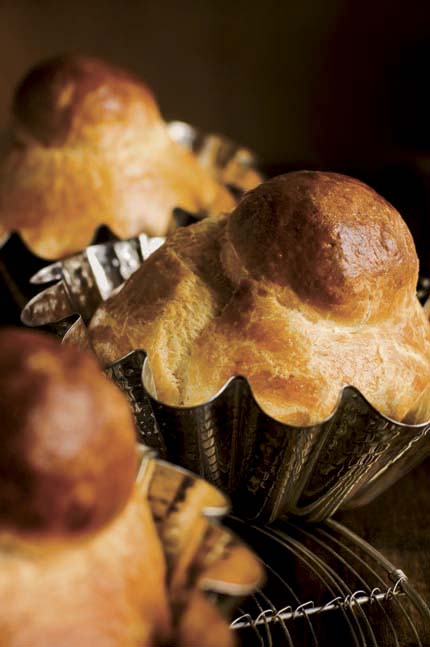
We have finally, finally finished our Final Pass manuscript (final seems to be the recurrent theme). That means we don’t get to look at Healthy Bread in Five Minutes a Day again until it’s in print. The book won’t be on shelves until October 27, and after that, we won’t be posting on good old-fashioned brioche for a while, so I decided to reprise a great post from a year and a half ago, Zoe’s post on Brioche à Tête–I’ll give you the link at the end. There’s one nice tool to have– the brioche pans, which you can get from Amazon.
It’s also another shameless excuse to savor another great photograph from Mark Luinenburg, who did all the photos in Artisan Bread in Five Minutes a Day (above), as well as the new shots for Healthy Bread. All you need to do is start with our brioche dough, and then go to Zoe’s post on the Brioche à Tête. It’s much, much easier than it looks (non-chefs can do it). For something less rich, try the challah dough if you like, on page 180 of Artisan Bread in Five Minutes a Day.
Stay in Touch: Follow us on Twitter…
I am really looking forward to the new book! Zoe has teased me with the Whole Wheat Brioche that I cannot wait to try! 🙂
I can’t wait for the new book (Healthy Bread) to be in print! I’m excited to see what changes will be made and how the recipes turn out. I look forward to seeing new blog posts/recipes with the new “healthy” recipes as the book hits just in time for Christmas! Thanks!
Hi Shelly,
Thank you so much. We are very excited about the new book and can’t wait until it is out and we can share it with you all!
Zoë
I just finished Julia Child’s biography. Toward the end she talks about a recipe similar to beef Wellington, but she used brioche dough instead of puff pastry. I haven’t tried the brioche recipe yet, but now I’m going to have to give it a whirl!
Camille: I have been meaning to try a Beef Wellington with our brioche forever, I’m pretty sure she uses brioche rather than puff pastry in “Mastering the Art…” If you try it, please let me know how it comes out. Jeff
As an update for anyone who has a “steam assist” oven, the recipes work out excellent. However, follow your oven manual directions for temp ( 25 degrees lower than in book) and cook on the bottom self. The oven will release steam so there is no need to use a tray with water. Works great. Cannot wait for the new book on whole grain breads. Thanks
Thanks for this, Karen. I think I may have to buy one of these next time I need a new range. Jeff
Looks like a great recipe. I have only one comment: I have made cinnamon rolls for years and I have always cut them with dental floss. The dental floss goes under the rolled up dough and you just pull it through and repeat. So easy. Thanks for all your great work.
Keep trying to find a Sweet Portuguese Bread recipe please!
Hi Arlene,
I’ve done the dental floss trick with cheesecake, but not cinnamon rolls. I have to give it a try.
We’ll look for a good Sweet Portuguese Bread, sounds great!
Zoë
I found four of these little brioche pans at a flea market for $1, I was so happy! Now I have to make the bread!
Hi itsworthalook,
Lucky, lucky you! Enjoy! Zoë
Have you used the basic dough recipe in ABIFMAD using sprouted flour? I prefer to use sprouted flour for more nutrient availability but I don’t know if your method would work. I hesitate to try it because sprouted flour isn’t cheap and I’d hate to waste it.
Pam: Haven’t tried sprouted flour. My guess is that it swaps well for the all-purpose in our basic white recipe, so long as you don’t exceed more than about 1.5 cups cups of sprouted flour.
Since I haven’t tried it myself, I hate to recommend it, given the expense that you mentioned. Jeff
Thanks, Jeff. When I get a hold of some, I’ll give it a try and let you know how it goes.
Have started baking brioches in muffin trays. Seem ideal and will be great for baking brioches for morning teas at work. (have tried small ‘buns’ and cinnamon whirls)
Peter: Great, we’ve done this on the website a number of times, works beautifully. Jeff
Question: can spelt flour be subsituted for wheat flour for any of your master recipes? Spelt flour is making a huge comeback in Europe. I would like to try it, but I don’t know if it can be subsituted 100% or maybe partial for white flour.
What do you think? 🙂
Yes– it can, but swap it for whole wheat, not for white unbleached all-purpose or you’ll have trouble. You can swap a little spelt for white— no more than about 20% by volume. Spelt is always sold as whole grain.
See also our post on whole grain breads at https://artisanbreadinfive.com/?p=142, and let me know how you make out. Jeff
I tried the brioche and it’s really good, and being French I am probably more picky! I want to try the artisan bread but is the crust very hard(I had dental surgery and still on soft food for a while!) or is there a way to get it less crusty? Great job and hope to see you one day in my area in Washington DC
Hi Brigitte,
I’m thrilled that you are baking and enjoying the brioche, it is one of my favorites in the book.
You can reduce the amount of crust on the bread by using a dough with oil in it, like the olive oil dough and painting the surface of the dough with more oil (or butter) when I comes out of the oven. The fat softens up the crust.
Enjoy! Zoë
Zoe,
Thank you so much and what a fantatic website. I made individual brioches for my kids and they decided to make some next time since it’s so easy with your method.
Hi Brigitte,
How wonderful to start them baking at a young age. It is exciting to think of a whole generation of bread bakers. I’ve started with my boys as well!
Thanks! Zoë
I love brioche, and it takes longer than 5 minutes to go to the bakery! Congratulations on the new book, and on being so popular at the library. The waiting list for your first book is still a mile long.
Terrific— try the whole wheat brioche in book #2, but if you have the first printing, note the correction– https://artisanbreadinfive.com/?page_id=73
I made a batch of challah dough last night and this afternoon I removed a 1.5 lb piece and tried to rotate and cloak but it was almost impossible to do. Each time I drew the dough over and under it would tear across the top. Wondering what could be the cause. I ended up rolling it with my hands on the counter into a rope about 8″ long, cutting it in thirds, and then rolling each third into a little ball with my hand cupped over the dough. It seemed to work alright and it has risen nicely covered on the counter, however I’m not sure what I did wrong. Hopefully, it will bake up nicely.
Hi Denise,
It sounds like maybe your dough was a bit too dry? The whole grain doughs don’t have quite the same gluten, so it won’t have exactly the same ability to stretch, but it still shouldn’t be tearing as you describe.
What kind of flours are you using?
Thanks, Zoë
Hi Zoe,
I live in Vancouver, B.C. and a popular brand here is Robin Hood Unbleached All Purpose Flour. I am not sure of the protein content; perhaps I should check with their web site?
Denise: Robin Hood should be fine if it’s labeled unbleached AP…
I’ve always found both the brioche and challah doughs too dry to rotate and cloak but the results have always been wonderful.
Hi Magali,
Both of those doughs have less stretch to them then the master recipe, so your experience may not be out of the usual. The butter in the brioche makes it a tighter dough once it is chilled. It should have some stretch, but not as much as the master. It should be very easy to shape. If you are having trouble shaping your breads your dough may be slightly too dry and may require a few more tablespoons of water!
Thanks, Zoë
I recently received your first book “Artisan Bread in 5-minutes a day”as a gift. It’s the answer to my winter goal of making more bread. This past week I’ve made the “boche” and the European Peasant Bread. I’ve read your entire book this week and there just isn’t enough time in the day or funds right now to make bread 24/7. It’s just a fabulous book. I have a couple of questions regarding processes. 1) What would happen if I added the ingredients that are being “rolled” into the dough after the gluten coat — when I add the flour to the liquid? It seems that the added ingredients would be distributed more evenly if they were added w/the flour to the liquid. What do you think?
2) I just learned that your new book is out so this question may be redundent: Can I add grains and seeds to some the the whole wheat/rye/white flour peasant breads? Is there anything I have to do to the grains and seeds first?
Thanks for this book, it is so much fun to make bread and actually have 100% success every time it comes out of the oven. Keep up the great work.
Rosalie: Yes, go ahead and add the roll-ins with the liquids, that will work fine. Grains and seeds are fine, but some need to sit after being mixed for at least 24 hours, other just require more water. You are right– we deal with this more directly in the second book.
Thanks so much for all the kind words…. Jeff
Got both books and baking bread like crazy. One problem I have is loaf pans. I have a parrot and cannot use nonstick pans since it can be deadly to a bird. Any suggestions?
Hi Carol,
Try any other type of pan, well greased and with a piece of parchment on the bottom to insure it will release from the pan.
Enjoy, Zoë
I have 2 questions. The first is I made the Whole Wheat Stollen in the new HBin5 and had to use whole wheat flour only, as I could not find “white” whole wheat flour. Would this have made a difference to the end product? My stollen seemed a little flatter than it should be. Also, what is the best way to store the stollen and how long will it last on the counter?
Thanks!
Hi Denise,
No, the dough should come out very similar, albeit darker, using regular whole wheat flour. Did you use the scoop and sweet method of measuring the flour. Sometimes when people spoon the flour into the measuring cup they end up with a dough that is too wet. Did you use the dough right after the initial rise or had it been chilled first?
Traditionally Stollen was served stale, so it can be left out for a couple of days. Because there isn’t a crust on the bread to begin with you can actually wrap this loaf to keep it.
Thanks! Zoë
Hi Zoe, Thanks for the quick response. Yes, I did use the scoop & sweep method. I pour a good half 10 lb bag of flour into a glass jar as you have and then just scoop & sweep. The dough had been chilled first and I used it the next morning.
I did brush it immediately it came out of the oven with melted butter and the a sifting of confectioner’s sugar.
I am also wondering whether you can brush it with brandy each day as well to help keep it for a few days longer?
Thanks so much for you and Jeff!
Hi Denise,
It is rather a mystery to me why this dough would be so wet. If anything I find the Stollen is a bit tighter than some of the other doughs. Is it possible that you just miss counted the cups? If you still have dough left you can just add more flour if it isn’t baking up well.
Soaking the bread with brandy sounds like a great idea! It reminds me of a traditional fruit cake, which I love! I have a loaf resting on the counter right now and I am going to try this.
Thanks, Zoë
Just made a Bostock from your first book. It’s amazing!! The best thing I ever tasted.
Made that Bostock and took it to a Christmas Eve party. Remember to serve it warm. They served it cold and it just wasn’t as wonderful as it could have been.
Carol: Yes, small or flat things are OK to serve a little warm. Especially rolls. The smaller it is, the less likely it is to seem “gummy” even though served warm (that’s the effect if you do this with a large tall loaf). Jeff
Could you use brioche dough to make croissants??
Jennifer: In the new book, we use whole grain brioche to make a crescent roll that looks a lot like croissants. We wouldn’t call them that though because we’re not “laminating” the dough with butter. But they’re really, really good. And actually whole grain. Jeff