Kicking off the outdoor baking season with a boule on the gas grill

cover-on-the-grill.jpg

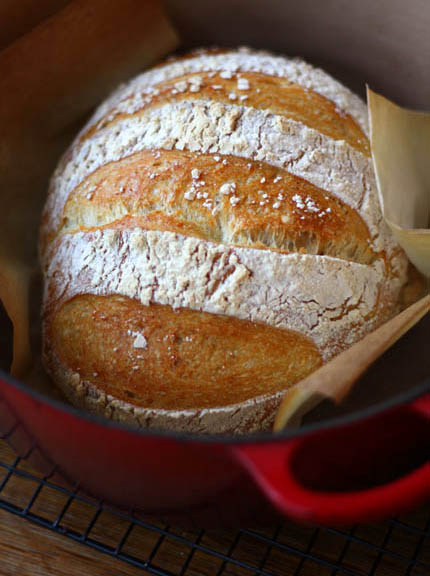
Even in Minnesota it’s 83 degrees today, so out to the gas grill I went.  Last summer, we did pizzas, and other breads on the gas grill (I like the Weber gas grills for this), but I never tried baking on a gas grill with a closed cast iron pot.  The results are terrific– the crust is much better than last summer’s projects because the Dutch Oven traps steam next to the bread–you don’t have to add any other steam to the baking environment.  But you also need to use a pizza stone under the pot, or it can scorch. Continue reading

Roasted Red Pepper Fougasse

cover-roasted-red-ppr-fougasse.jpg 

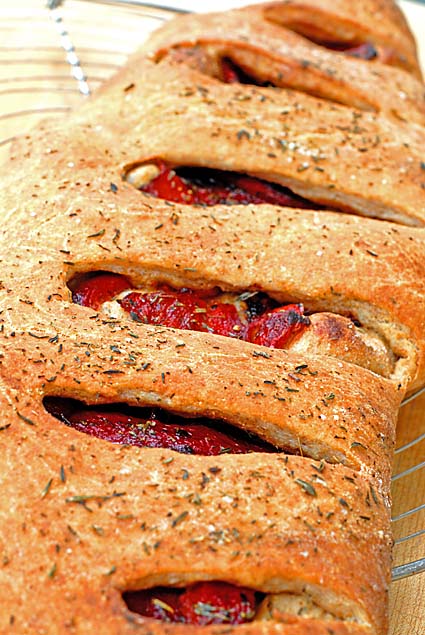
When interviewers ask me for my favorite bread from the book, I always give the same answer–it’s this gorgeous roasted red pepper fougasse (foo-gass)– a stuffed flatbread originating in the south of France.  It may be because of where I first ate it (perfect fall day, after a bike ride with my wife).  The rustic colors and flavors of Southern France burst out of this flatbread– carmelization of peppers highlighted by thyme, olive oil, and salt.  It’s festive, but so easy to bake from stored dough.  Continue reading

Lemon-Poppyseed Mini-Brioches (with a couple of healthy tweaks)

 4-paint-with-glaze.jpg

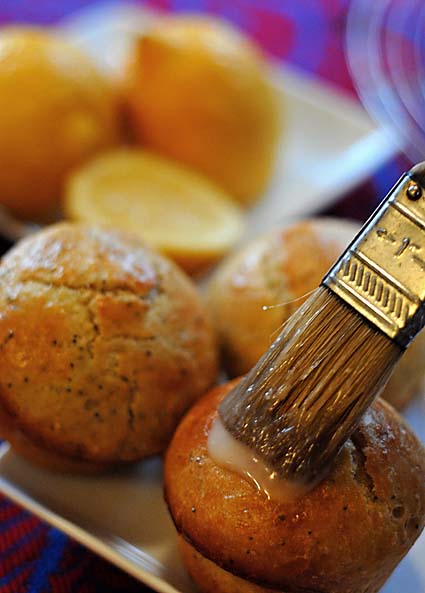
On Mondays, it’s my turn to pick up my oldest daughter from school, and then stop for tea and treats before her guitar lesson.  We’ve been doing this for six years, and I think I love the tradition as much as she does.  Our downtown coffee shop has great coffee and tea, but the baked goods leave a lot to be desired, especially by the time we roll in at 4:00pm.  There’s one exception– they have a lemon-poppyseed pound cake that is just terrific (or it would be, if it were fresh!).  I wondered if we could adapt the brioche from Artisan Bread in Five Minutes a Day to the bright fresh flavor of lemon and the crunchy texture of poppyseed, topped with a simple glaze.  They baked up perfectly in cupcake tins so if you’re inclined to call these cupcakes, go right ahead.  And I snuck in two healthy tweaks to the recipe:  canola oil instead of butter, and even a little whole grain.  Continue reading

Baking Bread in a Closed Clay Pot (“Cloche”)– the best crust yet!

cover-cloche-baked-boule.jpg

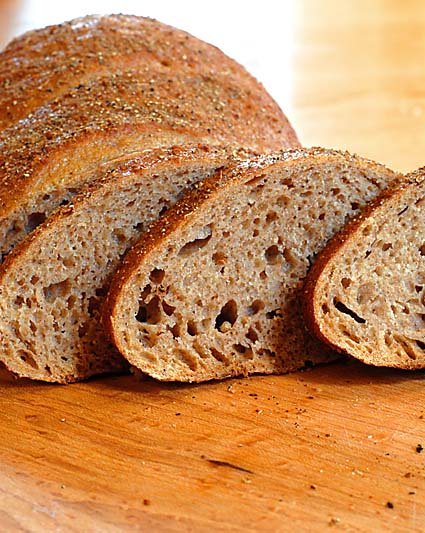
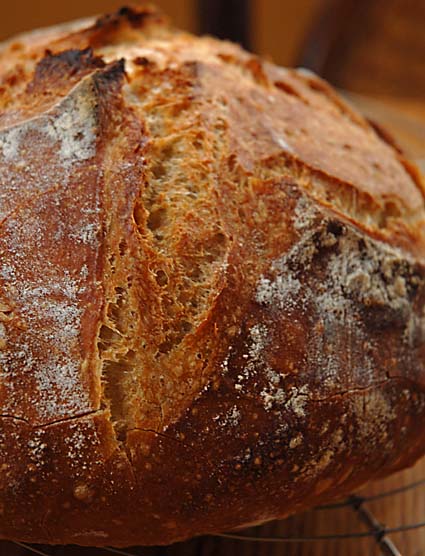
So many people asked us about baking our dough inside a closed cast-iron pan that Zoe did a beautiful post on the subject a few weeks ago.  The cast-iron pan method is based on a much older method, where bread is baked inside a closed clay pot (or “cloche,” meaning “bell” in French).  Both methods depend on trapped steam from the dough to create a perfect crust, but the clay pot has the added benefit of being porous, so moisture is trapped, but also conducted away from the surface as the bread bakes.  I tested the Sassafras brand “La Cloche” product, and I’m very impressed with the crust I’m getting –take a look at the picture above; this crust is thin and shatters when broken (the burned bits are perfect in artisan loaves; that’s how you know you’ve baked long enough).  Keep in mind that these crust results are hard to re-create with loaves very high in whole wheat (because of oils in the wheat’s germ).  The bread above is about 15% whole grains– it’s a light version of the Peasant Loaf on page 46 of the book.  Whole grain breads perform beautifully in “La Cloche,” but the crust tends to be softer and thicker.

For crust aficionados, I think the ”La Cloche” results are a little better than what I get inside closed cast-iron.  We didn’t put these two methods in our first book, because we wanted to keep things as simple as possible.  But with results like these, they’re going into he second one (publication date is 10/13/09)! Continue reading

Broa (Portuguese corn bread) with Caldeirada de Peixe (Portuguese fish stew)

broa.jpg

I may have made a resoution about not complaining about the weather this year, but too bad!  Greetings from Minnesota– today’s the third day of spring but it’s 45 and rainy.  I’m still in Polarfleece at my desk, so today’s a soup and bread day.  In the book, we included a Portuguese Corn Bread (Broa) and an accompanying Portuguese Fish Stew (Caldeirada de Peixe) to go with it–it’s a perfect combination.

The Broa dough is simply our Master Recipe, substituting 1 1/2 cups of cornmeal (yellow or white, stone-ground or regular) for 1 1/2 cups of unbleached all-purpose flour.  Bake as usual as a round loaf.  In the picture above I used a lightly greased and stove-top pre-heated black cast-iron skillet (my skillet doesn’t come with a cover or I’d have tried that, see Zoe’s post about baking in covered cast-iron).  Amazon carries the Lodge brand (click here to view).   Here’s the Caldierada de Peixe recipe: Continue reading

Baking Bread in a Dutch Oven! (see post below for winner of the book giveaway!)

dutch oven bread

Here is yet another way to get a fabulous crust on your bread without using any steam in the oven. I mentioned my very unsophisticated disposable lasagna pan as an option and now I present you with yet another ingenious idea. Baking bread in a Dutch oven was made popular by a Mark Bittman’s article in the New York Times  about baker Jim Lahey. He introduced home bakers to a professional style bread that didn’t require a steam injected oven.  All the iron-pot methods are based on the old European technique of baking inside a closed clay pot.  Most people don’t have one of those, but enameled cast-iron pots are readily available– and they trap all of the internal moisture in the dough and that creates the steam you need to get a crisp and shiny crust. It really is fantastic and it works perfectly with our stored doughs from the book. Continue reading

Free Book Giveaway: Who Can Fix My Kaiser Rolls? (WINNER ANNOUNCED, SEE 3/11 POST ABOVE)

kaisers-cover.jpg

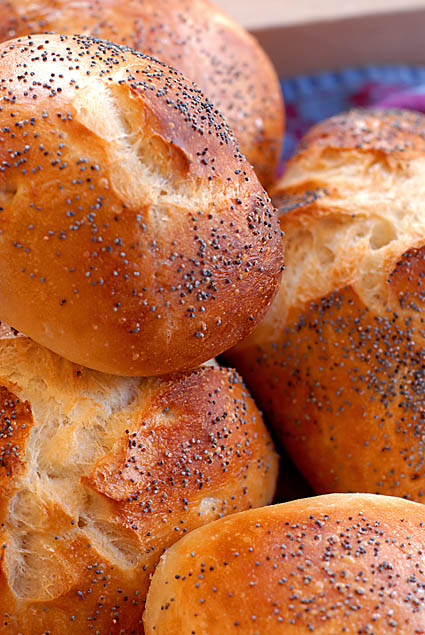
OK, I’m pretty happy with this photo, but… well, they aren’t really Kaiser Rolls.  I was on a “roll” from last week (sorry), when I thought my Brotchen were more than passable.  So I wanted to re-create another German roll style– the famous 5-petal Kaiser roll.  I have to say that even though the picture is pretty, the rolls didn’t retain the 5-petal shape that defines the Kaiser roll– it ended up as just a round, though beautiful and tasty roll. 

And so fellow bakers, I turn to you for help!  What did I do wrong?  Please make suggestions that help me perfect this beast, and I’ll send you a signed copy of Artisan Bread in Five Minutes A Day to the winning suggestion (as judged, I’m afraid, by me).  If no one can help me, I’ll draw a random winner from all the responses.  OK, here’s what I did… Continue reading

Fresh Pita – the fastest bread in the land!

pita

(photo by Mark Luinenburg from Artisan Bread in Five Minutes a Day)

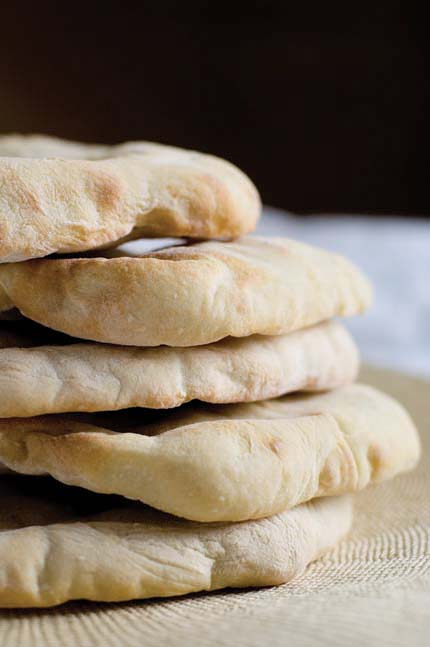
Pita bread is a simple, unadorned flatbread that dates back to antiquity. You simply roll out your favorite non-enriched dough as thin as possible and bake it on a hot stone. There is no resting time or other ingredients to prepare, so you can have it in a matter of moments. Despite its simplicity pita is one of the tastiest breads we make. Perhaps it is all of the surface area and the soft chewy crumb? This time of year I bake the pita on a hot baking stone in the oven (without steam), but in the summer I make it on the grill directly on the grate.

Happy Birthday Jeff, I hope you are enjoying the beach!!!

Continue reading

Bacon and Eggs in Toast!

eggs in toast

It is the quintessential breakfast combination; bacon, eggs and toast. But I had no bread to make toast (seems hard to believe, but true). In a desperate race to get my kids to school on time I decided to bake the eggs right into the dough. Not only was it fast, but my kids may never settle for regular eggs and toast again. I threw a bit of Emmenthaler cheese and bacon into the mix and 15 minutes later breakfast was ready!

Jeff and I finished up the manuscript for book #2 yesterday. We are thrilled to be done with this first phase of the book. Now we look forward to months of testing recipes, editing copy, testing recipe and editing more copy! First we will CELEBRATE! :)

Continue reading